
Home Blog Page 25

Game Developer Salary in India 2024: Job Profile & Description

3
GAme developer salary in india

The game development area is one of the most demanding centers for IT specialists. Individuals are always keen on engaging in enjoyment and video games, and game development is also developing as a top interest. In this article, we will discuss the Game Developer Salary in India 2024 Job Profile & Description, and Career Scope. Game development includes a technique in which the game developer creates an application for a particular platform.

It’s the same for consoles, smartphones, COMPUTERs, VR helmets, and plenty of other devices. There are many specialists working in the game development area. India has a completely strong game development enterprise measuring worth ₹2,300 crores and employs more than 10,000 people. Here, we are going to tell you about the game developer’s salary, job profile, role and responsibilities, career scope, etc.

Game Developer Job Profile in India

The given table shows the job profile of game developers with their average salary details.

Job ProfilesJob DescriptionsAverage Annual Salary (INR)
Game DeveloperDevelops games internally for a single platform or console4.2 L
Second-party developerDevelops video games completely for a console (however, it isn’t always completely owned by  the platform or console)5 L- 6 L
Third-party developerDevelop and submit their games or expand video games for different game publishers5 L – 6 L
Indie developerDevelops self-funded indie games as an individual or small group3 L – 4 L

Also Read:- Veterinary Doctor Salary in India | Interior Designer Salary in India | Investment Banker Salary in India

Game Developer Salary Trends in 2024

The average salary of a Game Developer is ₹478,895/- per annum. The access-level salary earned is ₹330,000/- per annum, with the highest salary going up to ₹860,00/- per annum. Bonuses can add up to anywhere among ₹10,000 – ₹49,000/- depending on the type of bonus it’s far, and the salary can move anywhere as high as ₹115,000/- per annum.

Game Developer Salary in India By Experience

Understanding the salary developments for game developers in India throughout exclusive experience tiers is important for both aspiring specialists and industry veterans. Here’s a breakdown of average game developer salaries based on experience levels.

Experience LevelAverage Salary (INR)
Less than 1 yearRs. 330,000
1-4 yearsRs. 475,000
5-9 yearsRs. 859,884

Game Developer Salary Based on Skills

The game development industry in India gives various compensation programs relying on the specific skills possessed by specialists.

Game Development SkillsAverage Salary (INR)
Computer Gaming SoftwareRs. 523,810
C# Programming LanguageRs. 355,931
C++ Programming LanguageRs. 450,000
Unreal EngineRs. 589,581
Unity EngineRs. 360,000

Must Read:- Product Manager Salary in India | Fashion Designer Salary in India | Web Developer Salary in India

Factors Affecting Game Developer Salary

The gaming enterprise in India has been witnessing exponential growth, with a surge in demand for skilled game developers. However, the salary of game developers in India can range based on several factors given below.

Job Position

The level of understanding, skills, and duties associated with a selected job role considerably impacts the salary of a game developer. Junior developers typically earn less than their senior level or lead game designers because of differences in experience and knowledge.

Location

Location plays a pivotal role in figuring out game developer salaries in India. Developed cities together with Bengaluru, Hyderabad, and Pune typically provide higher salaries thanks to a more vibrant job market and higher cost of living. On the other hand, smaller cities like Jaipur or Bhopal may offer lower salaries.

Company Size

The size and reputation of the game development employer also affect salaries. Established and large agencies tend to offer extra competitive salaries compared to startups or smaller companies.

Education and Certification

The level of education and specialized certifications attained by a game developer also impact their salary. Professionals with superior tiers or specialized certifications generally tend to earn more than those without formal qualifications, as they carry enhanced skills and understanding of the job.

Career Scope for Game Developer

There is a broad career scope for game developers. After working as a game developer and gaining experience and knowledge, you can pursue the following job role and widen your career.

  • Gameplay Programmer
  • Graphics Programmer
  • UI/UX Designer
  • 3-D Artist/Animator
  • Game Writer/Narrative Designer
  • Level Designer
  • Audio Engineer
  • Gameplay Designer
  • Producer
  • Quality Assurance Tester

Most game developers work full-time for foremost game studios like Ubisoft, Electronic Arts (EA), Epic Games, or smaller indie studios. Jobs generally tend to salary attention in gaming hubs like Silicon Valley, Los Angeles, Seattle, Austin, and some other places. Remote work is restrained, however increasing.

Also Read:- Graphic Designer Salary in India | Cyber Security Salary in India | BCA Salary in India

Role of a Game Developer

The game Developer job is the most interesting and innovative process in which you have to put a lot of effort into the layout of the game.

  • Game Designer
  • Game Audio Engineer
  • Animator
  • Game System Designer
  • QA Game Tester
  • Game Artist
  • Creative Game Director
  • Game Programmer
  • Game Marketer

Responsibilities of a Game Developer

The responsibilities of a game developer can vary depending on their position in the development group. However, some common responsibilities may also include:

  • Writing and Designing code for the game
  • Creating 2D or 3-D pictures and animations
  • Developing the game’s storyline and user layout
  • Creating sound outcomes and track
  • Testing and debugging the game
  • Collaborating with different group contributors to make sure the game meets task necessities

Qualifications and Skills Required

Qualifications and Skills Required

Game developers should have an aggregate of technical knowledge, creativity, and smooth skills to create attractive and thrilling gaming reports.

These consist of:

  • Strong programming skills, in particular in languages such as C++, Python, Java, and C#, to create complicated gaming codes.
  • Experience with game engines such as Unity or Unreal, which are frequently used in the development of video games.
  • Understanding of computer pics and physics to create realistic animations and game mechanics.
  • Creativity and creativeness to design unique and tasty game eventualities and characters.
  • Problem-solving skills to pick out and fix bugs, improve game overall performance, and conquer development challenges.
  • Strong communication and teamwork skills, as game development regularly includes collaboration with different programmers, artists, and designers.
  • Knowledge of the gaming enterprise, which includes tendencies, popular systems, and the tastes and options of various gamer demographics.
  • Awareness of user interface layout and consumer experience concepts to create games that are intuitive and fun to play.
  • Time control abilities to satisfy undertaking time limits in a fast-paced and stressed environment.

Also Read:- Data Analyst Salary in India | Software Engineer Salary in India | Data Scientist Salary in India

Future of Game Developer Profession

There is a great future for a game developer in various fields. Here, you can choose your career growth in these given sectors.

Mobile Gaming

As smartphones and capsules grow to be more popular, mobile gaming has emerged as a giant growth area in the gaming enterprise. As a result, in the coming years, mobile gaming salary is expected to surpass that of traditional console and COMPUTER gaming.

Mobile gaming is a primary contributor to industry increase since it has a low access barrier for users and creators.

Virtual and Augmented Realities

Virtual truth (VR) and augmented realities (AR) technologies are becoming more advanced and broadly available. These innovations present simple, immersive approaches to playing games and are anticipated to seriously affect the enterprise going forward. Applications for VR and AR encompass entertainment, studying, and enterprise, among others.

Cloud Gaming

An approach called cloud gaming enables gameplay on devices without using powerful hardware. Cloud gaming makes playing games on low-end devices like smartphones and pills feasible and offers a smoother gaming experience.

Gaming as a Service

The fashion toward gaming as a career, in which game enthusiasts pay a monthly fee to get access to numerous video games, is predicted to continue to amplify. This commercial enterprise model gives gamers a realistic and lower-priced way to get access to a good-sized library of video games while permitting developers to generate ordinary sales from their video games.

Game Monetisation

The monetization strategy used by the game enterprise is developing more state-of-the-art. It is projected that in-game marketing, the selling of digital goods, and other monetization techniques will boost in the next few years.

Artificial Intelligence

More and more video games incorporate artificial intelligence to raise engagement and immersion. AI may be used to expand game characters who react to player alternatives and moves and provide gameplay elements.

FAQ’s:-

What is the average salary of a Game Developer?

The common salary of a Game Developer is INR 6,00,000 – 8,00,000 per year.

What are the common job profiles in Game Developer?

The common job profiles are QA employee, Tester, Software Developer, etc.

What is the common salary of a skilled Game Tester?

A skilled Game Tester can anticipate earning $67,454 per year.

What are the colleges offering the courses associated with Game Development?

The various faculties providing courses related to Game Development are DTU, New Delhi, CV Raman Global University, Bhubaneswar, SRM Engineering College, Kanchipuram, IIFA Multimedia, Bangalore, Backstage Pass Institute of Gaming and Technology, Hyderabad and many others.


How to Calculate Gratuity for Government Employees

0
How to Calculate Gratuity for Government Employees

In the Gratuity calculator for central government employees, Calculate Gratuity for Government Employees as part of the salary that we receive at the end of our employment service time, i.e. Retirement. The recent regulation has been passed by the authorities of India., the Payment of Gratuity Act 2018, which went into effect on March 29th, followed by the Ministry of Labor & Employment.

According to the Payment of Gratuity Act 1972, any store or infrastructure like a factory, plantation, port & railway businesses, shops, mines, oil manufacturing, and so on., tends to offer a gratuity for an employee who has 10 or more employees in its company when you consider that one year from the day of graduation.

The gratuity calculator for central government employees is a crucial component that government employees don’t understand. It’s part of the salary slip that they don’t even receive each month, but at the end of their service tenure, irrespective of corporation/ legit advancements. There are some issues regarding the rate of gratuity. In case of loss of life and disability, the sum amount below the gratuity is paid, no matter the service time, to the respective civil servant or their family participants.

What is Gratuity in India?

Gratuity is a benefit given to employees after their service time is completed in the company. Governed by using the Payment of Gratuity Act of 1972, gratuity is a lump sum amount paid by employers to eligible employees upon their retirement, resignation, or demise.

The Payment of Gratuity Act sets the guidelines concerning the gratuity fee, ensuring that employees acquire a financial basis to acknowledge their committed service. The Act outlines the eligibility standards, calculation approach, and other important factors related to gratuity.

Also Read:- How to Calculate Gratuity for Private Employees | Income Tax Slab and Rates for FY 2023-24

Calculation of Gratuity for Central Govt Employees

There are two categories of employees for the purpose of calculating gratuity for vital government employees. These include employees covered and not included under the Payment of Gratuity Act of 1972. The forms of employees covered under the Act include the ones working in valuable govt, which includes:  

  • Ministries
  • Departments
  • Public area undertakings
  • Statutory businesses
  • Educational institutions
  • Universities, faculties, faculties, research establishments 

The types of employees now not covered under the Act consist of:  

  • Central govt employees are covered under separate statutes like members of the All India Services
  • Members of the Armed Forces (Army, Navy, and Air Force)
  • Those working for the relevant government-owned groups, however, have their own separate gratuity regulations or schemes.

Depending on the category, there’s quite a difference in formulas for the calculation. 

The method for the calculation of gratuity for central govt employees included under the Act:

Gratuity (G) = n x b x 15/ 26

Here, n = the number of years the employee worked in the organization

b = preceding month’s salary + dearness allowance (a further sum to offset inflation)

15 = calculation of wages at the rate of 15 days

26 = amount of working days in a month

The formula for the calculation of gratuity for relevant government employees not covered under the Act:

Gratuity (G) = n x b x 15/ 30

The biggest difference is that the number of working days under this method is 30. 

Example for the calculation of gratuity for central government employees

Here is an example to show how the formula works:

If an employee earns Rs. 1 lakh every month and has worked at an enterprise for seven years, right here is how their gratuity calculation would appear like –

G = 1,00,000 x 7 x 15/ 26 = 4,03,000

Also, to simplify the calculation, if an employee completes 6 months of a year in their company, the time might be rounded off to at least one year.

Retirement Gratuity Calculation for Central Government Employees

The retiring Government servants are entitled to the retirement gratuity. Any central authorities employee who has worked for a minimum time of 4 years is eligible for a lump sum gratuity fee. The calculations for such a gratuity amount are based on 1/4th of the Basic salary, including Dearness Allowance, as on their date of retirement. There is no minimum limit for this amount. The government employees, at the time of their retirement, are eligible to acquire 16 times their Basic pay, including DA, for their qualifying service of 33 years or more (as relevant). However, according to the new rule, this amount can’t be more than ₹20 lakhs.

Also Read:- Income Tax Slab and Rates for FY 2023-24 | What is TDS in salary | What is Gratuity in Salary

How Can a Gratuity Calculator Help You?

Calculating gratuity involves a method based on the employee’s withdrawal salary and the time of years served. A gratuity calculator simplifies this process, thinking of elements with the basic salary and the dearness allowance to offer an accurate estimate of the gratuity amount.

Features and Benefits of Using a Gratuity Calculator

From accuracy to quick results, there are many benefits of using a Gratuity calculator.

  • Accuracy: Avoid errors and mistakes by counting on a medical and correct gratuity calculation tool.
  • Time-Saving: Quickly assess the gratuity amount without the need for complex guide calculations.
  • Planning: Facilitate financial planning for employees drawing close to retirement by providing them with clear expertise on their gratuity entitlement.

What are the Eligibility for Gratuity?

Here are the eligibility criteria that decide who is eligible for gratuity

  1. (a) The gratuity payable under rule 45 will be paid to the individual or people on whom the proper to acquire the gratuity is conferred by a nomination under rule 46.

(b) In case there’s no such nomination or if the nomination made does not subsist, the gratuity will be paid in the way given below,

(i) if there are one or more surviving participants of the own family as in clauses (i), (ii), (iii), (iv) and (v) of the reason below sub-rule (6) of rule 45, to all such participants in same stocks; or

(ii) if there are not any such surviving contributors of the family as in sub-clause (i) above, but there are one or more members as in clauses (vi), (vii), (viii), (ix), (x) and (xi) of the rationale below sub-rule (6) of rule 45, to all such participants in same shares.

  1.  In case a nominee pre-depends the Government servant and the right conferred on that nominee has not been surpassed on to every other character under sub-rule (4) of rule 46 or the nomination made in appreciation of such individual does now not subsist or the nomination has come to be invalid attributable to happening of any contingency cited therein, the proportion of gratuity in recognize of such nominee shall be disbursed equally to all different individuals of the own family who had been eligible and alive at the date of dying of the Government servant, which includes the individuals of the own family in whose favor nomination has been made for a charge of the final amount of gratuity.
  2.  In case government employees die after retirement without getting a gratuity, then their gratuity amount will be given to the family in the way mentioned in sub-rule (1) of this rule.
  3.  The proper of a woman family member, or that of a brother, of a Government servant who dies whilst in service or after retirement, to get hold of the proportion of gratuity shall not be affected if the girl member marries or remarries, or the brother attains the age of 18 years, after the death of the Government servant and before receiving their share of the gratuity.
  4.  Where gratuity is granted under rule 45 to a minor family member of the deceased Government servant, it will be payable to the parents on behalf of the minor.
  5. Payment of Minor’s share of gratuity will be made to the parents of the minor, if any. In the absence of parents, the minors’ share of the gratuity fee will be made to the individual who gives a certificate of guardianship.
  6. In the absence of a natural dad or mum, a charge of an amount not exceeding 20 percent of the teenage share of gratuity may be made to the guardian without the manufacturing of a guardianship certificate; however, on manufacturing of an indemnity bond in Format 7 and the stability amount of percentage of gratuity may be paid to the parents on the certificate of guardianship.
  7.  If there is more than one member of the family eligible to acquire gratuity under this rule and if a family member has not submitted his claim for gratuity in Form 9, the case for sanction of gratuity to him can be processed after his claim has been obtained. The case of other eligible members of the family for sanction of gratuity may be processed without linking it with the case of the family member who has now not submitted the claim in Form 9.

What are the Taxation Rules for Gratuity?

The maximum amount of retirement or dying gratuity that may be received by a retired or deceased Central Government Employee is ₹20 lakh, as mentioned in ‘Pension Rules 2021’ launched by the Department of Pension and Pensioners’ Welfare (DoPPW). As per Rule 44, a government servant who has finished 5 years of qualifying service and is eligible for service gratuity or pension may receive retirement gratuity equivalent to 1-4th of emoluments for every finished 6-month period of qualifying service. However, the gratuity is capped at a maximum of 16 1⁄2 times the emoluments.

Under the Pension Rules 2021, a Government employee who has finished 5 years of qualifying service and qualifies for service gratuity or pension below Rule 44 will acquire retirement gratuity amounting to 1-4th in their emoluments for each finished 6-month period of qualifying service upon retirement. However, this gratuity is a situation to a maximum of 16 1⁄2 times the emoluments.

1) Death Gratuity

  • Less than 365 days of qualifying service: Gratuity equals 2 times the emoluments
  • One year or more but much less than 5 years of qualifying service: Gratuity equals 6 times the emoluments
  • 5 years or more but less than 11 years of qualifying service: Gratuity equals 12 times the emoluments
  • 11 years or more but much less than two decades of qualifying service: Gratuity equals 20 times the emoluments
  • 20 years or more of qualifying service: Gratuity equals half of the emoluments for each finished 6-month period, capped at a maximum of 33 times the emoluments.

2) Qualifying Service

When figuring out the duration of the qualifying service, any fraction of a year equal to or more than 3 months is taken into consideration as a complete 6-month duration and counted as a qualifying service. If an employee has served for 4 years or more, however less than 5 years, their qualifying service for gratuity calculation could be considered as 5 years, rendering them eligible for retirement gratuity.

3) Dearness Allowance

As per Pension Rules 2021, the dearness allowance granted at the retirement or demise date will also be seen as emoluments whilst computing the gratuity amount.

Also Read:- BAMS Doctor Salary | Interior Designer Salary | Hotel Management Salary

Conclusion on Calculate Gratuity for Government Employees

The calculation of gratuity for central government employees will become easier as soon as you know the way the system works. To make matters less tough, you could also use a gratuity calculator. You can also take the suggestions of a certified financial expert to help you through the gratuity calculation procedure. 

FAQ’s:-

1. How is government gratuity calculated?

Retirement gratuity is calculated as 1/4th of a month’s Basic Pay plus Dearness Allowance drawn at the date of retirement for each finished 6 months time of qualifying service. There isn’t any minimum limit for the amount of gratuity.

2. What is gratuity eligibility?

To be eligible for gratuity under the Gratuity Act, an employee needs to complete a minimum of 5 years of service in the company, except in the event that an employee passes away or is disabled due to a case of disability or contamination.

3. Is it compulsory to complete 5 years of non-stop service to apply for gratuity?

Yes, it is important to finish 5 years of continuous service to apply for gratuity.

How to Calculate Gratuity for Private Employees

1
How to Calculate Gratuity for Private Employees

Are you an employee who has completed their 5 years of service? If sure, you then are eligible for gratuity in such a case. Understanding a way to Calculate Gratuity for Private Employees guarantees you receive the deserved financial benefit during years of employment.

Or are you an organization wondering how to calculate gratuity? Before directly moving to the steps to calculating gratuity, it is important to know about it. Calculating gratuity is vital for each employer and employee. For employers, it is important to ensure that they offer employees lawful benefits. For employees, it guarantees that they receive the gratuity amount they’re entitled to. In this article, we are going to determine the factors that have an effect on gratuity calculation. Also, we will tell you about some legal provisions that employers must adhere to when calculating gratuity.

What is Gratuity?

An organization will pay a gratuity to employees on the basis of the services they provide to the company. It is a part of the income received by employees, and the objective is to offer retirement and social protection benefits while employees leave the job.

The Payment of Gratuity Act 1972 governs gratuity and its payment strategies. It is given to government employees and private sector employees. However, the employee has to have completed 5 or more years of service with the employer. The employee is eligible for a gratuity earlier than the completion of 5 years in case of inability or death.

Many people need to learn how to calculate gratuity for private employees because it allows them to avail themselves of future benefits and meet long-term financial goals.

Also Read:- What is Vehicle Allowance in salary | What is TDS in salary | What is Gross Salary

Eligibility for Gratuity in Private Company

The first factor to not forget is whether or not you qualify for gratuity. There are two fundamental types of jobs: those where gratuity is compulsory and people in which it is not compulsory. Mostly, all salaried employees who perform services for suggestions are eligible for gratuity. This consists of waiters, bartenders, waitresses, busboys, cab drivers, bellhops, and other job roles.

However, there are exceptions. If you are hired for this type of occupation, you’re automatically considered eligible for gratuity. They might also decide not to pay you anything, or they may decide to pay you a small amount. If you are employed in a role in which gratuity is non-compulsory, then you need to ask your company if they want to pay you gratuity. Following Are the Conditions for Receiving Gratuity

  • There is a minimum salary law that covers your company.
  • Your organization should have more than 15 employees.
  •   It is possible that it will acquire superannuation
  •   When you reach 60 years of age, you’re eligible for retirement. If you’re planning ahead, a birthday age calculator can help you find out your exact age on any given date. Useful for checking when you’ll hit retirement or superannuation milestones that affect gratuity eligibility.
  • A time of 5/7 years as an employee has handed
  • A gratuity can be paid to your dependents/nominee in the event of your loss of life.
  • In the event of disability or permanent contamination
  • Your organization offers you medical insurance coverage.
  •   In the absence of gratuity, you haven’t any legal right against your company for unpaid wages. Your simplest way is to sue them.

How to Calculate Gratuity for Private Sector Employees?

The gratuity calculation components for private sector employees are as follows:

Gratuity = (Last drawn income x 15/26) x Number of finished years of services

Here, the closing drawn income refers to the basic salary plus any dearness allowance (DA) that the employee was receiving at the time of retirement or resignation. The fraction 15/26 represents 15 days of income for every finished year of service. For example, if an employee has finished 5 years and 7 months of service, then their completed years of service would be considered as 5 years.

Let us take an example to understand the calculation of gratuity better. Suppose an employee has worked for 25 years in a private sector company, and their remaining drawn income was Rs. 1,20,000 per month. Here, the completed years of service might be considered as 25 years. Using the gratuity calculation formulation, we can calculate the gratuity amount as follows:

Gratuity = (1,20,000 x 15/26) x 25

Gratuity = Rs. 8,65,385

Therefore, the gratuity amount payable to the employees in this case would be Rs. 8,65,385.

Using a Gratuity Calculator

To calculate the gratuity amount, the user may also use the gratuity calculator available online in India. The benefits of using the calculators are as follows.

  • Calculating the perfect gratuity amount.
  • The calculator is free, and the results occur quickly.
  • Online gratuity calculators keep time spent on calculations by automating them.
  • The calculator is simple to use from anywhere.
  • It supports long-term financial planning. Making wise investments is important in preference to saving money in a financial savings account. Returns on financial savings money owed do not exceed inflation. As a result, returns are good. As a result, to make a large income, buyers have to make investments in their gratuity cash.

Rules of Gratuity

 The Payment of Gratuity Act of 1972 permits employers to get their gratuity bills. The person has completed at least 5 years of employment with the agency. There are several gratuity guidelines. Let’s study each of the gratuity regulations.

  • The threshold for the maximum gratuity amount has been lifted from the preceding cap of Rs. 10 lakhs to Rs. 20 lakhs in the most current e-book of the Government of India’s intervening time price range for the 12 months of 2019. The PSU people and those now not protected through the Payment of Gratuity Act will take advantage of this law as a way to take effect on March 29, 2018.
  • Only authorized people are the most restricted for gratuity raised; for non-authorities employees, the law remains the same, i.e., the gratuity sum can exceed Rs. 10 lakhs. Ex-gratia is the time period for any gratuity.
  • If there are more than 6 months in the final month of a person’s employment year, the amount is rounded to the next. A person would get the gratuity of 16 years, for example, if their service period had been 15 years and 7 months. However, if it ends up being 15 years and 4 months, the employee will get a 15-year gratuity.

Tax Regulations for Calculating Gratuities

After calculating the gratuity, it’s time to know the gratuity tax rules. The type of employment affects how gratuities are taxed. Three huge categories may be used to organization the people:

Government Employees

Any employee of the authorities is qualified to receive a tax-free gratuity. Regardless of whether they work for the federal government, a national authority, or a municipal authority, all dividends obtained by authority employees are free from income tax.

Employees Covered by  the Payment of Gratuity Act

Employees whose employers fall in the purview of the Payment of Gratuity Act will not issue income tax on the past 15 days’ worth of income.

Employees Not Covered by 1972 Gratuity Payment Act

The following sums will be excluded from income tax for employees whose employers are not under the Payment of Gratuity Act of 1972

10 Lakhs

The amount of the actual gratuity received

After twelve months of service with the agency, the employee gets an income of one-half of a month.

Where Can the Received Lump Sum Gratuity be Invested?

One may place their lump sum gratuity money into the following to make an investment or savings application.

Senior Citizens Saving Schemes (SCSS)

Safe retirement investing programs encompass Senior Citizen’s Saving Schemes. One of the office financial savings plans is it. Section 80C of the Income Tax Act permits investments of as much as INR 1.5 lakh to be tax-exempt. Saving taxes is responsible for investments in SCSS plans.

Fixed Deposits

For a few years, most of the financial savings options for Indians have been constant deposits. The current fixed-deposit interest rate is between 5% and 7.5%. Investors might also calculate returns using any of the web FD calculators.

Debt price range

Debt mutual budget invests in diverse belongings, along with company bonds, authorities bonds, and other types of authorities securities, as well as money market units. The term for investments impacts the capital advantage tax of debt finances.

Investors’ taxable income is improved while a short-term capital gains tax is implemented into the debt budget held for much less than 3 years. Long-Term Capital Gains Tax, but it best applies to property that investors keep for more than three years. These incomes are also issued to benefit from 20% taxation.

Conclusion on Calculate Gratuity for Private Employees

Gratuity calculation for private employees facilitates the amount you will get on leaving the activity. As a result, you can make long-term financial decisions for wealth introduction and ordinary investment income. You can use the cash you obtain from your company for your retirement or to pay for medical costs. You are eligible for a gratuity if you complete 5 or more years of service with your company. 

FAQ’s:-

What are the guidelines for gratuity for private companies?

The Act offers a rate of gratuity on the rate of 15 days salary for every finished year of service challenge to a maximum of Rs. 10 lakh. In the case of an established order, gratuity is payable at the rate of 7 days’ wages for each season.

Is gratuity calculated on basic or gross income?

Gratuity is one of the important factors that make up the Gross Salary of an employee. The employee is eligible to withdraw the gratuity amount when they complete their service time of 5 years in the same company.

What is the most gratuity amount for the private sector?

The maximum gratuity can’t exceed Rs 20 lakh. Any amount above that is taken into consideration, ex-gratia is voluntary and not legally enforced. Service beyond 6 months is rounded as much as the following whole year for gratuity calculation. The gratuity is paid to the nominee as per gratuity policies.

Average BAMS Doctor Salary in India 2025 || Skills, Experience & Fresher Wise

1
BAMS Doctor Salary in India

The applicants who’ve graduated with a degree from BAMS have the opportunity to get diverse jobs like Medical Officers, Ayurvedic Doctors, etc. The average BAMS Doctor Salary in India is INR 4 Lakhs per year. The BAMS Doctors’ Salary in India per month is an average of INR 33.3K. BAMS full form is Bachelor of Ayurvedic Medicine and Surgery. Further, the BAMS Doctors’ Salary abroad ranges from INR 25,00,000-30,00,000.

The BAMS Doctors Salary in Government Sector averages from INR 2.7 Lakhs to INR 4.6 Lakhs per year. The BAMS Private Doctor’s Salary varies from INR 3.0 Lakhs to INR 5.0 Lakhs. Furthermore, to know more about the BAMS Doctor Salary, here are articles you should read

Average BAMS Doctor Salary in India

The average salary of a BAMS medical doctor in India ranges from INR 3 LPA – to 3.6 LPA. The highest salary and lowest salary of a BAMS Doctor in India is INR 9.33 LPA, and at the same time, the starting salary of a BAMS Doctor in India is INR 2.70 LPA. There are several important factors on which a BAMS Doctor’s Salary relies, such as years of experience, organization, job role, etc.

Also Read:- Veterinary Doctor Salary | Lawyer Salary in India | Interior Designer Salary

Average BAMS Doctor Salary For Experience & Fresher: Experience Wise

If we talk about the salary package deal across any profession, experience is the important factor that determines the BAMS doctor’s salary. BAMS Doctors with relevant years of experience ranging from 7 – 10 years could be compensated more as compared to individuals who are freshers in the industry. The table below shows the average salary acquired by BAMS Doctors based on their experience.  

Years of ExperienceAverage Annual Salary (INR)
0 – 5 years3.60 Lakh
6 – 10 years7.33 Lakh
11 – 15 years11 Lakh
16 – 20 years13 Lakh
20 years and above17.11 Lakh

Average BAMS Doctor Salary In Government Sector: Designation Wise

The designation of a career is based on the years of experience gained and the qualifications which are pursued. The designation of a BAMS Doctor also affects the average salary as follows as

DesignationsAverage Annual Salary (INR)
Junior Doctor4 Lakh
Homoeopathic Doctor5.77 Lakh
Resident Doctor6 Lakh
Senior Resident Doctor14 Lakh

Average BAMS Doctor Salary in Private Sector : Organization Wise

The salary of a BAMS Doctor in India also depends on the organization where they work. There is quite a difference in the salary packages that BAMS doctors get while working in private or government hospitals. Here is a table that shows the BAMS Doctor Salary working across organizations.

Name of the OrganizationAverage Annual Salary (INR)
RG Technosolutions2.50 Lakh
Atkins2.60 Lakh
Patanjali Ayurved3.60 Lakh
Narayana Health4.20 Lakh
Lifeline Hospitals5.20 Lakh

BAMS Doctor Jobs: Skills Required

Individuals need to have strong skills to become BAMS Doctors. Here are the following skills essential for candidates to have a rewarding career

  1. Analytical skills
  2. Observational talent
  3. Interest in the medicinal residences of different herbs
  4. Time management
  5. Decision-making abilities
  6. Emotional Intelligence
  7. Communication Skills Empathy
  8. Counseling Abilities

Popular Career Paths For BAMS Graduates Doctors in India

Popular Career Paths For BAMS Graduates Doctors in India

There Are Various Career Growth And Paths Available for BAMS Graduates.

1) Medical Research Associates

People can take jobs as medical research Associates. Many colleges deliver medical research, which you can possibly pursue after a Bachelor’s Degree.

2) Drug Manufacturing

Drug Manufacturing is another enterprise from which BAMS holders can choose. Drug production in Ayurveda is the best option to achieve success in a few years. This is because many are opting for eco-friendly and non-carcinogenic cosmetics and medicines. Drug manufacturing is a booming and notable industry in which to work.

3) The Health Supervisor or Therapist

One can get jobs at Ayurvedic health inns and spas. Ayurveda is widely known for being a remedy for illnesses such as arthritis, obesity, migraines, skin issues, and diabetes.

4) Manager

They can emerge as managers in Ayurveda agencies by pursuing further tiers consisting of MPH (Masters in Public Health), MHA (Masters in Health Administration), or an MBA in Hospital and Healthcare Management.

5) Lecturer

They can come to be teachers of BAMS students themselves.

6) Physicians

Most people get jobs to become physicians at private or government hospitals. All degree holders go for internships under senior physicians to gain experience in treating patients.

Must Read:- Investment Banker Salary | Hotel Management Salary | Digital Marketing Salary

BAMS Doctor: Top Recruiters

The majority of recruiters of BAMS graduates are government or private hospitals. However, prestigious companies often hire current graduates in the pharmaceutical industry. The following are a few of the top recruiters.

  • Patanjali Ayurved Limited
  • Dabur India Ltd
  • Baidyanath
  • Hamdard Laboratories
  • Zandu Ayurveda
  • Himalaya Wellness
  • Surya Herbal Limited
  • Hamdard Laboratories
  • Vicco Laboratories
  • Charak Pharma Private Limited
  • Sandu Pharmaceuticals Ltd
  • Narulz
  • Emami Ltd

Conclusion

BAMS medical doctors are critical to India’s healthcare system. The salary of BAMS medical doctors in India varies depending on different factors, such as experience, city, job role, and the type of organization. BAMS doctors can work in multiple sectors, such as government hospitals, private hospitals, ayurvedic clinics, research institutes, and pharmaceutical groups. The opportunities for BAMS medical doctors appear promising, and the demand for Ayurvedic doctors is increasing in India.

FAQ’s About BAMS Doctor Salary

1) What is an Average BAMS Doctor’s Salary in India?

Ans:– The BAMS Doctor’s Salary is an average of INR 2.7 Lakhs to INR 4.6 Lakhs per year.

2) What is Average BAMS Doctor Salary in India Per Month?

Ans: The average BAMS Doctor’s Salary in India per month is INR 33,300

3) What is a BAMS Doctor’s Salary in a Private Hospital?

Ans: BAMS Doctor’s Salary in Private Hospitals is an average of INR 4.1 lakhs.

4) What factors affect the BAMS Doctor salary?

Ans: Experience, city, and the type of company are the factors that affect the salary of BAMS medical doctors in India.

5) What job opportunities are available for BAMS medical doctors in India?

Ans: BAMS doctors can work in government hospitals, private hospitals, ayurvedic clinics, medical institutes, and pharmaceutical groups. They can also start their own clinics and practice independently.

Recommended:-

1.SSC GD Salary
2.SDM Full Form Salary
3.LPA full form in salary
4.BCA Salary in India
5.HRA Calculator Income Tax

What is the Income Tax Slab for ay 2025-26

0
Income Tax Slab
Income Tax Slab

You might be thinking about the income tax slab. Is. Then let me clarify all your confusion. In India, we calculate income tax with the help of an income tax slab. This list of rates is based on the Assessment year(AS) and Financial year (FY). It is said that after every year, there is a financial year. The income tax slab may differ from old to new regime. In this article, we will discuss all the details of the necessary income tax slab. 

What is Income Tax Slab?

We all know what income tax means; however, for this income tax, individuals are charged with some charges that they have to pay based on their wealth. In India, the income tax charged to an individual is based on the slab system. The slab system mentions various income ranges and the tax rates charged to them. The income tax rate goes hand in hand; when the income tax increases, its tax rates also increase. India needs a stable economic system as every person’s status is different, so the progressive tax system is applied here—the income tax rate of the year changes and is charged on a yearly basis. Moreover, every income tax slab rate varies from one group of taxpayers to another. 

Comparison Between the Tax Rates Under the New Tax Regime and the Old Tax Regime

The tax system is divided between the two types. However, we have compared the new and old tax regimes below. 

Old Tax Regime (FY 2022-23 and FY 2023-24)New Tax Regime
Income SlabsAge <60 and NRIsAge 60-80 years Age above 80 YearsFY -2022-23FY 2023-24
Up to Rs. 2,50,000NilNilNilNilNil
Rs. 2,50,001 – Rs. 3,00,0005%NilNilNilNil
Rs. 3,00,001 – Rs. 5,00,0005%5%Nil5%5%
Rs. 5,00,001 – Rs. 6,00,00020%20%20%10%5%
Rs. 6,00,001 – Rs. 7,50,00020%20%20%10%10%
Rs. 7,50,001 – Rs. 9,00,00020%20%20%15%10%
Rs. 9,00,001 – Rs. 10,00,00020%20%20%15%15%
Rs. 10,00,001 – Rs. 12,00,00030%30%30%20%15%
Rs. 12,50,001 – Rs. 15,00,00030%30%30%25%20%
Rs. 15,00,000 and above30%30%30%30%30%

Also Read:- EPFO Passbook Online | How to Negotiate Salary with HR | How Much Does AirAsia CEO Earn

Income tax slab rates for FY 2022-23

  1. New tax regime until 31 March 2023

The income tax rates based on the new tax regime are given below:

Income slabs Individuals ( for all age categories) 
Up to ₹ 2,50,000Nil
₹2,50,001 – ₹ 5,00,0005%
₹5 00,001 – ₹7,50,00010%
₹7 50,001 – ₹10,00,00015%
₹10,00,001 – ₹12,50,00020%
₹12,50,001- ₹15,00,00025%
₹15,00,001 and above30%

If the Individual’s income slab doesn’t exceed ₹5 00,000, then they have to pay off ₹12 500 as a rebate. 

Changes Announced in the New Tax Regime in Budget 2023

Specific changes have been made in the new tax regime in budget 2023. However, those changes are:

  • The new tax regime is basically the default tax regime. In this system, if an individual doesn’t necessarily choose the type of regime, their income will be only charged based on the new tax regime. 
  • The new tax regime charges the pensioners an explicit deduction of ₹15 000
  • The essential new tax regime starts from 3 lakhs. Previously, it was 2,50,000 based on the old tax regime. 
  • The previous surcharge rate was 37%, but now it has been reduced to 25%.
  • An individual who gets a salary and pension is charged with a deduction of ₹ 50,000 under the New tax regime. 
  1. Old tax regime

The old tax regime applies to people above the age of 60 years and belongs to HUF. However, we have provided the income slab below based on the old regime. 

Income slabsIndividuals of age < 60 years and NRI
Up to  ₹2,50,000Nil
₹2,50,001 – ₹5,00,0005%
₹5,00,001 – ₹10,00,00020%
₹10,00,000 and above30%

Must Read:- SSC CHSL Salary | Marcos Commando Salary | BCA Salary in India

Tax slab for domestic companies

The income tax slab for domestic companies is given below:

ParticularsExisting or old tax regimeNew tax regime
The companies working under section 115BAA and registered after 1 October 2019 and have started manufacturing since 31 March 2023–15%
The companies under 115BA were registered after 1 March 2016 and have been working for education in the claim for any article. 25%
When the gross receipt of the company’s previous year is more than 400 crore25%25%
Rate of other domestic companies30%30%

Comparison of income tax slab under the New regime – before and after the budget

Here, we have provided you with a comparison in the table of the New regime before and after the budget rate:

Slab New tax regime (before budget 2023 – until 31 March 2023New tax regime ( after budget 2023 – 1 April 2023
0 – 2,50,000NilNil
2,50,000 – 3,00,0005%Nil
3,00,000 – 5,00,0005%5%
5,00,000- 6,00,00010%5%
6,00,000 – 7,50,00010%10%
7,50,000 – 9,00,00015%10%
9,00,000- 10,00,00015%15%
10,00,000- 12,00,00020%15%
12,00,000- 12,50,00020%20%
12,50,000 – 15,00,00025%20%
More than 15,00,00030%30%

What is the New Income Tax Slab for Ay 2024-25?

Annual Income (₹)Tax Rate
Up to ₹3,00,000Nil (No Tax)
₹3,00,001 – ₹6,00,0005%
₹6,00,001 – ₹9,00,00010%
₹9,00,001 – ₹12,00,00015%
₹12,00,001 – ₹15,00,00020%
Above ₹15,00,00030%

New Income Tax Slabs for AY 2025-26

Income Range (₹)Tax Rate (%)
₹0 – ₹4,00,0000%
₹4,00,001 – ₹8,00,0005%
₹8,00,001 – ₹12,00,00010%
₹12,00,001 – ₹16,00,00015%
₹16,00,001 – ₹20,00,00020%
₹20,00,001 – ₹24,00,00025%
Above ₹24,00,00030%

Conditions for voting for the New tax regime

There are some guidelines in both the New and Old tax regimes. However, anyone interested in paying taxes through the new tax regime must bear some of the deductions mentioned in the new tax regime guidelines. Here are some of the compulsory deductions from the new tax regime. 

Ordinary deductions that are allowed under the New tax regime

Some of the most common deductions under the New tax regime are below. 

  • Depreciation is charged under section 32 income tax, excluding the additional charge. 
  • Transportation allowance is for specially-abled people. 
  • Deduction from the salary slip of the new employee under section 80JJAA.When an individual invests in a Notified Pension scheme under 80CCD(2).
  • Allowance charged for the transfer or traveling for employment. 

Kinds of Taxable Income Sources in India

India is diverse, and you will find people with a wide range of employment options. Nowadays, various people have an idea about the source of income they want to choose. But you have to pay income tax in all these income sources. Whether you are a businessman or a salaried employee, you do have to pay income tax. Here are some of the taxable income sources in India. 

  1. Salary or pension: The taxes have been charged on the salary and salary allowance. When you are a salaried employee, you must pay some percentage of your monthly income. Moreover, for the pensioners who are paid up with pension after their retirement, some tax is also applied to an individual. The tax slab may differ from one person to another based on age, salary, pension, individual earnings, etc. 
  2. Businesses: If you’re a businessman, the profit earned from your income is also considered taxable. Businesses are charged taxes through the actual income and the profit generated. The tax rate may differ from one company to another. 
  3. Property income: Property income is gained when you own many houses and have been getting rent from them. According to the income tax law, renting a home is considered the taxpayer’s income. 
  4. Lottery, races, and more income: In India, many people who race and play other games and win prizes through them are also considered taxpayers. A separate income tax slab is made for these activities. 
  5. Capital gains income: Income is generated through capital gains after selling assets such as gold, mutual funds, real estate, etc. These incomes may be based upon short- and long-term financial income and are charged with taxes. 

Conclusion

There are a large number of people who often need clarification about choosing the Old and New tax regimes. This says that one should go for the New tax regime, which provides lower tax rates and much fewer exemptions. It even has a more straightforward tax structure and saves time and effort. This article has provided all the necessary details about the old and new tax regimes. 

What is TDS in salary?

1
What is TDS in salary

Salary is a fixed payment that is received by providing services. Salary comes under the purview of taxation, where the liability is calculated according to applicable slab rates, because of the income tax. It comes under the purview of section 192 TDS. As per the income tax provision, employers are entitled to deduct tax at source on the salary amount payable to an employee. Salary is an income received from the employer and it attracts a TDS based on the average prevailing rates of tax. If an employer pay a salaried income to their employees, then ITA is mandatory for employers to deduct TDS on salary. By the way this deduction can only be carried out if the salaried income is more than the minimum exemption limit. It is refundable in the salary section. 

When is TDS on salary deducted?

Employers have to deposit TDS to the government. These are some of the employers that can deduct TDS under section 192 in India- Individuals, HUFs, Partnership firms, Public and private companies, trusts, and Cooperative societies. When the salary of one month is paid out then TDS is deducted. The deduction on salary is carried out at the time when the salary is paid and not at the time of its accrual. Employees who are receiving advance salary will still be liable for tax deduction, if any employer fails to deduct the salary, they will be subject to a penalty and additional interest. If the salary of any employee is less or equal to the minimum exemption threshold then the tax will not be deducted. Let’s see the TDS on the salary slabs. The below table shows the salary slab.

S.no Income Threshold Tax slab 
1 Up to Rs.2.5 lakhs NIL 
2 Rs. 2,50,000-Rs. 5,00,0005%
3Rs. 5,00,000-Rs. 7,50,00010%
4 Rs. 7,50,000-Rs. 10,00,00015%
5 Rs. 10,00,001-Rs. 12,50,000 20%
6 Rs.12,50,001- Rs. 15,00,00025%
7 More than Rs. 15,00,000 30%

Also Read:- What is Gratuity in Salary | How to Claim Medical Allowance | What is Gross Salary

What is TDS Computed on?

Salary comprises two main elements: salary and perks. Salary is computed using the cost-to-company method. Perks are the benefits and facilities offered by an employer to the employee, including allowances for travel, housing, and medical expenses. Many companies, including employment agencies , structure salary packages with these perks to attract and retain talent while ensuring compliance with tax regulations. Employees can also claim exemptions on certain allowances such as travel and house rent, reducing their taxable income. 

  • Employees can claim an exemption for travel allowance to claim the amount spent on commuting TDS.
  • Employees can also claim for house rent allowance exemption in case the employee resides in a rented place. 
  • Employees can claim an exemption for medical allowance by submitting the required bills.

TDS Deductions  

Besides these exemptions, employees can also take benefits under the following exemptions. 

  • Under the section 80C

Employees can declare an amount above Rs.150000 for the exemptions. Some of these factors are considered for exemptions such as investments in mutual funds, life insurance premiums paid, 5-year FD schemes and equity shares. 

  • Under the section 80CCG

Employees can claim exemptions up to Rs.25000 in a year, if they have invested under specific tax saving schemes. These investments should be active for at least 3 years. 

  • Under section 80D

They can also claim exemptions against the premiums paid toward medical insurance. 

Let’s see all the items that are factors for TDS exemptions in the following table-

S.no Factors for exemption 
1 Public Provident Fund or PPF 
2 Bank fixed deposits 
3 Equity-linked savings scheme or ELSS
4 National savings certificate 
5 Employees provident fund 
6 Contribution to EPF 
7 House rent allowance 
8 Transport allowance 
9 Insurance policies premiums 
10 Repayment of the amount of home loan 
11 Savings which comes under section 80C of ITA, 1961

Lets see the income tax slabs before calculating the income tax on salary, it is decided by the income tax department of India for the financial year 2023-24 for the general category :

Income Tax Slabs on Salary 

Existing tax regime
Income slab Income tax rate 
Up to Rs. 2,50,000NIL 
Rs.2,50,001 – Rs. 5,00,0005% above Rs. 5,00,000
Rs. 5,00,001 – Rs. 10,00,000Rs. 12,500+20% above Rs. 5,00,000
Above Rs. 10,00,000 Rs. 1,12,500 + 30% above Rs. 10,00,000 
New tax regime
Income slab Income tax rate 
0-Rs. 3,00,000 NIL 
Rs. 3,00,000-Rs. 6,00,0005%
Rs. 6,00,000-Rs. 9,00,00010%
Rs. 9,00,000- Rs. 12,00,00015%
Rs. 12,00,000-Rs. 15,00,00020%
Above Rs. 15,00,00030%

In addition to these taxes, the following are also collected from the employee- 

  • If the employee’s income is between Rs. 50,000 lakh and Rs. 1 crore then a surcharge consisting of 10% of the income tax will be collected. 
  • If an employee’s income is above Rs. 1 crores and less than 2 crores, a surcharge consisting of 15% of the income tax will be collected.
  • A surcharge of 25% will be collected from the income tax if the income of the employee is between Rs. 2 crores to Rs. 5 crores. 
  • A surcharge of 37% under the old regime and 25% under the new regime of the income tax will be collected if employees income is above Rs. 5 crores. 
  • All the taxpayers have to pay 4% of the income tax as health and education cess. 

Also Read:- How to Calculate Income Tax For Salaried Persons | What is PF in Salary | Tax Benefit To Employee On Medical Reimbursement

Calculate TDS on Salary 

You can also calculate the TDS on salary in the following format-
Gross annual salary – exemption under section 10
Income chargeable under salary head + income from house property 
Rental income – deduction under section 24B
-30% rental income 
-interest paid on housing loan then add your income from any other sources 
Gross total income – chapter VI-A deduction = Taxable income

Make a Payment of TDS on Salary Online 

You can deposit the TDS online mode easily without any interference, the TDS amount deducted shall be deposited to the government. Let’s see how to make payment of TDS on salary through online mode:

  • You have to visit the NSDL’s website.
  • On the website select ‘Challan No’ under the TDS/TCS section. Click here.
  • In the e-payment page select ‘Company deductees’ under the tax applicable section, only if TDS is made for payment to the company in other cases select ‘Non-Company deductees’ 
  • Employees have to enter their TAN and assessment year for which payment is to be made. Then fill in your PIN code and state on the next page. 
  • On the next page select the mode of payment to pay TDS on salary and submit it.
  • After submitting this, you will receive a confirmation and on the confirmation of data, you will be redirected to the net banking portal of the bank. 
  • Fill in all the details for payment and after paying TDS on the salary you will receive proof, keep the proof of the payment made. 

FAQ’s:-

1. What is the Full Form of TDS?  

Ans. The full form of TDS is “Tax Deducted at Source.” It alludes to the framework where the charge is deducted from the source of salary at the time of installment itself. This component guarantees a relentless collection of charges by deducting a certain rate. 

2. What is the use of TDS challan? 

Ans. TDS challan is utilized to store charges deducted at Source (TDS) to the government. It encourages the installment of TDS deducted from different sources of pay, such as pay rates, intrigued, or lease. 

3. What is the TDS rate on salary?

Ans. The TDS rate on compensation shifts based on the pay piece and pertinent derivations. As of a recent data overhaul, for the evaluation year 2023-24, TDS on compensation ranges from 0% to 20%, depending on the individual’s add-up to salary. 

4. Is PAN required for payment of TDS?

Ans. Yes, PAN (Permanent  Account Number) is required for the installment of TDS (Assess Deducted at Source). It serves as a special identifier for citizens and guarantees precise following of assessed installments or other payments. 

5. What is the penalty if an employer fails to submit the returns within the due date?

Ans. If an employee fails to submit the  TDS returns within the due date, they may bring about punishments beneath Segment 234E of the Salary Charge Act. The punishment is ₹200 per day of default until the disappointment proceeds, with the most extreme punishment not surpassing the whole sum of TDS. 

6. How to deposit TDS?

Ans. To deposit TDS, one must begin with generating a Challan 281 online through the TIN-NSDL or authorized banks’ entries. At that point, fill in precise points of interest such as TAN, PAN, sum, and nature of installment. At long last, store the TDS sum utilizing online managing an account or physically at authorized bank branches to total the exchange. 

7. Is TDS required to be paid only by salaried individuals? 

Ans. No, TDS ( Tax Deducted at Source) isn’t as it was required to be paid by salaried people. It applies to different sorts of salary, counting pay rates, intrigued, lease, proficient expenses, etc. Anybody making installments indicated beneath the Pay Assess Act is committed to deducting and storing TDS as per the endorsed rates. 

8. Where is TDS applicable?

Ans. TDS (Tax Deducted at Source) is applicable over different sources of pay such as pay rates, intrigued, lease, commission, proficient expenses, etc. It is deducted and kept by the payer at the time of making indicated installments 

What is Gratuity in Salary?

1
What is Gratuity in Salary

A gratuity is a sum of money that an employer gives to a worker as payment for the work they have done for the company. However, only workers who have worked for the company for five years or longer are eligible for a gratuity. One of the superannuation perks that employees might receive from their employers is the gratuity amount. Even though it’s a retirement benefit, you can start using it prior to reaching old age. This article will assist you in understanding what a gratuity is, how much it is worth, and when it is given.

What Does a Salary Gratuity Mean? 

A gratuity is money that an employer gives to a departing employee who has worked for the same company for at least five years. It might be viewed as a monetary “thank you” present from your employer for putting in a lot of effort and sticking with the business for five years in a row. It is considered a benefit plan intended to help an individual with retirement and is a portion of the employee’s pay.

The formula used to calculate gratuity amounts

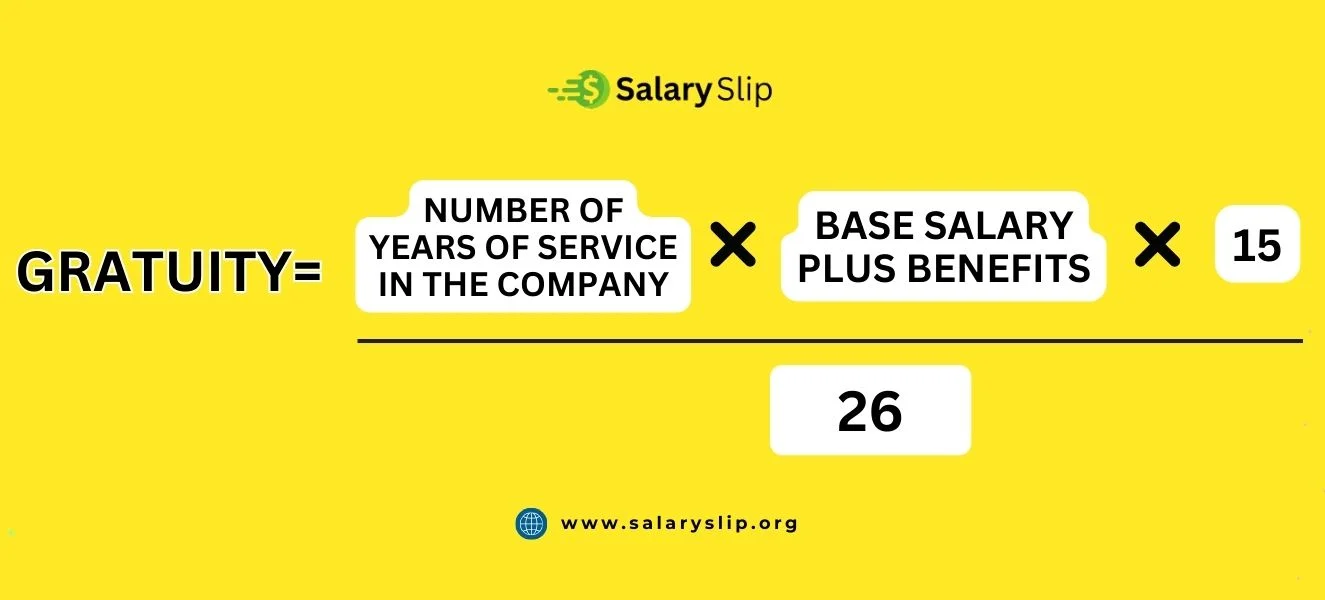
Gratuity Formula: The elements that are used to determine the amount of gratuity are listed below. The sum also depends on how long you’ve worked for the organization and how much you were paid last time. If you want to Calculate Gratuity for employees, then use Gratuity Calculator Online.

formula used to calculate gratuity amounts

Gratuity is equal to N*B*15/26, where 

N:- is the number of years of service in the company and

B:- is the base salary plus benefits. 

15/26: what is it? 

The number 26 denotes the number of working days in a month (excluding Sundays), and 15 denotes a half-month compensation of 15 days. 

What Does “Gift” Mean in a Salary? 

A gratuity is a monetary gift given to staff members who have worked for a company for at least five years as a show of appreciation. The Payment of Gratuity Act of 1972 governs all payments, and employers have the option to pay it out of their own funds or choose to use a gratuity insurance provider.

Also Read:- How to Claim Medical Allowance | How to Calculate Income Tax For Salaried Persons

Determining the Gratuity for Workers Not Covered by the Gratuity Act 

The organization may nonetheless give gratuities even if it is not covered by the Act. However, the amount of gratuity is determined by taking the half-month income of the employee and applying it to each completed year. The pay consists of a base wage, a dearness allowance, and a commission depending on sales. For workers who are not protected by the Gratuity Act, the following formula is taken into consideration while determining the gratuity amount: The gratuity amount is equal to (15 * the last pay drawn * the length of service) / 30. As an illustration: For instance, if your income is Rs. 50,000 and you have worked for a company for ten years and eight months, the gratuity amount is determined as follows:

Calculation of Gratuity in Case of Death of an Employee

Tenure of ServiceThe Amount Payable Towards Gratuity
Less than a year2 * basis salary
1 year or more but less than 5 years6 * basic salary
5 years or more but less than 11 years12 * basic salary
11 years or more but less than 20 years20 * basic salary
20 years or moreHalf of the basic salary for each completed six-monthly period. However, it is subject to a maximum of 33 times of the basic salary.

Tax on Tip:-  

The employee who receives the tip amount determines how the gratuity is taxed. The tax on gratuities can be calculated in two common scenarios: 

  • Government Employee Receiving Gratuity Amount: Gratuities are completely excluded from income tax if they are received by any employee of the state, federal, or local governments. 
  • Any Other Salaried Person Entitled to Gratuity Money from an Employer Protected by the Gratuity Payment Act: The following sum is free from tax when given as a gratuity to any employee whose employer is protected by the Gratuity Act.
  • Fifteen days’ pay based on the individual’s most recent salary draw 
  • Any Other Salaried Person Who Gets a Gratuity Amount from an Employer Not Listed Under the Gratuity Payment Act: The lowest of the following three amounts is free from taxes in this situation. 
  • The employee actually received Rs. 20 lakh in gratuity. 
  • The amount of gratuity that can be received.

Also Read:- What is Gross Salary | What is PF in Salary | Tax Benefit To Employee On Medical Reimbursement

Tax Breaks for Gratuities 

Here are the policy changes implemented during the 2016 budget that affect gratuity laws: 

  • Except for statutory corporations, gratuities received by government personnel are completely exempt from tax under Article 10(10) of the Income Tax Act. 
  • The Income Tax Act’s Article 10(10) ii states that the minimum sum of the following is free from taxation when it comes to death and retirement gratuities received by employees covered by the Gratuity Act of 1972.
  • (*15/26) X Last salary drawn** X Year of service completed, or portion thereof, exceeding six months. 
  • Twenty lakh rupees. 
  • The amount of the gratuity that was really earned.

Revocation of Gratuity 

According to the Payment of Gratuity Act of 1972, even after an employee has worked for five or more years, an employer may choose to withhold all or part of the employee’s gratuity payment. This only works in cases when the worker was fired due to disruptive behavior, which includes making attempts to harm other people physically while at work.

Summing it

A gratuity is simply a retirement benefit that an employee receives from their employer after years of service. Nevertheless, the gratuity sum may also be collected upon leaving the company following a five-year tenure, in the event of the employee’s disability or death. As a result, depending on the organization, different taxation standards and computation processes apply to gratuities.

FAQs on Gratuity in Salary

1. What is Forfeiture of Gratuities? 

Your employer may lose all or a portion of the gratuity as per the Gratuity Payment Act. These forfeitures, however, only apply if your employment is terminated due to disruptive behavior that causes harm to a coworker. 

2. When and How is The Gratuity Paid Out? 

You must complete an application and send it to your employer in order to claim the amount of your gratuity. Your company will then evaluate it and determine how much to tip you. The money will be paid out in 30 days after the company notifies the body responsible for paying gratuities. Additionally, you’ll get appreciation when your gratuity is given to you.

3. How Much Time Does it Take for the Employer to Give the Cash for the Gratuity? 

An employee who is eligible for the gratuity may submit an application within 30 days of the day it becomes payable. 

4. What Does The Gratuity Calculation Indicate as 15/26? 

The formula included in the Gratuity Calculator is referred to as 15/26 in the context of gratuity calculations. The computation of gratuity is based on the assumption that a month consists of 26 working days, with pay being calculated at a rate of 15 days. 

5. After Five Years, How Much Gratuity Will I Receive? 

The amount of the gratuity is dependent on when you were paid most recently. You can determine the amount of the gratuity by taking into account how long you have been with the company and how much you were paid when you last received your paycheck.

6. Is Form 16 Displaying Gratuity? 

Form 16 may or may not show a gratuity. Depending on whether the employer adds information on gratuities to the Form 16 that is given to workers. 

Employees’ Provident Fund – EPF Interest Rate and Passbook

0
EPF Interest Rate
EPF Interest Rate

Employee Provident Fund (EPF) is a retirement benefits scheme that works under the Employees Provident Fund & Miscellaneous Provisions Act of 1952. The scheme applies to people who are employed. According to the EPF scheme, the company deducts some amount from an employee’s salary and deposits it into their EPF account. A company also contributes to the employee’s EPF account.

On retirement, the employee receives a lump sum amount of EPF, including the employee’s contribution, the organization’s contribution, and the interest rate credited each year. The authorities review the interest rate on EPF debts regularly. For the FY 2022-23, the EPF interest rate is 8.15%. Keep reading this article to learn about employees’ provident fund, EPF Interest rate, contribution rate, etc.

What is EPF?

EPF, or Employee Provident Fund, is a contribution-based retirement scheme run by the Government of India. It allows the employees to build up their retirement during their working years. There are two types of contributions made to EPF; one is the employee contribution, and the other is the company contribution. On retirement, the employee receives a lump sum amount that includes the employee and the employer’s contribution with an interest rate.

Is EPF Mandatory for All Employees?

All companies with more than 20 employees are required to enroll in the EPF scheme. Certain agencies can be required to enroll in the scheme with positive relaxations even when the number of employees is less than 20. In the company, every employee whose salary is less than Rs 15000 is required to contribute to EPF.

Also Read:- Employees Provident Fund (EPF) – EPFO Benefits & Process | How to Login to EPFO Member Portal and How to Reset EPFO Login Password

EPF Interest Rate FY 2023-24

The interest rate on EPF is reviewed yearly. EPF interest rate for FY 2023-24 is 8.15%. Once EPFO evaluates the interest rate for the final year, the interest rate is calculated on the basis of the monthly balance and then calculated for the remaining year.

The year when the new interest rates are announced remains effective for the following financial year. For example, From the year starting on 1 April of 12 months to the year finishing on 31 March of the next year. Here are some important facts you should know about EPF Interest Rate

  • The interest rate i.e. 8.15% is legal and may be considered well on EPF deposits made between April 2023 to March 2024.
  • The interest, even though calculated on a monthly basis, is transferred to the Employees’ Provident Fund account only on an annual basis on 31 March of the economic year.
  • The earned interest is added for next month i.E. April’s balance and is then again used to calculate interest.
  • If the contribution is not made into an EPF account for 3 years constantly, the account is closed.
  • Interest is offered on debts of employees who’ve not attained retirement age.
  • Interest isn’t always given on the amount deposited in inoperative accounts of retired employees.
  • The interest earned on inoperative accounts is taxable as according to the member’s slab rate.
  •  For contributions made towards the Employees’ Pension Scheme by the company, the employees shall now not receive any interest. However, a pension is paid out of this amount after the age of 58.

Essential Details to Calculate EPF Interest Rate

The details required to calculate EPF interest are given below:

  • The current age of an employee.
  • Current EPF balance.
  • Monthly basic salary and dearness allowance are up to Rs 15,000.
  • Percentage of contribution to EPF.
  • Retirement age.

EPF contribution is added to the EPF account every month, and the interest rate is calculated accordingly. However, the interest for the year will be calculated at the end of the financial year. Interest for the FY 2022-23 is 8.15%. Hence, for every month’s interest calculation, the interest rate may be considered as 0.679%, i.e., 8.15%/12.

Methods for the calculation of interest rates

The EPFO comes to a decision on the interest rate for the EPF scheme on a yearly basis. The interest rate depends on the market situation and is set by the finance ministry. The interest rate may be calculated either by using an online technique or a formula. Here, we give you an example of the calculation of interest rate by using both methods with the interest rate of 8.25%

Assumptions

EPF Basic salary and dearness allowance: Rs.40,000

Rate of interest: 8.25%

Employee’s contribution to EPF (12% of Rs.40,000): Rs.4,800.

Employer’s contribution towards EPF (3.67% of Rs.40,000): Rs.1,468

Employer’s contribution towards EPS (8.33% of Rs.40,000): Rs.3,332

Employers’ contributions are closer to EPS under the Rs.15,000 salary scale (8.33% of Rs.15,000): Rs.1,249, which is around  Rs. 1,250.

The contribution made by the company towards EPS that is more than the salary scale (Rs.3,332-Rs.1,249): Rs.2,082

The extra contribution made by the company towards EPF contribution (Rs.2,082Rs.1,468): Rs. 3,550

Therefore, the total contribution made by the company and employees towards EPF (Rs.4,800+Rs.3,550) is Rs.8,350.

  • Formula method: Here, we tell you the formula that is used to calculate the interest by using the formulation method

(8.25%/12) x Rs.8,350= Rs.57.40, that is rounded off to Rs.57

  • Step approach: Mentioned below is the calculation of interest by using the step method

8.25%/12 = 0.6875% rounded to 0.69%

0.69% x Rs.8,350 = Rs.57.62, that’s rounded off to Rs.58

Therefore, the calculations for the interest rate are the same by using both methods. Interest can also be calculated with the PF interest calculator, which is available on an online website. 

Example of calculation of interest for an economic year

The table below is an example of the calculation of interest for a financial year

MonthsBasic salary plus dearness allowanceThe contribution made by the company (Rs.)Contribution made by employee (Rs.)The total balance is to be had at the end of the month (Rs.)Interest that is generated (Rs.)
140,0003,5504,8008,3500
240,0003,5504,80016,70057
340,0003,5504,80025,050113
440,0003,5504,80033,400170
540,0003,5504,80041,750227
640,0003,5504,80050,100284
740,0003,5504,80058,450340
840,0003,5504,80066,800397
940,0003,5504,80075,150454
1040,0003,5504,80083,500510
1140,0003,5504,80091,850567
1240,0003,5504,8001,00,200624

Calculation of the total EPF balance that will be given into account at the end of the year is the addition of the total balance that is present at the end of the month and the interest that has been generated. Therefore, the total balance available in the account is

Rs.1,00,200 + Rs.3,743 = Rs.1,03,943

Contributions made by employees and the company

Before knowing about the various strategies for calculating interest, employees must know their contribution to the program. Employee contributions would range between 8% (inside the case of ladies for the first three years of employment), 10%, and 12%. The organization’s contribution to the EPF plan is 10% or 12% of the employee’s salary. If the number of employees employed through the company is less than 20, the company’s contribution is 10%. The enterprise’s contribution, however, is split between the EPF, Employees’ Pension Scheme (EPS), and Employee Deposit Linked Insurance (EDLI). The breakdown of employee’s and organization’s contributions to the scheme is given below.

ContributionsEmployer’s ContributionEmployee’s Contribution
EPF3.67%12%
EPS8.33%Nil
EDLI0.5%Nil

Tax Benefits on EPF Contributions

An employee can get tax benefits for contributing to PF accounts under section 80C of the Indian Income Tax Act, 1961. This benefit can be availed by contributing up to Rs. 1 lakh to a PF account. If you contribute to an employee provident fund account for 5 years, you may break out tax deductions on the amount you have contributed. But, if the duration of your EPF contribution is much less than 5 years and also you withdraw your PF contribution before it completes five years, salary tax can be deducted at supply (TDS).

Conclusion: EPF Interest Rate

EPF or Employee Provident Fund is a contribution-based retirement scheme run by the Government of India. It permits employees to build up their retirement efficiently during the working years.

There are 2 portions to an EPF contribution; one is the employee contribution, and the other is the company contribution. On retirement, the employees receive a lump sum amount that includes the employee and the company’s contribution with interest.

FAQs

Is EPF interest credited monthly or yearly?

The EPF contribution is credited to the EPF account every month, and interest is calculated monthly. However, the total interest for the economic year may be credited at the end of the financial year.

Is the EPF interest rate fixed or variable?

The EPF interest rates are fixed by the government. The government revises the interest rate again and again. Currently, the government has a constant EPF interest rate for the economic year 2022-23 at 8.15%.

What is the method of crediting EPF interest rate to the subscribers?

The compound interest is credited monthly on the fees declared by the government for each year. For 2022-23, the interest rate declared is 8.15%.

How to Claim Medical Allowance in Salary?

1
How to Claim Medical Allowance

Medical Allowance is an amount of cash paid to employees through a company as part of their basic salary to satisfy their medical needs. This Allowance is given to the employees every month, whether or not the employees submit the medical bills to confirm the expenses. However, such a salary is taxable every month under the heading “salary from other sources.” In this article, we are going to tell you about the Medical Allowance in detail.

What is Medical Allowance?

Medical Allowance is an amount of money that an agency contributes to an employee’s basic salary slip to cover medical costs. Whether or not the employee files the medical bills, they will get access to this Allowance each month.

How do Reimbursements of Medical Costs work?

The process starts with acquiring a prescription from a doctor and a bill from the healthcare sector that provides healthcare services. The bill will encompass information consisting of the name of the service, the date, the amount charged, and other applicable facts. These bills and prescriptions are then submitted to the company or insurance company for Reimbursement.

Medical Reimbursement is a simple and easy method. The employee has to show their medical expenses, so for this, they receive a medical bill from the provider and submit it to their company or insurance company for Reimbursement. The company will then reimburse the amount paid by employees.

Medical Allowance Exemption or Reimbursements for Medical Expenses

Medical reimbursement policies are set by authority. Unlike Allowance, medical reimbursements are exempt from tax to a certain amount. Currently, reimbursements up to Rs. 15,000 each year are exempt from taxation. To declare this exemption, all employees must submit the medical bills for their medical expenses. Some other requirements that need to be met to claim medical allowance exemption are given below.

  • Any employee can claim reimbursements for themselves and their spouse, dependent parents, siblings, and children. Note that any medical allowance for siblings or dependents is possible to claim if they have proper medical bills, and it is best once they do not depend on the employee.
  • Medical bills and related documentation can cover every part of a reimbursement. Hospitalization, surgical costs, any medicines sold from retailers, and every other expense for post-hospitalization care can be part of reimbursement claims. This is mentioned under Section 17 (2), Clause (b) of the IT Act, 1961.
  • All components of medical reimbursements are mentioned in Section 80D of the IT Act of 1961. The employees need to submit all documents to the company. If there is a delay by employees in submitting the necessary documents, 30% of the Rs. 15,000 exemption can be used for taxation. However, the employee can claim this 30% if they file tax returns.
  • Under Section 80D, a medical allowance exemption every year is considered a deduction to a maximum of Rs. 40,000. Besides hospitalization and related expenses, this exemption also covers travel costs.  

Benefits of Medical Allowance

Here are a few benefits of medical Allowance

  • Covers medical prices: The benefit of medical Allowance is to reimburse is that it covers the medical costs that a person incurs. This benefit gives economic assistance to people and facilitates them to cover the cost of their treatments.
  • Tax advantages: Medical allowances provide tax benefits. It means that the amount reimbursed is tax-free.
  • Prevents unexpected financial costs: Medical Allowance can help individuals cover sudden medical expenses.
  • Access to quality healthcare: Medical Reimbursements give access to a person to quality healthcare without dealing with huge medical costs. It also ensures timely treatment without any economic burden.

Must Read:- What is Medical Allowance in Salary Slip | Tax Benefit To Employee On Medical Reimbursement

Medical Allowance vs Medical Reimbursement

Sometimes, humans use the words Medical Allowance and Medical Reimbursement together. Although both are payable to employees towards medical costs, the tax implication is specific. Medical Allowance is given to employees on a monthly basis as part of the salary. However, it’s completely taxable regardless of any submission of medical bills to your company. So, an employee does not need to submit medical bills to the organization to get a medical allowance. It is paid to him as a monthly fixed amount that is part of his salary. As per phase 17(2) of the Salary Tax Act, Reimbursement towards medical expenses of Rs 15,000 in a year.

What Is A Medical Allowance Exemption in Salary?

Clause (v) of Section 17 (2) of the Income Tax 1961 allows a tax exemption of as much as Rs. 15,000 on such medical reimbursements. Thus, the maximum limit allowed is up to Rs. 15,000 per annum. If an employee is provided an allowance instead of Reimbursement for medical treatment, it is going to be taken into consideration as part of the taxable component of the salary of the employees.

Medical Allowance Exemption Eligibility

The 1961 Income Tax Act states that medical allowance calculation of expenses is not a prerequisite/allowance for employees. Hence, for medical allowance exemption, the following conditions need to be met.

  • The employee has to have spent the amounts claimed monthly by getting medical treatment incurred on himself, his partner, children, parents, and other dependents.
  • Such amounts have to be covered as medical Reimbursement to be reimbursed by the organization.
  • Reimbursed amounts from the company do not exceed the medical allowance exemption limit of Rs 15000 in that Final year.

Claiming Tax Deductions on Medical Expenses

With the increasing cost of medical care in India, it is important that every salaried individual stay updated on tax deductions on their medical expenses. For example, Section 80D has provisions to find exemptions on medical health insurance. If employees take out insurance for themselves, their partners, and their kids, they can claim a deduction of Rs. 25,000 per year.

Additionally, if coverage is taken out for dependent parents, an additional exemption of Rs. 25,000 may be claimed in a year. These benefits apply to all insurance regulations granted by IRDA-acknowledged coverage companies. If dependents are senior citizens, the employee can declare exemptions of up to Rs. 50,000 every year.

Section 80DDB consists of further provisions for tax exemptions depending on age. Senior citizens of as much as 80 years can apply for exemptions of as much as Rs. 75,000 every year. Any dependent who is older than 80 falls under the ‘old age senior’ citizen bracket and can claim as much as Rs. 1 Lakh on exemptions every year.

How to claim your Medical Allowance?

Employees need to provide the following information to their employers to claim Medical Allowance.

  • Medical expenses: Employees must have their medical bills paid during the year. The employee or a member of their family needs to be mentioned on invoices.
  • Medical certification: Employees must get an accurate medical file from the medical expert or hospital in which they or members of their family got treatment. The certificate needs to consist of the patient’s name, the date of medical care, the type of illness, and the cost of medical care.
  • Claim form: Typically, employers give a claim form to employees to fill it with their information and submit it with their medical certificates and medical prices.

The company will check the request for Reimbursement and give you medical allowances after verifying your complete information and medical bill documentation.  

Things to Remember about Medical Reimbursement

Here are some things about medical Reimbursements that you should know

  • You can’t file an application for medical expenses from the preceding financial year.
  • Private or government hospitals, which your company may own, don’t have any maximum limit on payments for Allowance.
  • Premiums for mediclaim regulations are included in Section 80D benefits.

Conclusion

A medical allowance is a monthly amount that employees give to help with medical costs. Employees may also deduct as much as ₹15,000 in taxes under Section 10 of the Income Tax Act, but the thing is that the allowance benefits are taxable.

Medical Reimbursements are tax-free for employees for verified medical expenses. Employees need to spend monthly payments on medical care for themselves and their family members to qualify for the medical allowance exemption, and the organization’s medical health insurance must reimburse the amount.

With a tax exemption of up to ₹15,000, the medical reimbursement exemption enables employees to post medical bill payments to their employers. According to the union finances for the financial year 2023-24, clear proposals and minor changes have been made regarding basic deductions for the benefit of employees.

FAQs:-

How do I declare a medical allowance exemption?

Medical Reimbursement comes under Section 80D, in which the maximum limit is Rs. 15,000 p.A. If payments regarding medical Reimbursements are not submitted on time by the employee, 30% of Rs. 15,000 will then emerge as the taxable amount. However, at the same time as filing tax returns, employees can claim 30% of the amount.

How do I declare medical Reimbursement?

In order to declare a claim, you need to get treatment in a hospital or medical facility of your company. Contact your firm’s branch and inform them about your declaration. Provide all the bills associated with your treatment. You also need to fill out the medical Reimbursement declaration form to become eligible to claim it.

How can I declare medical expenses on my income tax?

If you’re salaried, you may claim the 80D deduction by submitting insurance receipts or medical payments to your agency, or you may also declare it while filing your income tax return (ITR). 

Read More:

1.SSC MTS Salary After 5 Years
2.Black Cat Commando Salary
3.Merchant Navy Salary After 5 Years
4.10 LPA in Hand Salary
5.12 LPA in Hand Salary

Lawyer Salary in India 2025 and How to become a Lawyer?

0
lawyer salary in India

The government of India has been giving lots of job opportunities. The legal sector of India is multiplying in demand and job opportunities, which makes this a lawful career choice. In India, with a population of 1.3 billion, the legal industry has become one of the biggest Industries and lawyer salary in India. It is the most popular career path, and there are many opportunities to pursue this course. The lawyer’s life is full of immense potential for personal and professional growth. 

It is a lucrative career, and it can make a real difference in the lives of many people in India. There are various reasons why you should pursue law as a career in India. The realm of layers in India encompasses more than just offering legal guidance to businesses and individuals. The law also involves managing civil and criminal disputes in India. The field of lawyers provides a wide role as corporate lawyers, legal advisors, and partners in legal firms, etc. 

Lawyer Salary in India 2025

  • In India, a lawyer salary usually depends on specialty, skills, location, and mainly experience. 
  • Lawyers also earn a plus percentage of the money they recover from clients. The full-time lawyer salary in India is around 2 lakhs per annum. 
  • If any law graduate is working with legal process outsourcing may earn a payment amount of rs 20,000 to rs 50,000. 
  • After an undergraduate degree, a lawyer who begins practicing in court can earn rs 5,000 to rs 40,000; it depends on the advocate he is associated with to practice and train himself. It is a good career to make a bright future. 
  • The overall earnings depend on the qualification of the candidates, his/her popularity, and success in cases. It also depends on which law college you have taken courses and studied law. 

The table below shows some details about the Lawyer salary in India. 

Career in law Average salary in this field 
Junior Lawyer Salary 2-3 LPA 
Corporate Lawyer Salary 7 LPA 
Litigator Salary2.5 LPA 
Advocate Salary 3-4 LPA 
Paralegal Salary3-4 LPA 
Private Lawyer Salary3-4 LPA 

Lawyer salary structure in India: Qualification-wise 

Qualification Salary
LLBRs. 2.20 – 3.50 Lacs 
BA LLB / B.com LLB / BBA LLB / Bsc LLBRs. 3-5 Lacs
LLMRs. 5-6 Lacs
LLDRs. 4.5 -6 Lacs

Lawyer salary structure in India: Experience-wise 

ExperienceSalary
0-5 yearsRs. 2 – 3.5 Lacs 
5-10 yearsRs. 5-6 Lacs
10-20 yearsRs.12-17 Lacs
20+ yearsRs. 40 lacs + 

Lawyer salary structure in India: Company wise 

CompanySalary
Delhi High Court Rs. 3.6 Lacs 
Khaitan & Co. Rs. 9.2 Lacs
ICICI BankRs. 6.7 Lacs
LawFirm.comRs. 4.0 lacs 
Ernst & YoungRs. 6.40 Lacs

Lawyer salary structure in India: City-wise 

CitySalary
Delhi Rs. 5.70 lacs 
PuneRs. 5.6 lacs
MumbaiRs. 7.19 lacs
HyderabadRs. 6.0 lacs 
BangaloreRs. 8.00 lacs
Kolkata Rs. 6.08 lacs

Also Read:- Hotel Management Salary in India | Investment Banker Salary in India | Graphic Designer Salary in India

Scope in the Law field in India 

There are various roles in this field and individuals can obtain the courses to make opportunities to become lawyers in India. Indian lawyers are divided into two main fields such as public-sector lawyers and private-sector lawyers. Let’s see detailed information on these sectors and the opportunities in these sectors for lawyers. 

scope in law field in india
  • Private lawyers in India – Private lawyers only fight cases like legal disputes between parties; it includes contracts law, property law, torts law, and commercial law. In contract laws when one of the parties to a contract does not fulfill their stated obligations then the rest of the parties take legal action and appoint lawyers. Let us talk about one example of private law which would be the creator of a copyrighted work suing someone for the use of this work without their permission. Mainly the private lawyers are to maintain public order and protect individuals’ rights from being abused by the government itself. Also, this law is to provide fair regulations of interactions between individuals and businesses. 
  • Public lawyers in India – Public lawyers are always concerned with the government, including constitutional law, administrative law, and criminal law. This law governs the relationship between the state and its citizens and also the relationship between individuals directly concerning society. It is the law that governs the government, and it influences everything that the government does. Let us talk about criminal law where the individual harms the state law or any person then the public lawyers are appointed to take legal actions required for the well-being of the person harmed or the state. 

These are the two main sectors apart from this there are various specializations within the field of law including business law, admiralty law, criminal law, environment law, property law, etc. All these fields give individuals the opportunity to choose this career and become successful lawyers in India. All these fields contain unique focus and challenges for the individuals. 

Scope of Law In India and How to Become a Lawyer

  • Law is one of the most famous careers and it gives a rewarding experience in terms of financial benefits and the sense of fulfillment and happiness that comes from helping citizens of our society. This law field requires dedication toward the goals, and strong communication skills are necessary. For individuals who have strong communication skills and problem-solving skills, this is a good field for them to pursue a career in India. 
  • To become a successful lawyer in India, firstly you have to study law and pursue an undergraduate program such as LLB/BA after completing class 12th. It is necessary to study law to become a lawyer. 
  • To enter law school you have to know a few things to get admission to these law courses. 
  • After graduation, the individual can practice law in any court or associate with a law firm to become an expert in this field. It will help the individual to increase their communication and other skills. 
  • Besides this, there is also another option for students to enroll in a postgraduate law program, such as LLM, which will help them to gain advanced knowledge and practice the skills that make them popular in this law field. 

These are some things you need to know to become a lawyer in India. 

Vast specializations of the Law field 

There are various types of specialization in this field of law. Students can choose from these fields what they want to do. The fields include civil law, criminal law, corporate law, taxation law, local or wholesale real estate law, international law, and others.

1) Criminal law 

  • Criminal lawyers help in defending clients accused of crimes. 
  • In India, criminal lawyers get a salary of 8 lakhs to 15 lakhs per annum. 

2) Civil law 

  • It involves working on guardian disputes and damage suits, individual rights & conflicts, etc. 
  • In this field, the government and the private sector provide various opportunities. 
  • A salary depends on the qualifications and experience of the individuals. 
  • Usually, these lawyers in India can earn Rs 6 lakhs to Rs 12 lakhs per annum. 

3) Taxation law 

  • These lawyers advise clients on tax-related matters such as tax filing, and tax code understanding and also help to resolve clients’ disputes. 
  • These lawyers focus on the law related to taxation in India.
  • The salary of Tax lawyers in India can range from 3 lakhs to 10 lakhs per annum. 

4) Corporate law 

  • These lawyers focus on providing legal advice and services to businesses. 
  • It involves advising companies on legal matters related to business operations such as setting up a corporation, bankruptcy, securities ETC.
  • Corporate lawyers’ salaries depend on the firm’s size, experience, and geographic location. 
  • These lawyers usually earn higher salaries as compared to others in India. 
  • Corporate lawyers will experience salaries from 15 lakhs to 2 crores and sometimes above this per annum in India. 

5) Real Estate law 

  • These lawyers provide legal advice and services related to selling, leasing, and financing real estate. 
  • Real Estate lawyers deal with legal property matters.
  • A Real Estate lawyer salary ranges from $60,000 to $ 150,000 in India.

6) Family law

  • These lawyers cover various types of topics such as marriage, divorce, child custody, and adoption, etc.
  • The family lawyer salary in India can vary from 2 lakhs to 6 lakhs per annum. 

7) International law

  • These lawyers deal with the legal interactions between different countries and their governments. 
  • The range of international lawyer salary ranges from $90,000 to more than $200,000, depending on experience in this field.
  • The salaries of these lawyers can also sometimes depend on the type of international law being practiced. In-house international lawyers earn more than lawyers in international arbitration and dispute resolution. 

8) Constitutional Law 

  • Constitutional lawyers have higher salaries than practicing lawyers, averaging around $120,000 per annum. 
  • Constitutional lawyers who work for large firms can earn more than the average six figures or more.

9) Employment law 

  • Lawyers from this field understand the various laws governing employee hiring, firing, wages, and benefits. 
  • Employment lawyers focus on the laws related to employee relationships, including wages and hours laws, discrimination, and more.
  • The salary of these lawyers in the United States varies from $86,000 per annum, this is an approx. amount by the Bureau of Labour Statistics. 

10) Intellectual Property law 

  • These property lawyers deal in copyrights, trademarks, and patent law cases.
  • Intellectual property lawyers help clients to protect and defend their creative products, which include books, music, and inventions. 
  • The salary of these lawyers ranges from 8 lakh to 15 lakhs per annum. These intellectual lawyers who have expertise in these fields can earn more than this. 

Unknown Career Opportunities in The Law Field 

Career Opportunities in The Law Field

In this field, there are vast opportunities available. You can become what you want, whether a successful lawyer, a legal advisor, or pursuing a career in legal research; the law sector offers many different positions for students to choose from. Let’s see some of the most popular career options in India such as Corporate legal advisor, LPO (Legal process outsourcing), Indian Judicial services ETC. 

Corporate Legal Advisor 

  • These advisors are responsible for advising their clients. Advising may include drafting contracts and related legal documents and analyzing laws, regulations, and other legal issues. 
  • They are also aware of changes in the law and can advise their clients on how to comply with them. 
  • They are also involved in the negotiation process. These advisors can negotiate contracts and other legal documents and provide advice on dispute resolution. 
  • They must also understand the language of contracts and the implications of specific clauses. 
  • The advisors should also be familiar with the court system and have the ability to navigate it correctly. 
  • Corporate legal advisors can also prepare legal documents and present them in court. 

Legal Process Outsourcing 

  • It is an increasingly popular career for lawyers and legal professionals in India. 
  • It has become a viable alternative to traditional law firm practice and is an attractive option for those seeking legal experience and knowledge in a challenging environment. 
  • LPOs are growing rapidly in this industry, and they offer unique opportunities for legal professionals to work in this dynamic field. 
  • These fields are responsible for providing outsourced legal services to their clients, such as document review, legal research, document drafting, and legal document management. These services are offered on a contract base. 

Indian Judicial Services 

  • The Indian government opened career opportunities for those who want to make a difference in the legal world. 
  • This judicial system offers a variety of positions and unique opportunities to join this field and grow. These fields offer positions like district court judge and supreme court judge etc. 
  • It is an excellent choice to make a career in the government judicial system.
  • This field includes positions like district court judges, high court judges, appellate court judges, etc. 
  • Public policy is also an area that can be used to make a path in the judiciary system as the government uses public policy analytics to research and analyze various policy issues. 

Legal Analyst 

  • It is a very rewarding career in many different industries.
  • Legal analysts are in high demand in India.
  • They work on interpreting and analyzing laws and regulations and provide legal advice to organizations.
  • They have in-depth knowledge of India’s legal system. They must be able to analyze and present it. 
  • These lawyers must also be able to communicate with their clients and colleagues. 
  • Legal analysts are employed by law firms, corporate legal departments, and other organizations. Some of these choose to work on a particular area of law such as corporate, tax, and international law.
  • They are usually employed full-time though part-time and other positions are also available. 
  • Legal analyst’s salary depends on their experience and the industry in which they work.

Legal Journalist 

  • These journalists interpret and analyze legal documents. These legal journalists have excellent skills, can think critically, and can communicate effectively. 
  • They provide accurate, thorough, timely coverage of news and other related topics.
  • This area offers an excellent opportunity to make a difference. It is good work to alert people about important and legal issues.

Legal Advisor 

  • These advisors advise clients on business and corporate law family law and real estate laws.
  • Legal advisors help clients to understand the legal implications of their actions and make the right decisions.
  • They can work in various settings, such as law firms, corporate legal departments, and nonprofit organizations.
  • Legal advisors work in fields such as tax law, bankruptcy law, or intellectual property law.
  • The advisors need to communicate strongly. They must be able to interpret legal documents and regulations and represent in court.
  • Advisors must have an understanding of the laws in their jurisdiction and explain all things easily. 

Law Agency 

These agencies offer various opportunities, from research and writing to client representation; various positions are available.

  • Paralegal :- They work closely with lawyers and help them to prepare legal documents. 
  • Legal Secretary :- These secretaries provide administrative support to lawyers and legal professionals. The legal secretary handles filling, scheduling appointments, and clerical tasks. They usually have a good understanding of the legal system. 
  • Law clerk :- They research legal precedents and assist attorneys in legal proceedings. They help to prepare legal documents and must have the understanding skills and be familiar with law writing.
  • Legal researcher :- They research legal topics and prepare reports for attorneys. These researchers have advanced degrees in the field of law.

Growth and Opportunities 

  • These legal professionals have benefited from the previous years and have seen constant increases in earnings and wages, so it is a very good option to make a career in this field. 
  • Any law graduate student can become a lawyer. There are various law fields you can choose from.
  • Law students can become judges by passing tests taken by the public service commissions. They can also be solicitors, general or public prosecutors, and provide legal services to government agencies.
  • If you have worked with various other organizations as a legal counsel, then you can also become a lawyer. 

Retirement Prospects in the Law Field 

You can retire after the age of 60. If you do not want to retire, then there is no need to take retirement because lawyers never retire. They become gems at that age with lots of expertise. Lawyers can also work as writers, lawyers, and social workers and enter politics after retirement. 

Conclusion 

The salary of lawyers in India depends on their qualifications, experience, and states. the field they choose, etc. There is no fixed salary structure for all Lawyers. However, we can conclude from the above article, that the lawyers earn a handsome salary and their designation increases with their experience and successful cases. 

FAQs:-

1. What is the Average salary of a Criminal Lawyer in India? 

The average salary of a criminal Lawyer in India is 5.40 Lacs per annum. 

2. Who are the top companies offering jobs to Lawyers? 

The Major companies offering jobs to Lawyers include Amarchand & Mangaldas & Suresh A Shroff & Co., AZB & Partners, Khaitan & Co., and J Sagar Associates. 

3. What are the types of LAwyers? 

When you pursue law, you will find various branches such as Corporate lawyers, Divorce Lawyer, Civil rights Lawyers, and Public Defender. 

Recommended:-

1.Ultrasound Tech Salary
2.CRNA Salary
3.Anesthesiologist Assistant
4.Phlebotomist Salary
5.Paramedic salary