Home Blog Page 32

Salary Slip Format in Excel, Word, and PDF (Download Salary Slip Free)

0
Download Employee Salary Slip Template in Excel, Word, & PDF

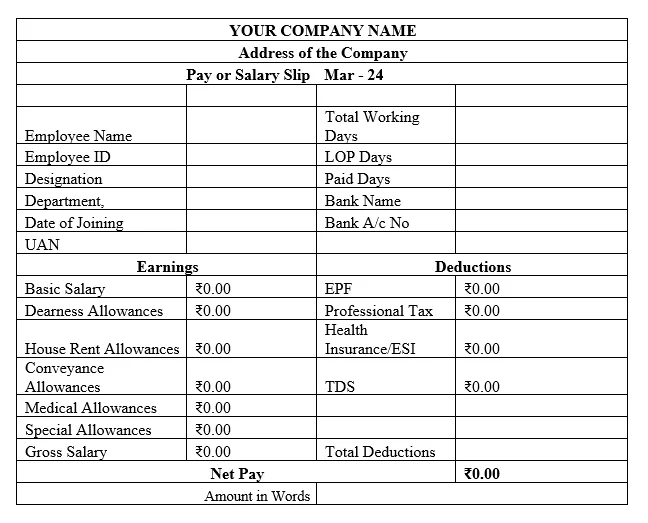
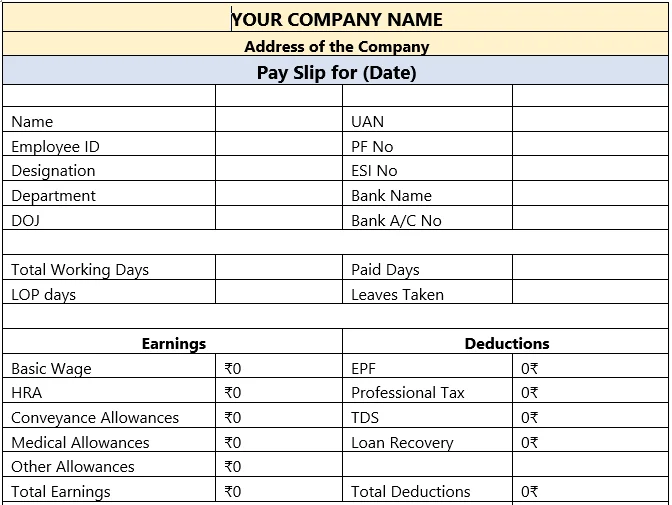
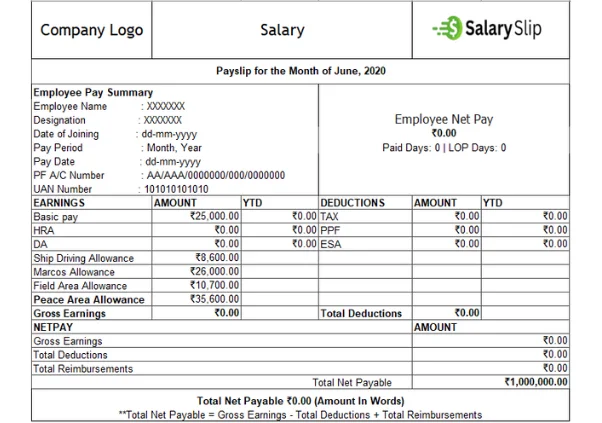
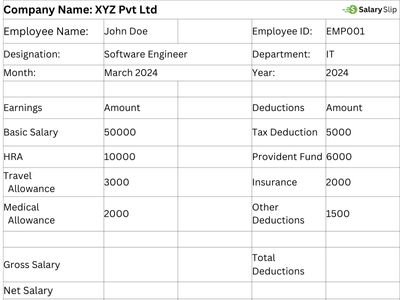
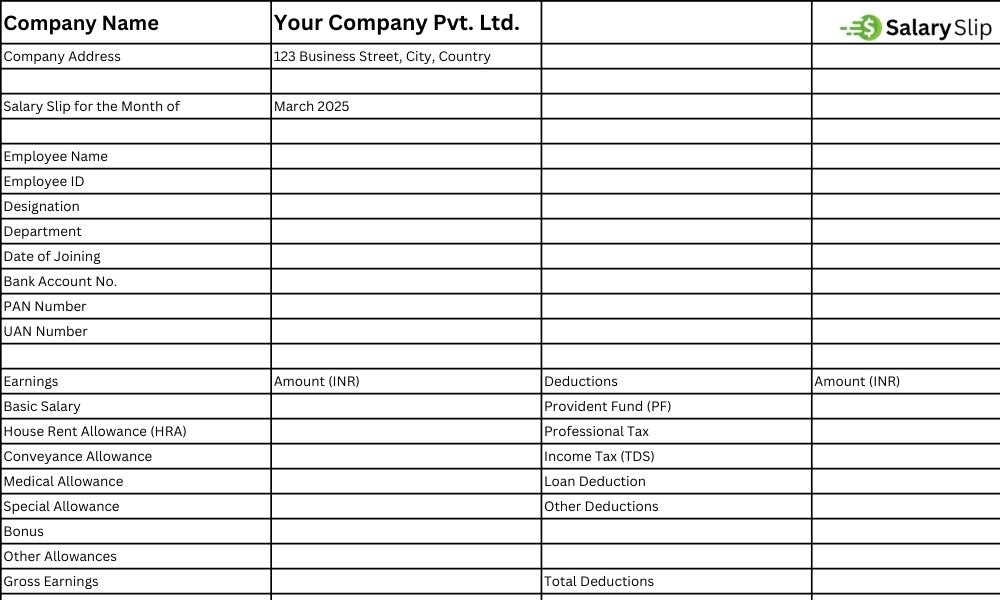
The salary slip, also called a payslip, serves as an official document outlining a worker’s salary and deductions. Salary Slip Format can be provided as an official payslip. Each month, employees get hold of pay slips from their employers detailing critical data, which include the company’s name, the employee’s designation, area, and bank info.

Within the salary slip, there are key components. Salary, together with basic pay, dearness allowance, rent allowance, medical allowance, and unique allowance, are mentioned. Additionally, deductions such as expert tax, tax deduction at source, and worker provident fund are also particular. It’s important to mention that this information can vary from one company to another.

In this article, we’ll delve into the importance of the salary slip format or pay slip, explaining its importance in a financial context. Here, we also tell you about the format of salary slips in Excel, word, and PDF.

What is the Original Salary Slip Format Or Pay Slip Template?

A salary slip can be defined as a file that contains the details of a worker’s salary. These details consist of the basic pay, bonuses, deductions, etc, which are given to the employee every month by the agency. The employees frequently get copies of the same and, at events, are given different copies as well. Read More About What is Salary Slip.

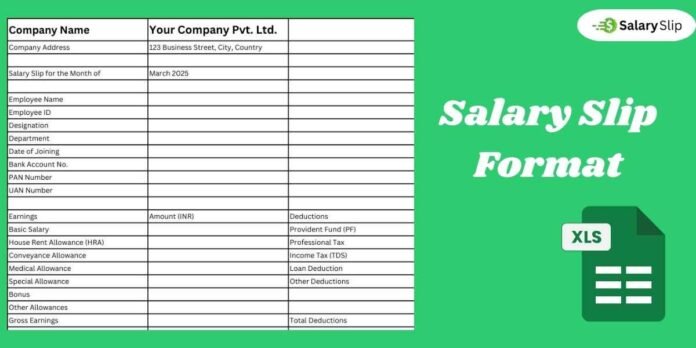
General Salary Slip Format or Payslip Format of Any Organization
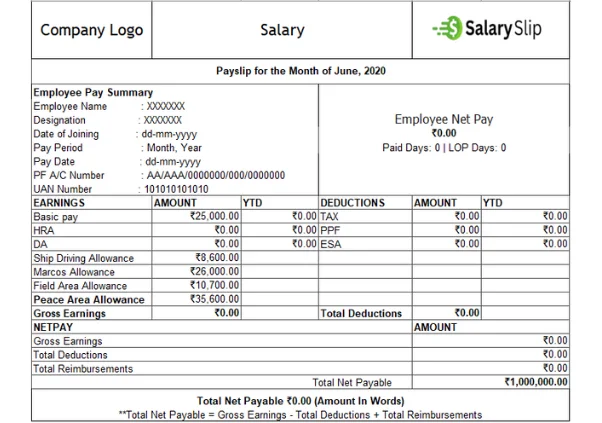
How to Online Downlaod Employee Salary Slip Format in Excel, Word and PDF?

All formats are available here, so you can easily proceed with Salary Slip Download.”
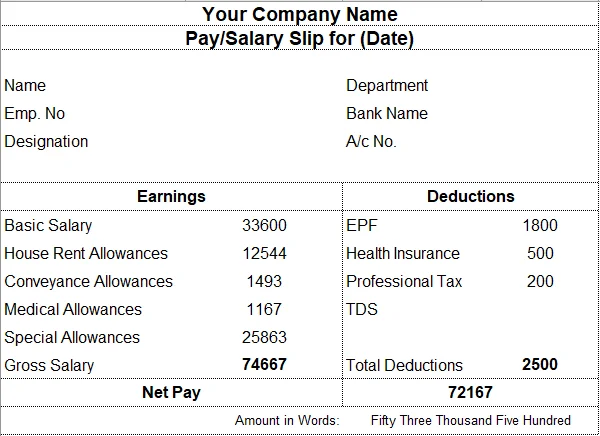
What are Important Components of Salary Slip/Pay Slip?

Grasping the deductions on your salary slip, consisting of Provident Fund, expert tax, tax deductible at source, and Employee State Insurance, assists you in knowing your universal financial commitments and financial savings. These deductions create financial safety, ensuring access to other benefits. 

Your salary slip in PDF form, which you get hold of each month, isn’t just a piece of paper to be used for loan applications. It holds the utmost significance in diverse aspects of economic management. It’s crucial to know the economic intricacies inside your salary slip so that you can manipulate your economic future. By learning the components of a salary slip, you may make knowledgeable choices on finance and make sure that you are in charge of your salary and investments.

The components of the salary slip can be divided into elements: Employee Salary and Allowances and Deductions.    

 Employee Salary and Allowances Provided by Company    

The components in employee salary and allowances given by the company are mentioned below   

1. Basic Salary

This is the number one component of a worker’s salary structure. It constitutes a vast portion of the salary; however, it is taxable. Basic pay is generally higher at the entry level and progressively gives way to other allowances as employees climb to higher positions. 

2. Dearness Allowance (DA)

DA is a dynamic aspect, and this is immediately encouraged with the aid of the value of living modifications due to inflation. It caters to diverse locations and guarantees truthful repayment relative to the nearby economic situations. Although taxable, DA attempts to stabilize the workers’ buying power towards the rising rate.

3. House Rent Allowance (HRA)

HRA is designed for employees living in rented motels. It presents tax exemptions primarily based on the hire paid, which can be a massive financial comfort. The exemptions are governed by specific percentages and rent-charge criteria, permitting employees to optimize tax savings based on dwelling preparations.

For rented houses, the exemption is 50% (metros) or 40% (others) of Basic. Tax exemption standards encompass actual rent paid minus 10% of pay (Basic + DA), actual HRA acquired, and 50%/40% of (Basic + DA) based on city. Read In Detail About HRA or Housing Rent Allowance

4. Conveyance Allowance

Commuting is a day-by-day fact for most employees. Conveyance allowance knows these expenses by providing tax exemptions up to a particular limit. It represents a crucial financial relief for plenty, making their everyday experience of work more financially attainable. The exemption restriction is up to ₹ 1600/month or the Amount acquired as salary. Read in Detail About Conveyance Allowance.

5. Medical Allowance

Medical allowance assists the employee in protecting scientific fees and catering to their healthcare wishes. Tax exemptions are contingent on submitting medical bills, encouraging employees to maintain their general health and well-being. The allowance underscores the company’s dedication to worker welfare. The exemption restriction is as much as ₹ 15,000/year if proof is submitted. Read in Detail About Medical Allowance.

6. Leave Travel Allowance (LTA)

LTA is meant to offer tax benefits for employee tours, acknowledging their want for leisure and their own family time. It fosters healthy work-life stability and aligns with employees’ tour aspirations, ensuring periodic possibilities for rejuvenation. Its calculation is block-based. Read In Detail About Travel Allowance.

7. Special Allowance

Special allowances are designed to behave as effective motivators, encouraging the employee to perform well in their roles. Although fully taxable, they represent the business company’s recognition of fantastic performance. These allowances are frequently tailor-made to individual job roles, acknowledging and profitable specific skills and achievements.

8. CTC or Cost To Company

You don’t want to forget numerous components to calculate an employee’s rate to the employer (CTC). The fundamental salary is a percentage of the CTC, whilst the house rent allowance (HRA) is a percentage of the basic salary. The special allowance (SA) is the difference between the CTC and all other allowances. The provident fund (PF) is a percent of the basic salary, and the gratuity is based on years of provider and basic salary. Medical allowances and bonuses might be constant amounts or percentages of the CTC. 

Lastly, there will be different allowances as well. Understanding these components leads to a more productive and hit business. Read in Detail About CTC

Also Read:- How To Calculate HRA in Salary | Salary Certificate Format | Salary Slip Definition

Deductions in Salary Slip Format by Employers   

Various deductions are made from employees’ salaries:

1. Provident Fund (PF)

The Provident Fund (PF) is a worker financial savings device controlled under the Employees’ Provident Funds and Miscellaneous Provisions Act of 1952. This scheme calls for the employee to contribute a fixed percentage of their salary, which their organization matches. The contributions form a secure fund that the Employees Provident Fund Organization manages.

2. Professional Tax

This is a nation-imposed tax levied on all citizens earning a salary, varying in Amount across states. Individuals make an obligatory contribution from their salary, ensuring financial guidance for country initiatives.

3. Tax Deductible at Source (TDS)

TDS represents the Amount deducted from a salary at the supply of income. The entity making the fee removes this tax, ensuring compliance with tax policies. The salary recipient is answerable for this tax, streamlining the taxation system.

4. ESI

Employee State Insurance (ESI) is a social security scheme that safeguards employees all through challenging instances. ESI deductions are calculated based on the gross salary paid to employees. According to the ESI Act, the employer contributes 3.25% of the wages, while the worker contributes 0.75% to the contributory fund. This joint contribution creates an economic protection net, making sure employees have access to vital benefits and hospital treatment after they need it the most.

5. Gratuity

It is a financial advantage provided to the employee at the time of retirement. Companies commonly deduct a percent (4.81%) of an employee’s basic pay.

Importance of Salary Slip for Employees

Salary slips may be very vital in the professional world. They function as the legal proof of you being a salaried employee. It could be of incredible help to constantly hold them safe, as you’ll do with different significant documents. 

  1. Proof of Employment: Pay slips endure a load of credibility in numerous respectable contexts. Whether applying for tour visas, university access, or undergoing heritage checks, a salary slip validates a person’s expert status. It no longer only affirms modern employment; it additionally delineates the career trajectory, imparting a comprehensive image of an individual’s designation within the organization and their usual employment history.
  2. Strategic Salary Tax Planning: Beyond their role in employment validation, salary slips serve a crucial reason in salary tax planning. The provision of an in-depth breakdown of salary and deductions in those files empowers employees to strategize their tax liabilities effectively. From basic salary to allowances and deductions together with Professional Tax, EPF, and TDS, salary slips provide insights that permit individuals to calculate TDS returns correctly. Furthermore, the resource in maximizing advantages from tax deductions, rebates, and allowances within the prison limitations stipulated by way of the Salary Tax Act of 1961. Effectively managed tax planning ensures economic prudence and permits individuals to navigate the complexities of the taxation system with self-belief.
  3. New Employment Opportunities: Salary slips become priceless property during salary negotiations and whilst exploring new employment possibilities. When accomplishing negotiations with potential employers, beyond salary slips, offer a tangible basis for discussions. They provide a clear historical perspective, enabling employees to advise for equitable reimbursement based on their preceding salary. In the realm of new employment, HR employees frequently request those documents for verification purposes, ensuring transparency and credibility within the negotiation manner.
  4. Facilitating Financial Transactions: Beyond their position in employment and taxation, salary slips are pivotal in facilitating economic transactions and credit management. When people practice for loans, credit cards, loans, or different styles of borrowing, financial institutions demand concrete evidence of a stable salary. Salary slips provide this guarantee, showcasing a person’s capacity to meet monthly charge duties. They not only set credit limits but additionally serve as a crucial eligibility criterion for numerous financial products. In essence, salary slips simplify personal finance management, enabling seamless financial transactions and fostering responsible credit practices.

The last three Months’ Salary Slip Format

When a maximum of you try to switch jobs, HR will request previous pay slips. Most importantly, HR requests the last three months’ pay slips. 

  • To check if you are within the salary variety for the placement. If your current salary is more than the offered salary, then HR will reject you. If your cutting-edge salary is much less than the offered salary, then the HR department will check on your designation and offer a designation that includes senior supervisor, VP, etc.
  • HR released a request for a salary slip to check when you have been hired for the closing 3 months. There are probably some candidates who could have switched organizations in 2 months or 1 month. To check the previous heritage of an organization, ask for a payslip.
  • Additionally, HR will try to make suggestions for different compensations aside from the take-home salary. Further, HR will check when you have any other benefits and attempt to provide a few extra benefits.
  • To carefully examine your pay slips, HR requests most of the last 3 months’ salary slips. Here is a sample closing 3 months’ salary slip format that you could use to prepare the salary slip.

How To Download Sample Salary Slips from Google Sheets?

If you’re seeking out a brief and efficient way to control tasks like price range tracking or simple undertaking planning, pre-designed sheets that require minimal alteration may be very beneficial. In this sort of case, Google Sheets is a brilliant device for collaborative tasks, permitting you to work together seamlessly with no complications. It’s also cost-effective and integrates properly with different Google apps, making it the best choice for an all-in-one solution. The following steps will guide you on how to download salary slips on Google Sheets. Here are free payroll templates for Google Sheets; simply click on them right away!

  • Monthly Payroll Template: Tracks monthly payroll, such as hours worked and taxes deducted. 
  • Annual Payroll Register: Monitors annual compensation and taxes. Both templates are easy to apply and may save you time. Download them now!

How to Create a Salary Slip for Employees?

To create an employee salary slip, these components and steps are necessary:

  • Open a new spreadsheet.
  • Add the organization name at the top of the sheet.
  • In the best fields, input the employee’s name, ID, branch, and job title.
  • Create three columns for salary, deductions, and net pay.
  • Under the salary column, list all the allowances, extra time pay, health insurance, and other benefits the employee is entitled to.
  • Under the deductions column, list all of the wages, house lease allowance (HRA), basic pay, and other deductions.
  • Calculate the full salary and deductions and show them in separate boxes.
  • Subtract the full deductions from the overall salary to get the total pay.
  • Display the total pay in a separate box and make sure it’s far seen.
  • Review the salary slip for accuracy and make necessary modifications before printing or distributing it to the employee.

Salary Slip Format for Contract Employees

Regarding salary slips for settlement employees, the salary slip format is crucial to include precise info to ensure accuracy and transparency. Contract employees must additionally acquire their salary slips as per Form XIX, which covers salary cycle, nature of work, wage fees, extra time info, gross salary, deductions, and actual salary paid. Here’s a basic format you could use

1) Employee Information

Full name
Address
Social Security Number (SSN)
Employee ID (if relevant)

2) Payment Information

Pay length dates
Hourly fee or contract amount
Total hours labored or assignment final touch percentage
Gross pay
Deductions (e.g., taxes, benefits)
Net pay

3) Employer Information

Company name
Address
Employer Identification Number (EIN)

Double-check all records before releasing charge slips to agreement employees to keep away from any discrepancies or errors. 

Advantages of Creating Monthly Pay Slip in Excel

Creating monthly pay slips in Excel has numerous benefits, as mentioned below. 

  • Easy To Use: Excel allows easy customization of the pay slip to fulfill the company’s or employees’ specific needs.
  • Automated Calculations: Excel provides numerous tools and formulations for calculating different deductions and taxes, which saves time and decreases errors.
  • Electronic Storage: Pay slips may be without problems stored and accessed electronically, making monitoring and managing worker information more sincere.
  • Cost-effectiveness: Creating payslips using Excel is more affordable than traditional payroll software programs, which may be high priced to buy and maintain.
  • Professional Look: Excel’s formatting tools can make the pay slip appear, expert, organized, and easy to examine.
  • Accuracy: Excel’s integrated functions can assist in ensuring the accuracy of calculations and reduce the risk of errors.
  • Flexibility: Excel lets in smooth updates and changes to the pay slip template, making it extra flexible than traditional paper-primarily based systems.

Employee Salary Slip Format Without Deductions for Salaries under Rs. 3 Lakhs

If you are based totally in India and reach a salary under Rs 3 lakhs, no deductions might be made. Did you know that in advance?

Salary Slip for [Employee Name]
Salary:
Basic Salary: Rs. [Amount]
House Rent Allowance: Rs. [Amount]
Conveyance Allowance: Rs. [Amount]
Medical Allowance: Rs. [Amount]
Special Allowance: Rs. [Amount]
Gross Salary: Rs. [Amount]
Deductions
(No deductions for salaries beneath Rs. 3 Lakhs.)
Net Salary: Rs. [Amount]
[Company Name]
Salary slip calculation formulation
Here are the components to calculate salary slips in India,
Net Salary = Gross Salary – Gross Deductions
right here,
Gross Salary = Basic Salary + HRA + All kinds of Allowances + Reimbursements + Arrears + Bonus
Gross Deductions = Professional Tax + Public Provident Fund + Salary Tax + Insurance + Leave modifications + Loan repayments (if any)

Difference Between CTC vs Gross Salary

CTC stands for “Cost to Company.” It represents the total amount of money that an employer is willing to spend on an employee during a financial year. It includes all the benefits, and perks that an employee receives from the employer. CTC is the total of many components like the basic salary, perks, and other benefits. 

On the other hand, gross salary is the total amount of money received by an employee before any deductions and taxes are levied. Apart from the basic salary, gross salary includes bonus, holiday pay, and other overtime income before any deductions. Allowances like HRA, DA, TA, LTA, education allowances, medical expenses, and remuneration fees are also components of gross salary. 

Here is the difference between CTC (Cost to Company) and Gross Salary: 

ParameterCTC (Cost to Company)Gross Salary
DefinitionThe total amount a company would spend on an employee in a year, including all benefits, bonuses, and allowances.Total earnings of an employee before any deductions like taxes, provident fund, etc.
Inclusions– Basic Salary- HRA (House Rent Allowance)- Bonuses- Benefits (insurance, provident fund, etc.)- Stock Options– Basic Salary- HRA (House Rent Allowance)- Bonuses- Allowances (transport, medical, etc.)
DeductionsDoes not account for deductions; it’s the total cost to the company.Subject to deductions like tax, provident fund, insurance, etc.
Fixed vs. VariableIncludes both fixed and variable components (like performance bonuses).Typically, the fixed salary components (basic salary, HRA) are considered.
NatureComprehensive, includes all benefits and allowances that the company provides.Primarily the pre-tax earnings of the employee.
UseHelps companies calculate their total expense on an employee.Represents what an employee takes home before deductions.
Components Not IncludedDoes not show take-home salary; includes non-cash benefits and perks.Does not include non-cash benefits or perks; it’s only the cash part of the salary.

Manual Salary Slip vs Digital Salary Slips

Manual salary slips are the traditional approach to payroll management that involves creating and sharing payslips made and signed physically on paper. Manual salary slips are often designed with pen, paper, and manual calculations. This is a conventional method of preparing salary slips, however, as the company grows and technology develops, the companies are shifting towards digital salary slips. 

Digital salary slips are created using HRMS and payroll software. Organizations can streamline the making and distribution of payslips. This helps save time as well as minimizes the chance of errors. 

There are certain pros and cons of both manual salary slips and digital salary slips. 

Pros and Cons of Manual Pay Slip

Pros

  • Physical documents that can be carried by an employee as proof of employment.
  • Convenient for smaller companies with fewer employees as it does not require them to use payroll slip software or other digital instruments.
  • No internet accessibility is required to create the salary slip. For employees as well, the internet is not required to access the payslip. 

Cons

  • Manual pay slips are time-consuming as it requires manual labor to calculate the salary, and create the pay slips.
  • The chances of errors in physical salary slips are more as there is scope for miscalculation. 
  • Physical documents can be lost or misplaced. Also, the manual salary slip can be accessed by other employees or staff, exposing employee’s personal and pay details.
  • Requires papers to make manual payslips, hence, this is not eco-friendly.

Pros and Cons of Digital Pay Slip

Pros

  • Digital payslips can be easily accessed regardless of the employee’s presence in the office. Employees can simply log in to their salary slip software and see or download their salary slip. 
  • Digital salary slips are created and stored safely on the software. Employees can save it to the cloud storage ensuring that only authorized employees can access it. 
  • Automated salary slips are time-saving as they save time for manual calculation and creation of the document.
  • Digital salary slips have less or no chances of error. Once the software is installed and set up, it automatically generates the accurate monthly and annual salary of the employee. 
  • Computed salary slips are eco-friendly as they eliminate the use of paper. 
  • Digital salary slips are created using HRMS software or other payroll management software which also streamlines the whole processing of payroll. 

Cons

  • Employees who are not so familiar with technology might face trouble in using the payroll management software and accessing and downloading the payslips.
  • It requires internet connectivity to use the software, access the document, and download it.
  • Smaller companies with fewer employees will be required to install payroll management software to generate automated salary slips. It could be slightly expensive for the businesses.

Conclusion 

Salary slips are essential documents for all employees to have. But, 93% of Indian employees are unorganized and hence do not get salary slips. They, for that reason, can’t avail of loans as they need evidence of employment. 

Q. What is the salary slip or pay slip?

The payslip also known as a salary slip. It is a legal financial record that serves as evidence of the money you receive from your employer. It shows every component of your pay, such as base pay, deducted expenses, tax paid, and both required and optional allowances.

Q. How do I get a Salary Certificate?

You must write a letter requesting a pay certificate from your current employer if you are an employee wanting one to submit as proof of income. Here are some pointers to remember, the letter should have a formal, courteous tone. Ensure that the format used for the wage certificate request is simple, clear, and brief.

Q. Are salary slips confidential?

Yes, a salary slip is a legal document of income and is confidential. You are free to decide who you want to know about it. The words “private and confidential” are usually found at the bottom of the company name on pay slips. A statement that only the employer and the employee have access to the wage slip document, which contains confidential information.

Q. What information should be included in the format of a salary slip for organizations?

 In India, there is no standard format for salary slips used by employers. But certain information will be required to be included on every pay slip. The following information may be on the salary slip, depending on the type of firm and compliance with it.

1. The Salary Paid Month and Year
2. Name, address, UIN/CIN, TAN, and PAN of the employer
3. Name, Code, Designation, and Department of the Employee
4. PAN and bank account number of the employee
5. UAN (universal account number) and EPF account number
6. The Total Number of Work Days and Leave Days
7. Earnings (income) and Deductions Classification
8. Net Pay in Words and Numerics
9. Give it all to balance. 

Q. How can I make a simple salary slip?

I can make a simple salary slip: 
1. First, The Name of the company, address, logo, month, and year of the payment.
2. Particular employee’s name, employee code, job role, and department.
3. Personal information such as an Aadhar/PAN number and necessary bank details.
4. UAN (Universal Account Number) and EPF (Employees Provident Fund) account numbers.

Q. Where is a salary slip required?

 The following are the reasons why you should keep your employee salary slips: 
 Employment Verification: Required for courses, visas, and job applications.
 Tax Planning: Assists with ITR filing and tax bill calculation. 
 Loan applications: Find out a person’s trustworthiness for credit cards and loans.

Read More:- Veterinary Doctor Salary per Month || 8th pay commission salary calculator
How To Calculate HRA in Salary

0
Calculate-hra

Per the Income Tax Act 1961 provisions, a section of the HRA received is exempt from taxation, while the remaining is considered taxable income. Calculating the eligible HRA deduction includes adhering to precise conditions mentioned in the Act. The technique of HRA calculation for income tax encompasses figuring out exemptions and deductions. House Rent Allowance (HRA) is a big aspect of many salary systems designed to ease personnel’s financial burden of rent expenses. Understanding a way to calculate HRA is crucial for employers and personnel to ensure accurate disbursements and tax benefits.

Calculate House Rent Allowance

How to Calculate HRA in Salary?

When it involves figuring out the part of House Rent Allowance (HRA) that can be excluded from the taxable salary, the following HRA calculation formulation is used: To calculate the HRA exemption, the here are values taken into consideration. 

  • Actual HRA received through the employee.
  • 50% of the basic salary if the worker is living in a metropolitan town.
  • 40% of the basic salary if the employee resides in a non-metropolitan town.
  • Actual rent paid by the worker minus 10% of the basic salary.

What is the Formula For Calculating HRA?

Actual rent paid – 10% of simple salary = HRA Tax Exemption Amount

By using the components noted above, the smallest amount amongst those options is considered exempt from the taxable salary. It’s crucial to note that personal circumstances may additionally range, and tax regulations can trade through the years. Therefore, it’s really helpful to seek advice from a tax professional or discuss today’s tax recommendations to make sure accurate calculations are well-made for your unique state of affairs.

Example For House Rent Allowance

Let’s check the case of Mr Aditya, a person living in Mumbai who is employed and receives a monthly salary. He lives in rented accommodation and will pay a monthly rent of Rs.10,000, which sums as much as Rs.1.2 lakh annually. Below is a table providing the various additives to his monthly salary.

ComponentsAmount
Basic SalaryRs.30,000
HRARs.13,000
Conveyance AllowanceRs.2,000
Special AllowanceRs.3,000
Leave Travel Allowance Rs 5,000
Total SalaryRs.53,000

For HRA deduction calculation, let’s examine Mr. Aditya’s House Rent Allowance (HRA). We need to keep in mind different factors primarily based on his annual salary.

  • Actual HRA component of his salary: Rs.13,000 * 12 = Rs.1.56 lakh.
  • 50% of his basic salary, as he is living in Delhi: 50% * Rs.30,000 * 12 = Rs.1.80 lakh.
  • Actual rent paid minus 10% of simple salary: (Rs.10,000 * 12) – (10% * Rs.30,000 * 12) = Rs.84,000.

Among these options, the bottom cost is Rs.84,000. Therefore, Mr Aditya can declare a tax exemption of Rs.84,000 on his HRA. Any amount obtained as HRA past this exemption may be tough to tax based totally on his salary tax slips.

By availing of this tax exemption, Mr Aditya can successfully reduce his taxable salary and doubtlessly reduce his tax legal responsibility. People need to understand the tax policies and exemptions related to their salary components to make informed financial decisions.

Also Read:- What is Travel Allowance in Salary Slip? || Housing Rent Allowance

How to Use the HRA Calculator?

To use the HRA calculator, follow these steps: 

  • Open the HRA calculator.
  • According to your paychecks, enter your base pay and HRA.
  • Enter your actual rent amount and also state whether you reside in a metro city from the drop-down menu.
  • Now the result will appear on the page. 

The House Rent Allowance (HRA) calculation for income tax makes it convenient and simple for employees to save tax. 

Benefits of Using an HRA calculator 

An HRA calculator can be useful for several reasons, including

  • Accuracy: The HRA calculator is beneficial as it gives precise results, that reduce the chances of errors. It is because of the presence of preset formulas in them. 
  • Time-saving: The House Rent Allowance calculator provides quick results, saving time in comparison to manual calculations. 
  • Easy to use: HRA calculators are easy to use, and require only a few inputs like salary, rent paid, and whether you live in a metro city.
  • Tax planning: HRA calculators are helpful as one can easily understand their tax exemptions and plan their taxes effectively.
  • Financial planning: These calculators help in planning and managing your finances efficiently, hence good for future planning.
  • Comparison: HRA calculators can help in differentiating the impact of your tax savings in different scenarios. With this, you can make informed decisions about housing and salary negotiations. 

Different Methods to Calculate HRA in Different Situations

There are various unique ways to calculate HRA for different situations. Let’s dive into these methods. 

  • Rent Paid To Family Members: You are eligible for an HRA deduction, even if you paid home rent to any family member. This approach means that if you could show proof of income transactions whilst living together with your parents, you qualify for the HRA exemption.

Providing your parents with financial transaction proof, income agreement, employment receipts, etc., will satisfy the HRA exemption requirements. Nevertheless, if you own the property, you are not eligible to have this advantage. Belongings held by a spouse cannot also be excluded from HRA.

  • Own a house in a different city: You are qualified to apply for an HRA claim even supposing your property is placed in an extraordinary metropolis from where you live and work. You can deduct the price of paying your home loan EMIs out of your taxes as well. This HRA exemption rule is stated under Section 10(13A) of the Income-tax, all you want to do is simply provide good enough proof for every to claim the exemption.
  • Rent shared with the partner: Only one person can declare the total amount as an HRA deduction if you and your partner share the rent of the home. The HRA exemption may be claimed individually by each of you in case you can get personal rent invoices for rental bills. To avoid problems with tax policies, you need to ensure there are not any duplicates.
  • Individuals whose employers do not get HRA: An employer is accountable for providing the HRA. But, if an employee works in an enterprise that doesn’t take into consideration an HRA factor even when calculating the whole salary structure, they could nevertheless claim it. You may also claim the benefit under Section 80GG of the Income Tax Act even when your company no longer pays HRA; however, you still need to pay rent. In addition, you also have to fill out Form 10BA to complete the process.

Eligibility to Claim HRA Tax Deduction

 There are many factors that decide the person’s eligibility for an HRA tax deduction. Here are the such factors given below 

  • Rent Receipt Requirement: To claim a portion of your House Rent Allowance (HRA) as a tax deduction under Section 10(13A) of the Income Tax Act, it is essential to make sure that your name is noted on the rent receipt. This serves as proof that you are the only one making income payments for the residence you are living in.
  • HRA Component on Pay Slip: Another crucial requirement is that your payslip needs to show the House Rent Allowance (HRA) to become eligible for it. This permits the salary tax government to perceive the unique part of your salary accuracy for house rent.
  • Salaried Employee Status: To qualify for claiming HRA as a tax deduction, you must be a salaried or paid worker. Self-rented individuals or those with income earned through different ways might not be eligible for this tax advantage.
  • Live in Rented Home: Lastly, you must live in a rented home to be eligible for an HRA tax deduction. If you are a homeowner or living in a house for which you do not pay rent, you cannot claim HRA as a tax deduction under Section 10(13A) of the Income Tax Act.

Remember, the assembly of this kind of necessity is critical to avail of the tax benefits related to HRA. By experiencing these situations, you may reduce your taxable income and potentially decrease your average tax legal responsibility.

Required Documents For HRA Exemption

To declare tax exemption on HRA, some documents are needed. These documents prove that the employee has paid rent to the rent owner. Taxpayers can declare exemption on HRA despite the fact that they’re paying rent to their parents.

  • Rent receipts – The most important file that has to be provided when claiming an exemption on HRA is rent receipts. These receipts act as proof of rent payments. 
  • PAN information of the landowner – The PAN number of the landowner is required via the income tax branch to confirm if they have acquired the rent. It is required if the annual rent is more than INR 1 lakh. 
  • Self-declaration – If the landowner does not have a PAN card, they can offer a self-statement showing the same. 

Important Points to Keep in Mind While Claiming HRA Deduction

If you want to claim the HRA deduction, then here are the various things you should know 

  • Landlord’s PAN: To declare HRA exemption, if your annual rent exceeds Rs 1 Lakh, you’ll need the landlord’s PAN. If the owner doesn’t have a PAN, a signed assertion is needed. Failing to offer both can also bring about the loss of tax deduction.
  • HRA Calculation: The House Rent Allowance (HRA) varies depending on the town in which you live. In metro towns, you may claim up to 50% of HRA as a tax deduction. For non-metro towns, the allowable deduction is as much as 40% of HRA.
  • Renting vs Owning: HRA is designed to help with the costs of a rented house. Therefore, if you stay in a house that you own, you cannot claim HRA as a tax deduction.
  • Staying with Parents: If you live with your parents and obtain a rent receipt of their name, you can claim an HRA exemption. However, your parents must include the rent amount in their salary while submitting their tax returns.
  • Spousal Payments: It is important to note that paying rent on your partner does not qualify for an HRA deduction. HRA benefits can best be claimed for rent paid to landlords who are not your spouse.

Conclusion 

Calculating House Rent Allowance (HRA) in your salary requires huge attention, understanding tax policies, and accurate documentation. By keeping all the above things in mind, a person can do correct calculations, increase their HRA exemptions, and experience good financial conditions. As HRA is a valuable tool for tax benefits and cost-effective living, learning its calculation artwork contributes to effective financial planning and the optimization of one’s average financial well-being.

FAQ’s

1) How does HRA become tax-exempt?

According to Section 10(13A) of the Income Tax Act, 1961, in certain conditions, a fixed amount of HRA is exempt from taxes. 

2) Who is eligible for HRA exemption?

Salaried individuals who pay rent for residential purposes are eligible for HRA exemption and can claim the benefits under HRA exemption. 

3) Can I claim HRA by paying rent to my parents?

Yes, you can claim House Rent Allowance by paying rent to your parents. However, the exception, is if you show, that your parents own the house and you pay rent to them and they show the rental income in their income tax returns. 

4) Can I get both tax exemption on HRA and a tax rebate on my home loan?

Yes, you can claim both HRA and home loans at the same time. For example, if you live in a rented house and pay rent, while you have another house for which you are paying a home loan, you can claim both.

5) How much of the HRA I earn is tax-exempt?

The following calculations apply in such instances: 

  • 50% of the basic salary for big metros.
  • 40% of the basic salary for non-metro locales.

However, usually, the gross HRA that the employer pays is non-taxable.

6) How is HRA rebate calculated?

The following is the formula to calculate the HRA rebate: 

a. HRA received from the organization

b. Actual rent paid – 10% of basic salary = HRA Tax Exemption Amount.

HRA rebate is considered the lowest between a. or b.

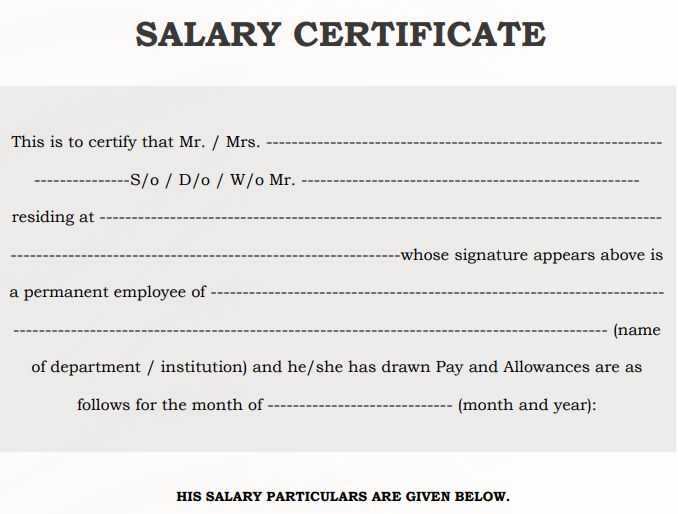
Salary Certificate Format: Formatting Tips, Download Word Template

1
Salary Certificate

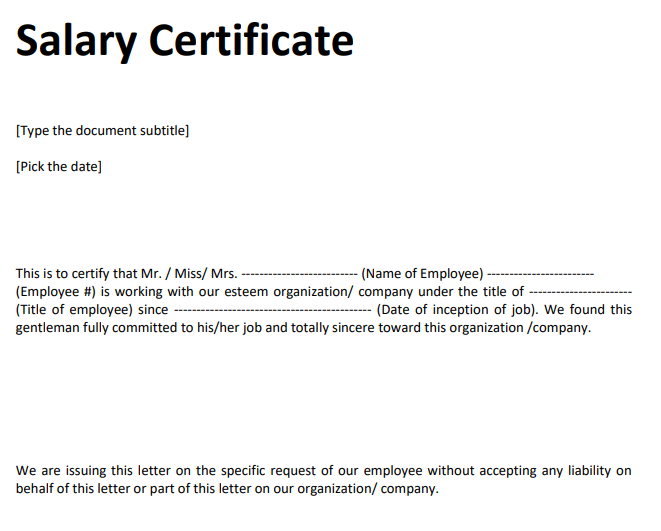
Information About hourly to Salary form Salary slip, A salary certificate is a record that confirms a person’s salary and employment information. In this blog, we are able to discuss the salary certificate format, its significance, and the way to create one. There are many platforms that offer free salary certificates in Word format that you may download and use immediately. But first, permits cover the fundamentals.

What is a Salary Certificate?

A salary certificate is an important file that verifies a person’s salary and employment details. It serves as proof of salary and is required in several conditions, consisting of applying for loans, credit score cards, visas, and different documents. Additionally, employers may require a salary certificate whilst giving a worker a housing allowance or a vehicle loan.

As a company, you’ll need to provide salary certificates to your employees due to the fact your employees can be required to share their salary details with diverse entities inclusive of banks, authorities organizations, and different firms.

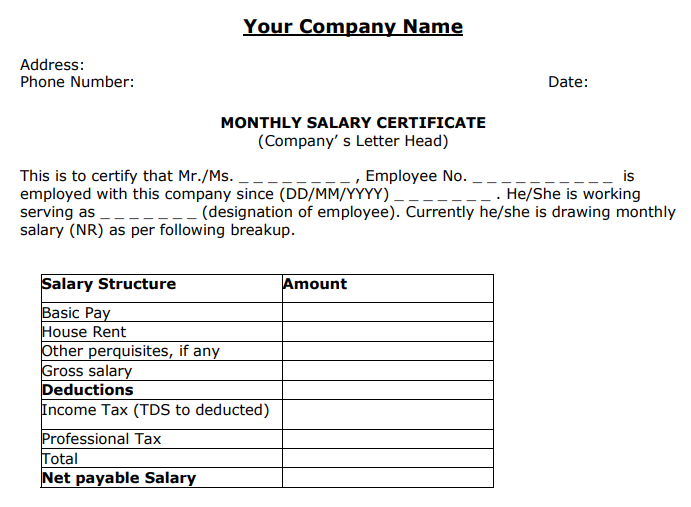
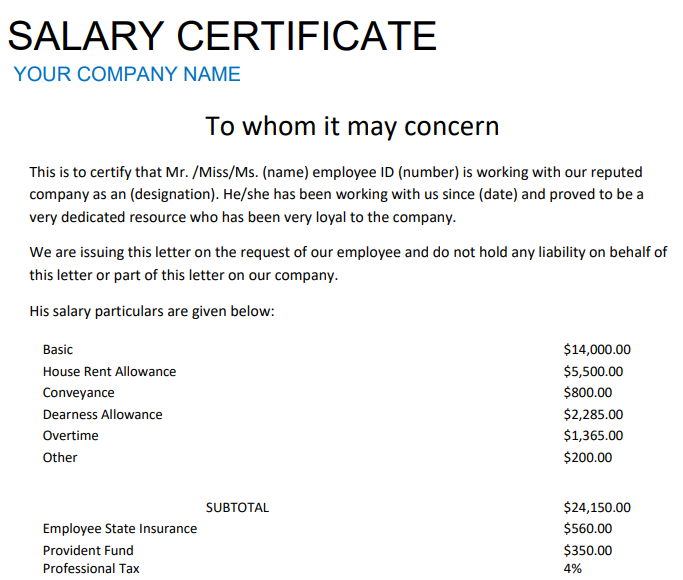
Format of salary certificates

The following information is mentioned in the salary certificate format

  • Employee’s name and ID
  • Name and deal of company
  • Date of enrolment
  • The date the certificate was issued
  • The starting wage
  • Allowances for things like house rent, transit, hospital costs, etc 
  • Salary general (base salary plus allowances)
  • Deductions include taxes, provident finances, and so forth.
  • Net salary (total salary less deductions)

The salary certificate format affords a salary summary, classification, and department for the employee. The particular format of a salary certificate is decided by current laws and regulations.

The salary certificate format is a preferred format that employers can use to speak information about their employee’s present-day or preceding wages. It frequently begins with an ID and then goes on to describe the requirements for the data to be mentioned in the salary report.

For all states, the critical structure of a pattern salary certificate is the same. The shape could be identical for all states. However, the format will fluctuate slightly depending on the necessities. Each person adheres to the laws and guidelines set up by the labor ministry.

Salary Certificate Template For Download

The format of a salary certificate varies according to state, but below is an example of a salary certificate format.

Regulations installed by salary certificates are available in a number of formats, depending on employment settlement and duty. The salary certificate is typically given in format (letterhead, worker name, company seal, certifying date, and so on).

The salary certificate format is a report designed for your future promotion, as well as a letter of recommendation for any shop clerk. The salary certificate is utilized in almost all industries and sectors. The salary certificate format absolutely shows how much you received and your annual salary.

Format of an Employee Salary Certificate Employee Name

First Name:

First Initial:

Middle Initial:

Year of Birth:

Address: 

(Home Telephone Number) 

Fax No.: 

Contact information via E- mail:

Designation: 

Unless exempt from any Act/GSTR Act/TCS Law, offer the name and address of the agency.

If to be had, the name and address of the organization’s touch individual.

If a company calls for a copy of an ID card or a passport with a photo under any regulation, it’s far solely for verification purposes.

What Are the Different Parts of a Salary Slip?

The parts of a salary slip include all the heads affecting your gross salary. The heads are divided into Salary and Deductions. Let us recognize these two subcomponents in more elements.

1) Salary Components

The following parts normally form a part of your salary section in salary certificates.

  • Basic Salary: The fundamental salary is the primary aspect of your salary. It is the basis of all other salary additives along with the deductions.
  • Dearness Allowance: Dearness allowance is part of old corporate and government salary systems. It is supposed to be an allowance to compensate for inflation. Dearness allowance is predicted as a percent of primary salary. This allowance is completely taxable.
  • House Rent Allowance: HRA, or house rent allowance, is to compensate you for the monthly charges for the house. This allowance is commonly up to 50% of your basic salary. HRA is partially taxable based on your town of house and rent paid.
  • Conveyance Allowance: This is an allowance to compensate you for your everyday office commuting fees. This allowance is tax-free, as much as the restriction is defined in the annual Union Budget.
  • Medical Allowance: A medical allowance is a totally taxable allowance as this comes under Section 80D, and the maximum restriction prescribed is Rs. 15,000 yearly.
  • Leave Travel Allowance: Leave travel allowance is likewise a partially taxable allowance. This allowance is offered for an employee to journey to their native land twice in a block of 4 years.
  • Special Allowance: Special allowance includes all of the ultimate part of your salary. This allowance is fully taxable. There are extraordinary categories of special allowance – non-public allowance and reliable allowance.

2) Tax breaks in Salary

The following components may show salary deduction amounts

  • Provisional Funds: Your contribution, as well as your company’s contribution, to your provident price range, along with EPF or NPS, is indicated as a deduction on your salary slips.
  • Taxation as a Profession: A professional tax is a country tax that applies to a unique career. If it applies to your activity, the deduction will show on your salary slips.
  • Personal Salary Tax: Your monthly salary includes strengthened salary tax deductions. These deductions are calculated primarily based on anticipated salary for the economic year. You can reduce this deduction by informing your business enterprise about tax-saving investments.
  • Paid and Unpaid Leaves: If you took any unpaid leaves all through the month, the withheld salary will be listed under this heading.
  • Gratuities and Health Insurance Premiums: Although no longer part of your compensation, the company regularly consists of such worker perk contributions in CTC (price to the organization). If this is the case, the sums are deducted out of your salary.

The Importance of a Salary Slip

Salary slips are a critical part of your work documentation. Here are the following aspects that show the salary slip’s importance  

  • Functions as Proof of Employment: A wage slip is an easy document that proves your work.
  • Becomes the idea for salary taxes: Different components of your salary may be taxed at distinctive costs. Your tax estimate for the financial year is based on the salary structure proven for your salary slips.
  • Beneficial in Search for Future Employment: Your new agency’s wage is regularly primarily based on your previous compensation. Salary slips help you negotiate a higher wage for your future work.
  • Assists in acquiring loans: Salary slips are an essential file to have handy whilst applying for a loan. Your loan eligibility can be determined via your wage shape and monthly salary.
  • Proof of Salary for Insurance and Credit Cards: When acquiring lifestyle coverage, you need to provide proof of salary because your maximum existence coverage eligibility is decided with the aid of your salary. Similarly, your credit card restriction is determined with the aid of your salary. As a result, a salary slip serves as essential documentation of salary and employment for each party.
  • Salary Certificate for Bank Loan in India: The maximum document that the bank or credit score card issuing organization will request from you when making use of a loan or acquiring a new credit card is your salary certificate. Your salary slips might be evaluated to determine if you will be capable of salary off your duties and interest on time.

How to Obtain an Employee Salary Certificate

A wage certificate is a vital file that a company affords to an employee after the employee is hired by a selected organization. The company is required to provide the employee with a Salary Certificate. Employees in government enterprises get hold of their salary certificates almost soon after being employed.

There isn’t potential for tiny and micro-companies or new startup organizations in India to provide a salary certificate to each of their employees. In any such circumstance, if the worker wants a salary certificate, he can ask his business enterprise to provide it by asking for the use of the Salary Certificate Request Letter. If an employee’s salary certificate is lost, he or she can request an option with the aid of writing a Salary certificate request letter to their company.

How Do I Create an Online Salary Certificate?

Here are the ways to create an online salary certificate. If you also want to create a salary certificate, then here are the steps you should follow 

  • Download the Salary certificates format in Word with the aid of clicking at the above link. Because the Word format is editable, the PDF model is not.
  • Fill in the blanks along with your name, company’s name, position name, etc.
  • Fill out all of the information about your salary and taxes.
  • Verify all of the figures with documentation.
  • After completion, go to your administrative center and reap your employer’s signature or the company’s.

Salary Certificate Application for an Employee

An employee salary certificate is each financial and the same tool. A salary certificate often confirms that a positive individual is or was a salaried worker of a selected organization. Salary certificates are used for the following functions apart from being an equal device:

  • Salary verification for a bank loan: A bank regularly requests an individual’s salary certificate so as to determine and get access to a person’s trustworthiness or credit rating. It is used to decide whether or not a person will be capable of salary off his loan and interest on schedule.
  • Tax act: Tax authorities use a salary certificate to evaluate whether or not or no longer a person is required to pay salary tax. It is likewise used to determine which tax bracket an individual will fall into under the Salary Tax Act of 1961.
  • Loan/Credit Card Salary Certificate: The most giant report that the financial institution or credit card issuing agency will request from you when applying for a loan or obtaining a new credit score card is your salary certificate. Your salary slips may be evaluated to decide if you may be capable of salary off your responsibilities and interest on time.

Also Read:- Data Analyst Salary || Data Scientist Salary || Full Stack Developer Salary

What exactly is a salary certificate?

A salary letter is a letter that a worker sends to his or her organization inquiring for his or her salary to be released.

  • Letter of Salary Certification:- A salary certificate letter is a letter released via an enterprise to an employee stating that the bearer occupies a role in a specific employer and has a decent, constant, and stable salary.

What’s the difference between a salary certificate and a salary certificate letter?

A salary certificate is a file presented via an organization to a worker through the recruitment technique that confirms the bearer is a salaried employee of a selected agency. It also specifies the numerous headings under which the worker’s wage could be determined.

Whereas 

A salary certificate letter is a letter sent by a company to a worker stating that the bearer occupies a role in a specific organization and has a decent, constant, and stable salary.

What exactly is a salary slip/salary slip?

A salary slip is a document given to an employee via his or her enterprise as proof of employment. It describes how the salary is computed in spite of all allowances and deductions that are taken into consideration. The salary slip carries the real wage amounts and is added on every occasion the organization salary the worker.

Also Read:-BSc Nursing Salary || Air Hostess Salary || CRPF Salary || Cyber Security Salary

Difference between Salary Certificate and Salary Slip

A worker’s salary certificate consists of various salary-related info inclusive of salary and deductions. It also indicates the connection between the employee and the enterprise. Whereas the salary slips consist of monthly salary info and are issued monthly for an employee. At the same time, the salary certificate is based totally on a selected length, which can be a year or the entire agency’s tenure. 

Salary CertificateSalary Slip
Issued by using the agency, it proves your employment status in the enterprise.It presents distinct information on the salary of a worker
It does not include a detailed employee’s monthly salary structureIt carries facts on a worker’s month-to-month salary structure
It is proof of salary but doesn’t show the financial status of the employeeIt is proof of employment in addition to showing the exact financial status of the worker

Components that must be included in our salary certificates

The following are the essential components that we should include in the salary certificate

  • Employee’s Name
  • The name and address of the agency
  • Employee ID (if to be had)
  • Employee designation and branch (branch).
  • Employee’s Beginning Date
  • Employee Salary Breakdown

Conclusion

An employee salary certificate is a vital report for employees and employers alike. It serves as proof of salary and employment and is often required for numerous purposes, inclusive of loan applications or visa processing.

The format of a salary certificate may rely on the organization’s regulations and the record’s motive. However, it generally includes information consisting of the worker’s name, designation, salary form, deductions crafted from their salary, and net salary. Ensuring your salary certificate is updated and correct permits you to keep away from any delays or headaches in your financial dealings.  

FAQs :

1) What is the Salary Certificate?

A Salary Certificate is a document provided by the company to an employee that confirms his/her association with a firm or company. It contains an employee’s important details, like tenure, designation, employee ID, and salary details in detail. Proof of Income is required on various occasions like when applying for loans, credit cards, visas, and so on. 

2) What is the Salary Certificate format? 

There is no predetermined structure for a salary certificate and changes from company to company. However, the salary certificates must include details like the employee’s name and ID, company name, date of enrolment, date of certificate issued, the starting wage, allowances given by the company, Salary general (base salary plus allowances), deductions including taxes, provident finances, net salary (total salary less deductions), and so on.

3) What details should be included in the salary certificate?

The salary certificate must include the name and employee ID of the employee, address, designation, work location, work tenure, and salary breakdown containing allowances, deductions, and more. Some salary certificates also have employee’s work ethics and behavior in the office. 

4) What is the difference between a salary certificate and a salary slip?

Employees regularly get their payslips or paychecks each month, which include a breakdown of their salary along with information on taxes and deductions. On the other hand, the salary certificate serves as a summary of the employee’s earnings and financial information for a given time frame.

5) Why is a salary certificate important? 

An employee receives a salary certificate on leaving the company and on joining another company, the new employer might ask them for a salary certificate. This salary certificate (Letter is Proof) of an employee’s association with the company contains important details like designation, date of joining, salary breakup, allowances, and more. Based on these given details, the candidate ask for an increment in the new company.

6) What is the salary certificate format for the bank loan?

Salary certificates format for bank loans are often provided without a set format. An employee’s tenure and other key information about their salary breakdown are included in the salary certificate format.

Recommended:- Hourly to Salary United States || Electrician Salary United States || Graphic Designer Salary

What is a Salary Slip or Payslip?

0
Salary Slip
Salary Slip

A salary slip is an important financial record that employees get from this company. It acts as the employment of proof. It will show all of the components of your Salary together with basic salary, obligatory and temporary allowances, deductions, tax paid, etc.

It is a legal requirement to issue salary slips to employees of a company. Companies need to issue salary slips to their employees. A salary slip is proof of income that workers get from the company. The details of a pay slip let you invest in tax-saving investments like transparent price range, PPF, NPS, insurance, etc. 

What is a Original Salary Slip?

A salary slip or a payslip is a legal record that establishes a worker’s employment proof. The salary slip carries the details of various components of a worker’s Salary. It is issued by the organization every month. Salary slips help people to make tax-saving investments.

What are the Components of Employee Salary Slip?

Your salary slip usually splits your pay into 3 principal components, as follows as:-  

1) Salary

  • Basic Salary: Your fixed part of the month-to-month Salary.
  • House Rent Allowance (HRA): Allowance for housing rent can be partially taxable.
  • Conveyance Allowance: Covers travel costs related to work.
  • Medical Allowance: Medical allowance is a fixed amount to assist cover employees’ medical expenses and become independent from any compensation claims they could get.
  • Other Allowances: These may encompass special allowances or bonuses.

2) Deductions

  • Professional Tax: State-levied tax on Salary.
  • Employee Provident Fund (EPF): Mandatory contribution toward your retirement fund.
  • Tax Deducted at Source (TDS): Income tax withheld via the agency.

3) Net Pay

  •  The final amount is deposited into your bank account after deductions.

What is the Format of a Salary Slip?

Employers in India follow a well-known salary slip format in excel. However, every salary slip will mandatorily comprise data. Depending on the kind of company and compliance, the salary slip may include the following data.

  • Salary Month and year
  • Employer’s Name, Address, UIN/CIN, TAN and PAN
  • Employee Name, Code, Designation and Department
  • Employee PAN and Bank Account Number
  • EPF Account Number and UAN (Universal Account Number)
  • Number of working days and number of leaves
  • Classification of Salary (Salary) and Deductions
  • Net Pay in Numbers and Words
  • Leave Balance

What is a Payroll Number?

The payroll number noted in a pay slip is the unique identification number given to an employee by their company. It facilitates the ID of the individual for the duration of the procedure of giving a Salary. The payroll number can be determined on the salary pay slip. It is typically used for administration functions.

What are the Importance of Salary Slip?

Salary slips are very vital and serve as proof of your employment. It is suggested that employees keep their salary slips because it helps in further negotiation during the new process. It also allows the avail of loans, subsidies, making plans, salary tax, and more. Hence, it’s important to have an in-depth knowledge of every issue of your monthly pay slip. Let’s first know the importance of salary slips.

  • Serves as proof of employment: A salary slip is a legal record that shows your employment proof. It is required in many cases, like applying for visas, new jobs, pursuing executive university programs, and many others., as proof of your designation and last Salary. It is likewise used to check your history as it is a legally valid report.
  • Support in planning income tax: Employee salary slip has a month-to-month salary report and includes components like basic pay, HRA, medical, TA, DA, etc. All the components of salary slips play an important role in Income Tax. Hence, you need to know those components well to file for tax.
  • Helps in getting loans: When planning to avail of a loan, your financier would possibly ask for your worker pay slip for the last months to decide in case you meet their requirement to offer a loan. This is also required whilst applying for credit cards, etc.
  • For new employment possibilities: A salary slip is required even when searching for a new job, as you have to put up your salary slips to barter your income at the new business company.
  • Salary slips offer access to welfare schemes: When it involves authorities-subsidized welfare schemes and subsidies, you could show your salary pay slip as proof of your income to avail of such schemes.

Difference Between Cost to Company (CTC) and Gross Salary

Cost to company or CTC refers to the money spent by the company for the benefits immediately and only to be had by you. For example, CTC may also encompass the following amounts 

  • Premium paid for the organization’s health and life coverage insurance to be had to you and your family’s individuals
  • Premium paid for retaining amount and depart encashment insurance plans
  • Employer’s contribution to your EPF or NPS retirement account

The payments and expenses are part of CTC. However, those amounts are never payable to you directly. Gross salary is the total amount paid to employees in salary form. This method includes all the cash allowances, your self-contribution to EPF or NPS, leave Salary, and so on. 

In-hand Salary is the amount of money you ultimately receive after all of the deductions. In-hand Salary is what shows in your bank account statements. In-hand Salary is likewise known as net Salary on the salary slip.

Latest Example of Salary Structure

Salary Slip Structure

The following table shows the estimates of gross Salary, the Salary to the organization, and net Salary or in-hand Salary. Remember, the advance tax is estimated on a gross salary after keeping in mind deductions. Employer’s contribution on your EPF/NPS retirement money owed is exempt from tax under section 80CCD(2).

Salary DeductionsComponentsCTC Calculation
Basic4,000EPF/NPS Contribution12,000
DA10,000Professional Tax–
HRA20,000Health Insurance Cover210
Conveyance1,800Advance Tax5,500
Medical15,000Gratuity310
Special Allowance60,000Unpaid Leaves–
Employer’s Cont. To EPF/NPS2,000Deductions Total17,764
Total In (Gross Salary)1,48,800Net Salary (Payable)1,30,410
Cost To Company (CTC)17,85,600 PA.

Various components of the salary slip are taxed in different ways. This means the tax on allowances is different from the tax on basic Salary. You can hold three specific kinds of allowances based on their tax. 

  • Fully-taxable allowances
  • Partially taxable allowances
  • Fully exempt allowances

Any allowance that doesn’t fall in the partly or fully exempt tax category is completely taxable. You can add the completely taxable allowances, like private allowance, variable allowance, and miscellaneous in the example salary slip, to the taxable Salary in full.

You will want to calculate the exempt amount of the in part exempt allowance like – House Rent Allowances (HRA), conveyance allowances, and unique allowances. Conveyance allowance is exempt as much as Rs. 1600 per month, while special allowance depends on the real cash spent on the overall performance of your obligation.

The business company may additionally offer a special allowance for positive charges you can incur within the course of your duties. Thus, the allowance is exempt from the volume of your expenditure.

Where Can I Find My payslip?

Finding your payslip depends on your company’s method. Usually, it may be:

  • Printed: Handed out physically or left in a designated location.
  • Online: Accessed through a company website or HR device.

However, the latest platforms online provide revolutionary techniques like WhatsApp integration which allows employees to receive their payslips without delay and save them on their phones. It reduces the need for physical copies and enhances accessibility. This convenient option simplifies the technique and ensures personnel have instant access to their pay slips. 

Conclusion 

A salary slip is an important document to be aware of the Salary you are receiving and the savings you’re making. To improve your savings, you have to invest in exceptional plans and products earlier than spending your Salary. You can use your pay slip to estimate a way to improve exemptions according to your Salary. Hence, knowledge and knowing your payslip is important for employees.  

FAQ’s

1) What is a Salary Slip?

A salary slip or a payslip is a legal record that establishes a worker’s employment proof. The salary slip carries the details of various components of a worker’s Salary.

2) What is the Payroll number on the Salary Slip?

The payroll number noted in a pay slip is the unique identification number given to an employee by their company. It facilitates the ID of the individual for the duration of the procedure of giving a Salary.

3) Who can issue salary slips?

A salary slip or pay slip is a document containing a detailed list of the various components of your salary along with specific details of employment.

Recommended:

1.Black Cat Commando Salary
2.Marcos Commando Salary
3.Phlebotomist Salary
4.Ultrasound Technician Salary
5.10 LPA in Hand Salary

What is Travel Allowance in Salary Slip?

5
What is Travel Allowance in Salary Slip

Travel Allowance is an allowance an organization or organization gives to employees to cover the cost of their traveling from their residence to their place of work. It is a type of special allowance given to employers. Like different allowances, travel allowance is part of CTC and has constant pay.

As the worker’s salary tax computation is completed by their employers for tax deduction purposes, salaried taxpayers may or may not be involved in their salary structuring and details of various types of allowances and exemptions available to them even before reaching gross Salary. However, understanding allowances and exemptions provided on such allowances is also important for tax-making plans. This facilitates them to select the right CTC structure and lawfully declare the tax gain to which they’re entitled. In this article, we are going to tell you about travel allowances.

What is Transport Allowance?

Transport allowance is an allowance given to employees, so they can cover the costs of traveling from home to office and office to home. However, travel allowance under Section 10(14) of Income-tax Act, 1961 examine with rule 2BB of Income-tax policies can be either of the following:

  • Allowance granted to an employee to fulfill his expenditure to commute between his place of residence and office/vicinity of responsibility
  • Allowance granted to a worker running within the travel enterprise to meet his expenditure all through his duty accomplished in the path of walking such travel from one place to every other location given to the employee isn’t always in receipt of every day allowance.

Transport allowance is taxable in the hands of the employee when you consider that it’s important to add to their gross salaries. However, employees can declare tax exemption for transport allowance as consistent with the exemption limit.

Also Read:- What is a Salary Slip? | What is Conveyance Allowance? | What is the Dearness Allowance?

Who receives Transport Allowance?

Not all of us receive the travel allowance. Only the employees whose agency specially provides it in their CTC structure get it. Thus, the relationship between the organization and the worker must exist as a precondition for receiving the travel allowance. In this approach all salaried people are eligible for receiving a travel allowance and self-employed people can’t declare it.

What are the Types of Travel Allowances?

Depending on the role of the individual, travel frequency, financial conditions of the organization, and more such factors, different sorts of travel allowances can be offered to a worker.

Types of travel allowances
  • Fixed Travel Allowance: A fixed travel allowance in Salary indicates the amount offered to the employees regardless of their real expenses.
  • Daily Travel Allowance: A daily travel allowance is given to employees daily. This allowance covers expenses of their travel, food, accommodation, and other such expenses.
  • Mileage Allowance: Employers can also provide a miles-based travel allowance to their employees, which relies upon the number of miles they travel for business purposes.
  • Travel Reimbursement: A travel reimbursement depends on the real rate proofs submitted by an employee, which may encompass travel via air, rail, or road. This type of travel allowance offered via a company may also depend on various factors consisting of the role of the person, frequency of travel, and financial conditions of the company

Quantum of Exemption

Section 10(14) examines Rule 2BB presents for transport allowance exemption. The quantum of exemption is as follows.

SR. No.ParticularsExemption Limit
A.Transport allowance for commuting from house to office location of obligation (with impact from FY 2018-19, no such separate travel allowance is allowed)Rs 1,600 per month or Rs 19,200 per annum
B.Transport allowance for commuting from the area of the house to the area of responsibility for an employee who’s physically challenged, inclusive of blind/deaf/dumb or orthopedically handicapped Rs 3,200 per month or Rs 38,400 per annum
C.Transport allowance for employees of travel enterprise for meeting personal expenditure in the course of running such travelExemption amount shall be lower of following: a) 70% of such allowance; or b) Rs. 10,000 per month.

Changes through Finance Act, 2018

From the financial year 2018-2019, the tax exemption for medical and travel allowances has been merged. The Income Tax Department introduced a popular deduction in the location of travel and medical allowance. From the economic year 2019-2020, the same old deduction is Rs 50,000, which covers the transport and medical allowance. 

  • Thus, employees can declare the deduction of Rs 50,000 whilst filing their ITR without generating any bills or documents. Employers will keep in mind the usual deduction to compute the net taxable Salary even as calculating the TDS.
  • This alternate shall take effect from the financial year 2018-19. Accordingly, no separate travel allowance of Rs 1,600 per month is to be given to employees apart from physically challenged employees and employees of a travel company. 
  • The limit of Rs 40,000 has been increased to Rs 50,000 in Interim Budget 2019. 

Difference Between Transport Allowance and Conveyance Allowance

A travel allowance is an allowance given to meet commuting charges among the location of home and office or to meet the private expenditure of a worker of a travel enterprise. A conveyance allowance is an allowance that is given to meet the conveyance needs.

Further, even as a set amount of travel allowance is exempt regardless of real expenditure, conveyance allowance is exempt from tax best to the extent of real expenditure incurred.

Example,

Let us derive the taxable Salary for FY 2017-18, FY 2018-19, FY 2019-20, and FY 2020-21 onwards.

Particulars Case 1: FY 2017-18

(Amount in Rs) Case 2: FY 2018-19

Amount (in Rs) Case 3: FY 2019-20 & FY 2020-21

Amount (in Rs)

Basic salary 4,50,000 4,50,000 4,50,000

Transport allowance 22,000 22,000 22,000

Transport allowance exemption (19,200) – –

Net Salary 4,52,800 4,72,000 4,72,000

Standard deduction – (40,000) (50,000)

Taxable Salary 452,800 4,32,000 4,22,000

Transport Allowance Under the New Tax Regime (FY 2020-21 onwards)

From the FY 2020-21, the authorities offer a new tax regime for individual and HUF taxpayers. In the new tax regime, there are flat tax charges and no deductions or exemptions. For example, an individual choosing the new tax regime can’t claim exemptions for HRA, popular deduction, and others. Also, the person cannot claim deductions for any tax-saving investments. However, the new tax regime allows the individual to get the following tax-exempt allowances.

  • Allowance via the company to fulfill the price of travel on excursion or switch. It consists of an allowance toward the cost of travel.
  • Any allowance via the agency to satisfy the ordinary day-by-day fees incurred by employees because of absence from the same old location of obligation. The allowance needs to be in admiration of the excursion or during the transfer experience. The allowance consists of the Salary a worker incurs for food and different daily fees, even as traveling.
  • Allowance to satisfy conveyance fee incurred whilst appearing obligations of a workplace or employment of income. However, in this example, the company must not offer a free conveyance to the worker. The allowance includes traveling costs an employee incurs at the same time as performing respectable responsibilities.

In the case of a worker who is blind, deaf dumb, or orthopedically handicapped, with an incapacity of decreased extremities can declare a travel allowance to fulfill expenditure on commuting between the house and the vicinity of responsibility. The benefit is up to Rs 3,200 per month.

How to get Transport Allowance whilst submitting ITR?

Generally, your organization takes care that you receive the benefits of tax exemption on transport allowance at the time of deducting your TDS from your paycheck. Then, all you have to do is just enter the amount of your Form 16 part B in the Income from Salary column of your ITR Form.

But in case you need to check whether or not your organization has given you a complete tax benefit on travel allowance or he forgot to offer the tax benefit on your Form 16, then here is what you have to do

  • Firstly test your CTC shape out of your salary slip.
  • See how a good deal of Transport Allowance is part of your CTC.
  • If the amount of allowance in CTC form is much less than Rs. 1600 per month, then the whole quantity could be tax-free.
  • If the amount in the CTC form is more than Rs.1600 according to month, then the tax-free amount would be to the extent of Rs. 1600 according to month most effectively.
  • Check that the accurate amount has been reduced in Form 16 from the Salary.
  • If you have not decreased the perfect amount in Form 16 from Salary, then you can decrease it and may declare it on your ITR.

Conclusion

Travel allowances are given to employers to cover the prices related to work travel. Different styles of travel allowances, including fixed allowances, daily allowances, mileage allowances, and travel reimbursements, may be supplied based totally on various factors. Each employer needs to understand the tax rules and regulations governing travel allowances, such as exemption limits, proof of travel, taxation on excess amounts, TDS deductions, and the inclusion of travel allowances in an employee’s Salary. Compliance with those rules guarantees proper documentation and accurate reporting of journey allowances for taxation purposes.

What is Conveyance Allowance in Salary Slip: Definition, Limit and Calculation

0
What is Conveyance Allowance in Salary Slip

Gift cards and coupons are practical, and versatile with great utility. Special events have a role to play in all special events like birthdays or anniversaries. There are awards like Bajaj Finserv Rewards, Gift Cards, and Coupons that save income be it shopping sprees or movie dates. When thinking about planning a lunch or when looking for the ideal birthday gift, these gift cards and coupons give extensive benefits beyond saving money.

What is the Bajaj Finserv Rewards Program?

Bajaj Finserve reward is all about giving various programs giving an extensive range of discounts and extensive range of rewards. Customers around the globe can earn rewards by clearing off their bills through Bajaj Finserv using the Bajaj Finserv Insta EMI card. Such purchases could be redeemed through coupons, cashback, offers, and promo codes. Thus popular Domino’s coupon codes, Reliance trends gift vouchers, and discount coupons unlock the savings and exclusive offers.

Key Features of Bajaj Finserv Rewards and Offers

  1. Bajaj Coins: You can earn key Bajaj coins by making bill payments or transactions with the Bajaj Finserv Insta EMI Card. All such coins make bill payments, or transactions using the Bajaj. It comprises coins worth 20 paise to be redeemed at all the partner merchants.
  2. Brand Vouchers:  You should enjoy cashback and discounts on a wide range of brand vouchers for platforms like Zomato, Swiggy, Bajaj Mall, and BookMyShow.
  3. Cashback: All you need to do is to process transactions with the Bajaj Finserv Insta EMI Card. When you spend more, you’ll cashback you earn. The cashback will be transferred to the bank account for future payments.

You must redeem your Bajaj Coins for vouchers or convert them into wallet money while accumulating a sufficient amount.

Also Read:- Electrical Engineer Salary in US || Section 139(1) of the Income Tax Act

Ways to Earn Rewards and Vouchers

To earn rewards and vouchers, simply make payments through Bajaj Finserv. To check your vouchers and cashback:

  1. Log in to the Bajaj Finserv app.
  2. Go to the homepage, select ‘REWARDS,’ and choose between ‘VOUCHERS’ or ‘CASHBACK’ to view your earnings.

Maximize Your Savings with Zero Hassles

All your Gift cards & coupons ensure maximum savings. Further, it gives ways to select gift cards and coupons on the recipient preferences from categories like:

  • Apparels & Accessories
  • Food & Beverage
  • Mobile & Electronics
  • Health & Wellness
  • OTT Subscriptions
  • Jewelry

In case you order food on frequent occasions, you should use Zomato or Domino’s coupons to get discounts of around 5%. For Amazon shoppers, the Amazon Pay gift card (ranging from ₹250 to ₹10,000) be converted into an Amazon Pay balance, providing savings across various retailers. Reliance Trends shoppers can save 7.5% with a Trends E-gift card.

 After using gift cards and coupons wisely, you should choose things in the combo to save across the expenditure list. All you need to do is load a Bajaj Pay Gift Card for your loved ones, allowing them to shop for what they desire.

Also Read:- Neurologist Salary in US || Medical Coder Salary in United States

Convenience with Bajaj Pay Gift Cards

Bajaj Pay Gift Cards are a convenient, modern gifting solution. These prepaid cards are available with a fixed monetary value to be used across a range of online platforms and retailers.

Benefits of Bajaj Pay Gift Cards:

  • Multi-Platform Use: These cards can be used both online and offline, providing flexibility in how and where they’re spent.
  • Convenient: No need to carry cash—these digital cards can be used for online or in-store shopping.
  • Ideal for Gifting: Hassle-free gifting option with customizable themes and messages.
  • Secure: Comes with security features to minimize fraud or theft risks.
  • Lucrative Discounts: Often come with discounts or rewards, maximizing your savings.

Also Read:- Nutritionist Salary In United States || Sterile Processing Technician Salary

How to Buy a Bajaj Pay Gift Card?

  1. Log in to the Bajaj Finserv App.
  2. On the homepage, select ‘GIFT CARDS.’
  3. Choose ‘BUY NOW’ and select a card design.
  4. Enter the gift card amount and click ‘PROCEED.’
  5. Choose your payment method and click ‘PAY NOW.’

After completion, you’ll receive a confirmation of your gift card purchase.Takeaways:

All the Bajaj Finserv Gift Cards and Coupon provides an extensive smart range to spend and save. It gives you a fair idea of how to give thoughtful gifts, earn cashback, and make the purchases more ROI-friendly. With these digital payments, you can continue to evolve and remain a key essentiality for smarter and secure spending.

Housing Rent Allowance in 2025 and How to Calculate HRA in Salary Slip?

7
What is Housing Rent Allowance HRA

Are you a renter in India? Do you want to maximize your Housing Rent Allowance (HRA)? Understanding how it works, its eligibility standards, calculation, and tax implications is important for increasing your rent benefits. This article can delve into the House Rent Allowance in India. Whether you are a first-time renter or looking to optimize your HRA, this article will provide you with all the important information. 

What is HRA (Housing Rent Allowance)?

A Housing Rent Allowance is an allowance given by a company to an employee to cover the cost of living in rented housing. HRA is not taxable, even though it is part of your salary. A part of HRA is excluded from taxation under Section 10 (13A) of the Income Tax Act of 1961, with difficulty to some provisions.

Until calculating taxable salary, the sum of HRA exemption is deducted from the overall salary, which allows an individual to save cash on taxes. However, keep in mind that if an employee lives in their own home and does now not pay rent, the HRA deducted from their company is taxable.

Eligibility Criteria To Claim Tax Deduction On HRA

Housing rent allowance is eligible for HRA deduction under Section 10(13A) of the Income Tax Act if a person meets the following standards.

  • Salaried and self-employed people can claim HRA deductions.
  • The individual has to be living in a rented house. HRA tax calculations can’t be made for living in your house.
  • You need to be capable of submitting proof of rent paid, including a house rent receipt.

This way, if you no longer pay rent, you can not declare an HRA deduction even if your employer pays you HRA as part of your salary.

HRA for Self-Employed Individuals

Like salaried individuals, self-rentals do not receive the housing rent allowance. But they could additionally be living on rent for their accommodation. Keeping this in mind, the government has allowed self-employed individuals to claim a deduction for house rent.

According to income tax guidelines, self-employed people who don’t get a housing rent allowance can claim for HRA deduction. However, the most amount that may be claimed under this section is Rs 60,000 (Rs 5,000 per month). 

HRA for Salaried Individuals

According to Section 10 (13A) of the Income Tax Act, salaried individuals have the opportunity to avail exemptions for their Housing Rent Allowance (HRA). Since HRA paperwork is a significant part of a person’s salary, it’s far more important to adhere to the employer’s guidelines and rules while making HRA claims. By doing so, you may ensure compliance and maximize your HRA benefits.

 HRA Calculation Formula with Example

HRA calculations are primarily based on a number of things, which include your salary, the HRA you acquire out of your organization, the actual rent you pay, and whether or not you stay in a metro or a non-metro town. While calculating HRA tax, the amount of tax exemption will lower of

  • The HRA your company will pay you
  • Actual rent paid for house minus 10% of simple pay
  • 50% of basic salary plus dearness allowance in case you stay in a metro town (Mumbai, Delhi, Kolkata, or Chennai) or 40% of basic salary plus dearness allowance in case you stay in a non-metro town

The HRA formula or Housing rent allowance is to calculate the above 3 elements and declare HRA deduction under Section 10 ( 3A). Consider the following instance for a higher expertise of the HRA method

Mr. Gopal Ramanath lives and works in Pune. He has rented accommodation, paying Rs. 7,000 according to month. His monthly salary is Rs. 5,000, with the following

ComponentAmount (INR/ Rs.)
Basic Pay25,000
HRA8,500
Allowances8,500
PF3,000
Total Salary45,000

Using the HRA calculation system, Mr. Ramanath get

  • An annual HRA of Rs. 1,02,000 from the company (₹8,500 X 12 = ₹1,02,000)
  • An annual rent of ₹84,000 that he truly pays. However, we want to use the HRA percentage formulation, which is real rent minus 10% of simple pay. This comes to ₹54,000 (₹7,000 x 12 – ₹30,000 = ₹54,000)
  • Pune is a non-metro city. Therefore, 40% of the basic salary amounts to ₹1,20,000 (forty% x ₹3,00,000 = ₹1,20,000).

The deduction that Mr. Ramanath can claim under section 80C of the ITA as an HRA deduction will be the lowest of the 3 amounts, ₹54,000.

The remaining ₹48,000 of the HRA allowance might be taxable as per Mr. Ramanath’s salary tax slab. If you are nevertheless not satisfied that you may calculate your HRA using pen and paper, don’t fear that you can use the free online HRA Calculator.

HRA Taxation Rule in India

HRA exemption regulations state that HRA deduction is simplest allowed for salaried and self-employed people who stay in rented accommodation. It means even if your salary slip has an HRA phase, and if you don’t pay rent, then your total amount is taxable.

Taking Mr. Ramanath’s example, if he doesn’t pay rent, then the HRA of Rs. 84,000 paid to him by the company would be taxed beneath his applicable salary tax bracket.

For self-employed individuals who no longer obtain an HRA aspect, HRA guidelines permit the benefit of claiming HRA exemption under Section 80GG of the ITA. This is the direction even salaried people paying rent can take in case their organization does not pay HRA.

So, while calculating HRA exemption, it is crucial to know whether you claim the deduction under Section 10 or not.

How to Claim Deduction Under Section 80 GG?

You can claim for HRA deduction under Section 80GG when you fill out your ITR. You must own an official rent receipt or rent agreement as proof that you are staying in rented accommodation to avoid tax discrepancies in the future.   

As per salary tax regulations, self-employed those who do not acquire HRA from the company can avail of the bottom of the following 3 as a deduction.

  • Rent paid an extra 10% of the adjusted overall salary
  • 25% of adjusted general salary
  • Rs 5,000 per month or yearly Rs 60,000

Adjusted salary is your general salary minus long-time period capital salary, quick-term capital gains under Section 111A, and deductions from Section 80C to 80U (excluding Section 80G deduction). Salary under Sections 115A, 115AB, 115AC, or 115AD.

What are the Tax Benefits of HRA?

HRA deduction under Section 10(13A) of the ITA has the following benefits:

  • The largest benefit of the HRA rebate is that it reduces your taxable salary.
  • You can claim a deduction on HRA in salary tax by submitting even if you stay with your parents, so long as you give proof of paying rent.
  • You can claim HRA tax benefits even at the same time as paying EMI on a home loan as long as the house isn’t positioned in the town of employment/house. In case you own a house in the same city as employment and living, you will want to give an official explanation as to why you cannot stay there on the way to claim the HRA exemption.

Important Points To Remember For Claiming HRA Deduction

  • You do not become eligible to claim HRA exemption if your agency will pay you HRA as a part of your salary. You will need to be living in a rented home to say HRA tax exemption.
  • The whole HRA paid to you can’t be claimed as an exemption. The lowest annual rent is paid minus 10% of the primary salary, HRA is paid by means of the organization, and 40%/50% of the salary, depending on where you stay, can only be claimed.
  • For HRA calculation purposes, Mumbai, Delhi, Chennai, and Kolkata are taken into consideration as metro towns. All others are non-metro cities.
  • You can declare an HRA deduction even if you are staying with your parents as long as you give proof of rent payments, such as rent receipts or bank transfers. However, your parents must show this as their salary when submitting their returns.
  • Rent paid to a spouse isn’t always eligible for HRA deduction.
  • If the annual rent exceeds ₹1,00,000, then the owner’s PAN could be required to assert HRA exemption. If they do not have a PAN, a signed assertion may be required.

How to Claim Deduction if You Do Not Receive HRA

Self-employed and salaried those who do not now get hold of an HRA cannot declare housing rent allowance deduction below Section 10(13A) of the ITA. However, they are still able to avail the advantage of rent exemption under Section 80GG of the Income Tax Act. Under Section 80GG, an individual can declare the least of the following in case of the housing rent allowance they pay:

  • ₹5,000 per month, i.e. ₹60,000 in keeping with annum
  • 25% of gross total salary
  • Actual rent paid minus 10% of the gross overall salary

For example, let us count on the fact that Ms. Gayathri Nair, living in Chennai, is self-employed and makes an annual gross general salary of Rs. 6,00,000. She can pay rent of Rs. 20,000 a month. The tax exemption she will declare below Section 80GG while filing her taxes is at the bottom of the:

  • ₹60,000
  • 25% x ₹6,00,000 = ₹1,50,000
  • Actual annual rent minus 10% of salary, which is ₹2,4,000 – ₹60,000 = ₹1,80,0000

Finally, the deduction Ms. Nair can declare under Section 80GG of ITA is ₹60,000. When talking about the difference between what HRA and the deduction claimed below Section 80GG, here are a few points to keep in mind:

  • Deduction below Section 80GG is to be the handiest for those who no longer get hold of HRA. This includes contributors of Hindu undivided families, self-employed people, and salaried people who do not acquire HRA from their company.
  • The most deduction allowed below Section 80GG is ₹60,000.
  • You cannot declare deduction under each Section 10(13A) and Section 80GG
  • Just like under Section 10(13A), the individual, their spouse, or minor children cannot own belongings in town or house to get the benefit.
  • Individuals seeking to say this deduction should post a form 10-BA that is self-assertion declaring that they meet all situations stated above.

Documents Required to Claim HRA Tax Exemption

The following documents need to be submitted to say tax exemption on HRA: 

  • Proof of rent: The most important document that must be provided when claiming tax exemption for HRA is the rent receipts to the rent agreement. You will want to provide bank statements if you do not have rent receipts. Being a taxpayer, you will be eligible for this exemption even if you are paying rent to your parents.  
  • Bank Statements: You must provide bank statements in case you no longer have rent receipts at the side of your rent settlement.  
  • PAN card of your landlord: As the taxpayer, you may need to submit your rent receipts to avail of tax exemption on HRA. The PAN Card information of the owner/landlord is required to be given as well in cases in which the annual rent of the housing unit is more than Rs.1 lakh. 
  • Self-assertion form: If the owner/landlord no longer has a PAN card, he or she can provide a self-declaration quoting the same. 

Conclusion

Housing Rent Allowance (HRA) refers to a detail of the salary of a worker. It offers financial assistance for renting a home. It is a valuable gain provided by employers to help personnel address the high housing rent allowance costs in urban regions. HRA is governed by the Income Tax Act and allows people to assert tax exemptions on the amount spent on rent.

What is the Dearness Allowance in Salary Slip? Types of Dearness Allowance

1
what is dearness allowance

Dearness Allowance Meaning is an allowance given to employees by the government or helps employers with the increasing value of living due to inflation. The allowance is calculated as a percentage of the worker’s simple salary and is normally adjusted two times a year, depending on the inflation rate.

The time period “Dearness” in Dearness Allowance refers back to the expanded value of living, which can cause financial problems for employees, especially people with fixed salaries. Therefore, DA is given as a way to ensure that employees can maintain their general standard of living regardless of the increasing cost of living. The allowance is usually adjusted 2 times a year, depending on the inflation rate and other financial factors.

DA is especially applicable to authority employees, but many private region businesses also provide DA as a part of their worker compensation package. The intention of providing DA is to hold the buying energy of the employee’ salaries and to make sure that their general lifestyle remains unaffected even with the increasing cost of living.

What is Dearness Allowance?

Dearness Allowance is paid via the authorities to its employees in addition to a pensioner to face the effect of inflation. The salary of employees calls for increments to assist them in coping with the increasing costs. Despite several measures by the authorities to govern the rate of inflation, the simplest partial fulfillment has been performed because the rates fluctuate according to the market. 

So, it becomes important for the government to shield its employees from the outcomes of inflation. As the impact of inflation varies according to the area of the worker, dearness allowance is calculated, therefore. Thus, DA varies from worker to worker primarily based on their presence in the city, semi-city, or rural areas.

Dearness Allowance Rate

The dearness allowance rate can vary depending on the country and its policies. Dearness allowance is typically an allowance paid to employees as a cost of living adjustment to offset inflation. In countries like India, for example, the dearness allowance rate is periodically revised by the government based on changes in the cost of living index. Last month, dearness allowance (DA) for central government employees was hiked from 4 percent to 50 percent. Dearness relief (DR) for central government pensioners has also seen a 4 percent hike, reaching 50 percent. These adjustments are effective from January 1, 2024.

What are the Different Types of Dearness Allowance in Salary?

There are especially two types of Dearness Allowance (DA):-

1) Fixed Dearness Allowance

Fixed Dearness Allowance is a fixed amount that is added to the employee’s basic salary as part of their compensation package. The fixed amount of DA does not change, no matter whether the inflation rate or other financial elements fluctuate. This sort of DA is generally provided to employees who work in industries where the cost of living does not change for years.

2) Variable Dearness Allowance

Variable Dearness Allowance is calculated as a percentage of the worker’s primary salary and is adjusted twice every 12 months, relying on the inflation rate and different financial factors. This form of DA is especially relevant to government employees and is calculated primarily based on the Consumer Rate Index (CPI) or Industrial Average.

Variable Dearness Allowance can Similarly be Divided into the Sub-Parts 

  • Consumer price Index-primarily based DA

 This form of DA is calculated based totally on the Consumer Price Index (CPI), which measures the modifications in the cost of living over the years. The percentage of DA given to employees is usually primarily based on the percentage change in CPI. 

  • Industrial Average-based DA

 This kind of DA is calculated based totally on the Industrial Average, which is the average rate of inflation in industrial sectors. The percentage of DA given to employees is commonly primarily based on the percentage change in the Industrial Average.

The two major types of Dearness Allowance are Fixed DA and Variable DA. Variable DA can further be categorized into Consumer price Index-based total DA and Industrial Average-based DA. The kind of DA offered to an employee relies upon various factors, which include the industry they work in, their salary form, and the inflation rate in their area.

How to Calculate Dearness Allowance

The authorities added the Dearness Allowance thing to the salary form after World War II. The technique to calculate dearness allowance changed in 2006, and on account of that, this approach has been used. Two exclusive techniques are used to calculate DA for vital authorities employees and public area employees. Let’s examine techniques one by one.

1) Dearness Allowance for Central Govt Employees (Calculation)

The dearness allowance is calculated through the following method:

((Average of All-India Consumer Rate Index (with the middle year 2001 = 100) for the past year – 115.76) / 100 and 15.76) * 100)

2) Dearness Allowance For Central Public Sector & Private Companies Employees (Calculation)

The following approach is used to calculate the dearness allowance for Central Public Quarter employees.

((Average of All-India Consumer Price Index (with the base year 2001 = 100) for the beyond 3 months – 126.33) / 126.33) * 100)

3) The Merger of DA with Basic Salary

The percentage of Dearness allowance for significant employees has been increasing since 2006. Currently, the dearness allowance makes up 50% of the simple salary. A consistent upward push in dearness allowance may be registered because of rising inflation over time.

According to rules and policies, if the share of dearness allowance crosses the 50% mark, then it mandatorily needs to be merged with the simple salary. This merger is expected to reinforce the salary of the employees. This is because all the other components of the salary are calculated as the proportion of fundamental profits. It’s been a while for the reason that authorities acquired the request to merge the dearness allowance with the primary salary. The Union government’s selection of the problem continues to be pending on request.

4) Pay Commission and the Dearness Allowance

Re-evaluation of the salaries of the employees of the general public quarter falls with the pay commission. The salaries are re-evaluated by considering all the components of the salary. Even Dearness Allowance is taken into re-checking earlier than freeing the pay commission record, which incorporates an in-depth evaluation of the salary and its numerous components. Factors that contribute to the calculation of salaries for important authorities’ employees are studied in detail. The pay commission is also liable for reviewing the modifications made to the multiplication thing used to calculate the DA.

5) Dearness Allowance for the Pensioners

Pensioners, in this case, are retired employees of the important government who are eligible for either individual or family pensions from the government. Every time the Pay Commission rolls out a new salary structure, the trade is likewise contemplated within the pension of the retired employee. Likewise, if the Dearness Allowance is modified by a specific percentage, the pension of the retired employees is revised for this reason.

Pensioners can not get DA while re-rented, and DA is granted on a time scale or constant pay. However, pensioners can on occasion get DA when they are re-rented, constrained to their remaining drawn pay. DA isn’t always paid to pensioners when they are living out of the country throughout re-employment. However, pensioners living overseas without being re-rented are eligible to get DA on their pension.

Factors Affecting DA Calculation

The calculation of Dearness Allowance (DA) may be affected by different factors, along with:

1) Base Index

The base index is the starting point for calculating the DA. The higher the base index, the decrease the DA percent increase can be. On the other hand, if the base index is decreased, the DA percent increase may be higher.

2) Consumer Price Index (CPI)

The DA calculation based on CPI is immediately laid low with the CPI. If the CPI increases, the DA percent boom will even boom.

3) Industrial Average

The calculation of DA based totally on the Industrial Average is directly suffering from the Industrial Average. If the Industrial Average increases, the DA percent growth may also boom.

4) Inflation

Inflation is one of the primary factors that affect the calculation of DA. A higher inflation rate will bring about a better DA percentage increase.

5) Cost of Living

The value of living in a selected place or town can also affect the calculation of DA. Higher living costs might also result in a better DA percent growth.

6) Employer Policies

Different employers may have distinctive regulations regarding the calculation of DA. Some may additionally use CPI-based total calculations, while others can also use Industrial Average-based calculations. Additionally, the pre-decided component used in calculating DA can range from one company to another.

7) Frequency of Revision

The frequency at which the DA is revised also can affect the calculation. If the DA is revised regularly, the proportion growth may be smaller than if the DA is revised much less frequently.

How is HRA Different from DA?

Dearness allowance like HRA (House-rent allowance) is part of the salary slip that’s calculated as a positive percentage of the basic salary, after which it is delivered to the simple salary. All the additives of the salary together make the full salary to which each employee is entitled.

HRA is a house-rent allowance and salary component. This allowance is granted by using the organization to its workers to help people with costs attached to renting accommodation for living purposes. Employees of both the public sector and personal sector are eligible for this allowance from the company.

Current DA Rates and Traits

The vital government has introduced a package for public quarter employees. Additionally to the 9% rate of dearness allowance for the authorities employees, the government announced a 3% hike within the dearness allowance. This benefit was effective at the beginning of this year, i.e., 1st January 2019. With this additional hike, the authorities will probably return down with the aid of Rs. 9,200 crores. It is expected that multiple principal authorities, employees, and pensioners might benefit from this hike. More mainly, it’s going to benefit around 62.03 lakh pensioners and about 48.41 lakh employees of the central government. This hike was carried out by the pointers made by the Pay Commission in their report.

Conclusion 

Dearness Allowance (DA) is an allowance paid by employers to their employees to make amends for the multiplied cost of living because of inflation. There are two types of DA – CPI-based and Industrial Average-primarily based. The calculation of DA is stricken by different factors consisting of the base index, CPI, Industrial Average, inflation, cost of living, agency guidelines, and frequency of revision. Understanding DA is crucial for each employer and employee, as it at once affects the compensation and cost of living. Employers want to calculate and revise DA periodically to make certain that their employees get hold of truthful reimbursement, and at the same time, employees want to apprehend the DA form to negotiate higher salaries and advantages.

What is Dearness Allowance?

Dearness Allowance is paid via the authorities to its employees in addition to a pensioner to face the effect of inflation. The salary of employees calls for increments to assist them in coping with the increasing costs.

Current DA Rates and Traits

The vital government has introduced a package for public quarter employees. Additionally to the 9% rate of dearness allowance for the authorities employees, the government announced a 3% hike within the dearness allowance.

How to Calculate Dearness Allowance for Central Govt Employees?

((Average of All-India Consumer Rate Index (with the middle year 2001 = 100) for the past year – 115.76) / 100 and 15.76) * 100)

How to Calculate Dearness Allowance for Private Sector Employees?

((Average of All-India Consumer Price Index (with the base year 2001 = 100) for the beyond 3 months – 126.33) / 126.33) * 100)