Home Blog Page 26

How to Calculate Income Tax For Salaried Persons with Examples

0
how to calculate income tax on salary

How to Calculate Income Tax on Salary, In India, figuring out income taxes can be difficult and intimidating, particularly for salaried people. But it’s an important part of personal finance management. Calculating the taxable salary, applicable tax rates, and accounting for deductions and exemptions are all part of the process. People who are aware of this procedure can better manage their money wisely and adhere to tax regulations. 

We will walk you through calculating income tax on salary in detail in this article completely with an example.

Calculate Your Gross Income:

Let’s look at calculating the gross income below-

  1. In income tax, the total earnings consist of HRA, which stands for house rent allowance; LTA, which stands for leave travel allowance; and distinct allotments like mobile phone remuneration and offers available for food vouchers.
  2. A house rent allowance can be asserted at best if you provide a reasonable rental fee slip as evidence in a temporary home.
  3. It will be diminished if dispensation from the earnings is integral.
  4. House rent allowance is dutiable if you are living with your guardian house or staying in your own home.

The lowest of the following amounts is calculated as tax exemption below the house rent allowance:   

  • The genuine rent reimbursed is not more than 10% of the principal of your per month earnings.  
  • The employer pays a portion of the house rent.
  • If the consumers who are also taxpayers stay in a metropolitan city, 50% of the principal earnings will be for HRA.
  • And if the taxpayers are staying in non-metropolitan cities, they need to give 40% of the principal earnings to the HRA.
  • Furthermore, other wages should be added separately from the house rent allowance to compute the total earnings.  

Also Read:- How To Calculate HRA in Salary | How to Login to EPFO Member Portal | Salary Slip Format

Remove Deductions and Determine Your Next Table Income:

  • Various withdrawals can be valid by the civilian commoner by laying out money in different economic plans.
  • Quality withdrawals of Rs 50,000 can be available by all unescorted infused in some projects.
  • A few tax withdrawals are relevant less than division 80C. For example, taxpayers can get additional money of 1.50 lakh rupees on numerous funding.  
  • Funding relevant under section 80C are known as employee provident fund (EPF), Sukanya Siddhi Yojana, equity-linked savings schemes also known as ELSS, public provident funds known as PPF, mutual funds, and so on.

Regulate the Net Taxable Earnings

You can be conditional on the relevant tax slab if you are required to reimburse the levy of a tax on your entire earnings, which is set by deducting the entitled subtraction from the overall ratable wages.   

These are the following tax rates for a solitude taxpayer who is less than 60 years of age:

Net income.Rate of income taxUnder section 87A, the outgo before rebate.
Before Rs 2.50 lakhZeroZero
Up to Rs 2.50 to 5 lakhs.5.00%.Rs 12,500.
Up to Rs 5 lakh to Rs 10 lakh  20%.Rs 1 lakh.
More than Rs 10 lakh.30%Rs 2,62,500 for net profit before Rs 15 lakh.

Points to Remember.

  • The levy on tax charge is zero for net profit before Rs 3 lakh for taxpayers whose age exceeds more than 60 years.
  • The tax levy is zero for net profit before Rs 5 lakh for taxpayers who are older than 80 years.

Calculate the Tax Levy

The Tax levy is deliberated on the consumer’s taxable salary, which is NIL for the priority of Rs 2.50 lakh and 5.00% for the upcoming Rs 2.50 lakh. In the interval period, tax prices are 20% and 30% for the upcoming Rs 5 lakh and more than Rs 10 lakh, respectively.

Combine Your Net Tax

If a person receives a salary that is not more than a particular attribute, then the government of India will give you tax inducement in the form of a levy on tax refund. The health fitness and higher studies can be levied on Tax of 4.00% can be attached to your levy on Tax total sum; if the entire levy on rateable salary is more than Rs 5 lakh, then the extra charge sum is 10% or 20%, and if the wages decreases in the middle of the fluctuate of Rs.50 lakh to Rs.1 crore and Rs.1 crore to Rs.2 crore accordingly.

An Example is Listed Below:

If an individual named X receives a salary of Rs.15 lakh and the net income comes to Rs.12.50 lakh, subsequently detaching all the dispensation, for example, customary subtraction and house rent allowance, also known as HRA.  

Tax calculationTax Amount
Gross salaryRs.1500000
HRA and LTA deductionRs.250000
Standard deductionRs.50,000
Total salaryRs.1200000
Income other sourcesRs.10,000
Gross taxable incomeRs.12,10,000
Under Section 80C(ELSS+EPF)Rs150000(Deduction).
Under Section 80CCD(1) for NPS  (National pension scheme)Rs.50,000(Deduction)
Under Section 80D for health insurance premiumRs.15,000
Under Section 80TTA for interest on the bank accountRs.10,000
Total taxable incomeRs.985000

The levy on the total tax sum of Rs.5 lakh to Rs.9.85 lakh is 20%, which is Rs.97000 rupees.

Income tax on salary with an example

income tax on salary

Let’s look at the example of Income tax on salary-

  • The sum of the total principal salary and the House rent allowance is the important allotment, and the transportation allotment and any conveyance are earned from wages. Your salary should be authorized, and a levy should be incorporated on tax-free interests like departing from travel charges and mobile phone fee compensation.  
  • Individuals who get a House rent allowance (HRA) can create an HRA exclusion assert. By utilizing their house rent allowance abacus, you can control the house rent allowance spared part.

If we see additionally these exclusions, the 2018 financial estimate also adds a grade subtraction of Rs.40,000 in this method, a Rs.50,000 uplift in the forecast for 2019 and to Rs, and a 50000 additional in the forecast for 2023.    

A grade reduction of Rs.50,000 is also present as an outcome of the new management. The consumer will not be able to construct utilization of this dispensation when you select the levy on tax new method.  

There are some examples given here of how tax total sum works under the new government system in comparison to the old government system:

Sample no 1-

Primary salary: Rs.1lakh every month.

House rent allowance: Rs.50000 every month.

Distinctive allocation: Rs21000 every month.

Leave travel allocation: Rs20000 every year.

The rent for the house is Rs40000 every month.

ComponentsAmountDeductionsTaxable amount under the old schemeTaxable amount under the new scheme
Basic salaryRs.12,00,000N/ARs.12,00,000Rs.12,00,000
Special allowanceRs.2,52,000N/ARs.2,52,000Rs.2,52,000
HRARs.6,00,000Rs.3,60,000Rs.2,40,000Rs.6,00,000
LTARs.20,000Rs.12,000Rs.8,000Rs.20,000
Deductions(Standard)N/ARs.50,000Rs.50,000N/A
Gross incomeN/AN/ARs.16,50,000Rs.20,22,000

In sequence to evaluate levy on income tax, the listed details should be mentioned:

  • The salary
  • Earnings from rent or interest that is rewarded for a home loan.
  • Earnings from your line of employment or trade.
  • You get earnings from your fixed deposit account, bonds, or savings account.

Below the new levy on tax government, various dispensations like mobile bill reimbursement, investments made in savings implements like NSP, PPF, EPF, etc., and House rent allocation are not present.

If an individual is awarded Rs.8000 in engrossment from your savings account and Rs.12 thousand in engrossment from your one-year term deposit every year. To lessen your income tax levy, you can incur numerous expenditures. Rs.50 thousand perfuse in a PPF and Rs20000 in one year respectively.  

If an individual invests Rs.8000 as a LIC premium membership and Rs.12000 has been reimbursed as health insurance, then some of the following will be the reason for tax reduction you will be able to like.

CategoryMaximum deduction allowedInvestment eligibleAmount claimable
Section 80CRs.1.5 lakhEPF, premium on LIC membership. PPF, ELSSRs.1.5 lakh.
Section 80TTARs.10000Interest on your savings account.Rs.8000.
Section 80DRs.25000 for himself, and 50000 for your guardians.Premium membership on your health insurance.Rs.12000.

Calculation of Gross Taxable Income

The given below data shows the computation of the gross taxable income under the new regime and the old regime:

CategoryAmountTotal
Salary incomeRs.20,220,00–
Income derived from extra sourcesRs.20,000–
Total gross income–Rs.20,420,00
Total amount taxable–Rs.3,25,104

The below data shows how income tax will be calculated Under the New Regime:

Up to Rs.3 lacsExempted from TaxRs.0
More than Rs.3 lacs and up to Rs. 6 lacs 5%Rs.15,000
More than Rs.6 lacs and up to Rs.9 lacs10%Rs.30,000
More than RS.9 lacsAnd up to Rs.12 lacs15%Rs.45,000
More than Rs.12 lacsAnd up to Rs.15 lacs20%Rs.60,000
More than Rs.15 lacs30%Rs.1,62,000
Cess4% of total TaxRs.12,504
Total amount taxable  –Rs.3,25,104

Computation of Gross Taxable Income-Old regime

CategoryAmountTotal
Salary incomeRs.16.5 Lakhs–
Income derived from extra sourcesRs.20,000–
Total gross income–Rs.16.7 Lacs
Deduction under Section 80CRs.1.5 Lacs–
Deduction under Section 80TTARs.8,000Rs.1.7 Lacs
Deduction under Section 80DRs.12,000–
Gross Taxable Income–Rs.15 Lacs
Total amount taxable–Rs.2.73 Lacs

Conclusion

Legal penalties like large fines and imprisonment can be imposed if one is found guilty of tax fraud. Everyone likes to live luxurious lifestyles, but they believe it is tough due to the fact that a high proportion of their hard-earned money will be spent on Taxes. Having the knowledge of how to compute the correct Taxes, deductions, and returns in proper money investments and tax savings will help people live the luxurious life that everyone wishes for. It will also help to put a stop to committing tax fraud.

Frequently Asked Questions

1. How do you calculate income tax on salary? 

In a general way, any person’s taxable income multiplied by the right income tax rate, allowable tax credits subtracted, and other taxes added determines their Federal income tax load for a given tax year. Every year, taxable income is calculated based on the taxpayer’s tax year.

These are the following formulas used to calculate income taxes: Gross Salary – Deductions = Taxable Income; Income Tax = (Taxable Income x Applicable Tax Rate) – Tax Rebate.

2. How is income tax deducted from salary?

The government sets the tax rates, which are based on income ranges. The following formulas are used to calculate the Income taxes: Gross Salary – Deductions equals Taxable Income. Income Tax is calculated as (Taxable Income x Applicable Tax Rate) – Tax Rebate.

3. What is the maximum limit for tax deduction under section 24?

In addition, Rs. 1,50,000 is the maximum income tax deduction allowed under Section 24 and it is not necessary to be present in that home to file for tax deductions. Further, if any of the following circumstances hold, you are eligible to deduct taxes from your income from your own house. 

4. How much income is tax-free?

India’s tax-free income limit, In the past tax system— a person under 60 years old was exempt up to Rs. 2.5 lakhs, senior citizens between the ages of 60 and 80 were exempt up to Rs. 3 lakhs, and a super senior citizen over 80 years old was exempt up to Rs. 5 lakhs.

5. Is tax calculated on Gross or Net salary? 

The tax can be calculated only on the gross salary and the following formula is used to calculate income taxes: Gross Salary – Deductions = Taxable Income; Income Tax = (Taxable Income x Applicable Tax Rate) – Tax Rebate.

6. How much of the amount in the bank is tax-free?

The Interest earned from all savings bank accounts up to Rs 10,000 is exempt from taxation under Section 80TTA of the Income Tax Act. This applies to savings Bank accounts, Post offices, and Cooperative banks.


What is Gross Salary? Gross Salary Components and Calculation

0
what is gross salary

What is Gross Salary, The business offers wages to their staff members as a form of remittance for their assistance. They are provided with a collection of repayment as their wages. Nevertheless, there are living dissimilarities between this gross Salary and staff members bringing home wages.  

What is Gross Salary?

It can be evidence of the quantity compensated out to a solitude earlier than some unsalaried or obligatory subtraction is created from this. Consequently, it is the gross payment that a staff member gets before levy on taxes and other withdrawals. Gross wages incorporate revenue from all resources, and they are not limited to the revenue collected in money.     

Consequently, it also contains advantages or assistance sustained by a staff member.

Also Read:- What is the Dearness Allowance | What is Travel Allowance | What is Housing Rent Allowance (HRA)

Gross salary components

The components of gross wages consist of numerous advantages for a staff member. Some of them are mentioned below:-  

  • The additional part is wage debt owing, payment or fees, double-time remission, and execution associated with a money prize.
  • Many advantages are also offered such as fees for rental houses, electricity, power fees are also provided and water for free.
  • Many allotments are also provided, like allotments for traveling,  healthcare-related allowances, holidays for travel allotment, etc.

Let us look at some of the above components in detail:

1. Basic Salary: Limited wages are the required quantity provided to a staff member before any removal is made. Basic Salary or additional parts are included in the wages. Apart from this, the basic Salary is mainly below the gross Salary or bring-home wages.

2. Perquisites: These are a substantial quantity of advantages for a staff member as a result of their level in an institution and are unpaid in addition to the wages given by them. Apart from all these advantages, there can be rateable or duty-free pivots in their thinking.

3. Salary arrears: Many people are aware of the terms and conditions of salary arrears. For details, money owed defines a quantity that is reimbursed as an outcome of a tramp or addition to your wage.  

4. House rent allowance (HRA): The HRA, also known as house rent allowance, is one of the main wages reimbursed by the staff members to their employees for obliging prices. Therefore, the house rent allowance (HRA) is relevant to each of the salaried and self-employed (businessman) solitudes.

Components that do not form a part of a gross salary

There are some of the parts that do not form a section of total wages reimbursed by the employer to the staff members of his institutions, like:

  • Food, drinks, and graze are given to staff members and provided by the employers throughout office hours, which we can also consider as lunch breaks.
  • Food, drinks, and other snacks are also provided for traveling, and food payments are also provided for business and official work.

Gross salary calculation

Gross Salary is evaluated by attaching a staff member’s standard wage and allocation preceding creation withdrawals, including taxes. Here is the standard wage, which is the foundation revenue of an employee or the secure section of one’s reimbursement collection.

Gross Salary = Basic Salary + HRA + Other Allowances.

For example, a chart is given below, which is the salary structure of an employee:-

Basic SalaryRs.20,000
House rent allowance  Rs.9,287
Transport allowance  Rs.1200
Provident fund  Rs.2500
Statutory Bonus  Rs.1650
Income tax  Rs.2000

The gross Salary can be evaluated as given below:

Gross Salary = basic salary + HRA + other allowances.

Gross salary = Rs. 20,000 + Rs. 9,287 + Rs. 1200 + Rs. 1650.

Gross Salary = Rs. 32,137.

Contingency funding is not withdrawn from the account when obtaining the total wages. Also, as the gross yearly revenue provides the total wage before any withdrawals are made, its residue remains unchanged by the sum of income tax.

Difference Between Gross Salary and Basic Salary

difference between gross salary and basic salary
          Gross Salary      Basic Salary
It will be the monthly or yearly Salary given to the staff member without any tax deduction.It is the Salary given to a staff member/employee before any additional benefits are given.
There are all the rewards, accommodation, overtime payments, and extra benefits in this.Basic Salary is the crux of the payment received by an employee.

Difference Between Gross Salary and Net Salary

difference between gross salary and net salary
        Gross Salary          Net Salary
 It is the amount exclusive of any tax deduction received by a staff member.It is the amount received after all the tax deductions are made.
Gross Salary = Basic Salary + HRA extra allowances.Net Salary Gross Salary -Income tax – Provident Fund- Professional.

PF is calculated on gross Salary

The evaluation of total pay for the aim of PF evaluation is dissimilar to that utilized in the context of the pay sheet. Now, let’s examine the PF total to signify the wages to be surveyed for PF evaluation.    

PF’s total pay consists of basic, transportation, DA, and several other different allocations. In PF evaluation, the head of reimbursement is provided. It precludes HRA, house rent allowance, extra payment, etc. For PF evaluation, the head of pay is excluded. As related to the facilities of the PF act.    

Deduction from gross Salary

To get an evaluation of income tax, total wages subtract the downside, and subtraction is observed. For example, you need to deduct house rent allowance (HRA) indemnity By any house mortgage EMI, investing under sections 80D and 80C and the same types of things for evaluation of taxable revenue.

Remember that The taxation procedure is dissimilar for businessmen and monthly wage solitudes.

FAQ:-

1. What is the rule for gross Salary?

It consists of the monthly and yearly wages given to a staff member without any tax withdrawals. It is known as the wage given to a staff member before any margin; advantages are included in it.  

2. What is not included in gross Salary?

There are a few parts that do not form a component of total wages given by the staff members to the employees of his corporation, like food and beverages and snacks given by the staff members to the employees during the time of office hours, which is also considered as a lunch break. Compensation for travelling and food payment is also provided by the office and for business-related work.

3. What is the difference between CTC and gross Salary? Difference between take-home Salary, net, gross Salary and CTC:

The CTC can be denoted as the total sum paid out to the staff members and rewards.
Which is provided to the staff members at the time of their retirement. Therefore, the organisation gives gross salary before the subtraction of employee wages. The net salary can be determined when the staff members get the salary after deduction.

4. What is an example of gross Salary?

For the salaried staff members, gross pay is equivalent to their yearly wages cut off by the digits at the time of the annual payment period. You can see the chart beneath, so imagine if any individuals make approx. $48,000 annually, and if paid at the end of the month, the total salary payment will be $4,000.

5. How do you explain gross Salary?

You can define gross Salary as the entire payment a staff member gets before any subtractions are created from their income. This consists of systematic wages, overtime rewards, extra payments, and many different payments assembled to the staff members. It doesn’t consist of taxes or further subtraction that can be grasped from the staff member’s payment.

EPFO Member Passbook Login: Step-By-Step Guide To Download

0
EPFO-Passbook-EPF-Passbook-Online

EPFO has an online EPF0 Passbook service. It’s just like a bank passbook in that it helps to check the EPF account balance. It permits customers to check, download, and print the account history. The EPF passbook is a database that lists all services made to EPF and the EPS debts of each of the employees. The passbook lists all contributions made in a month. Any interest that has been made in the beneficiary’s account is also mentioned in the passbook. Read this article to learn about the EPFO passbook online, its download process, and the benefits of using EPFO passbooks

What is an EPF Passbook?

The EPF Passbook is like a bank passbook that guides you through the EPF contributions. It is a report given by EPFO that offers detailed information on all transactions associated with your EPF account. This consists of your contributions and organizations, ensuring complete transparency to your retirement savings.

 Components of EPF passbook

Here are the components of the EPF passbook.

1) EPF account amount

This is the first and most important element of the EPF Passbook. The account number is in a numeral format. Let’s take an example to know the account number.  

  • Sample PF number – AP HYD 0074560 000 0001234
  • AP represents Andhra Pradesh
  • HYD represents Hyderabad that is the local office
  • The next 7 numbers represent established order ID ‘0074560’
  • The next 3 numbers constitute the extension ID. If no extension is provided, then it is 000.
  • The last 7 numbers represent member ID ‘0001234.’

2) UAN

The universal account number is a unique 12-digit number issued to every EPF Member. Hence, each member and company has to get it when they join EPF. The EPF member IDs are related to UAN. This serves as an ID for the EPF account and further transactions.

3) Basic Details

The passbook incorporates basic information like name and address of status with establishment ID, member’s name, date of start, etc.

4) Opening Balance

The passbook shows the EPF balance in both columns for the company and employees. The starting balance is the full contribution, with the interest rate earned in a year.

5) Monthly Contribution

The EPF passbook suggests the monthly contribution by both employers and employees. However, contribution to EPS is reflected one by one.

6) Interest

The interest on EPF is calculated at the current balance of every month. However, the interest is earned at the end of the financial year for employee and company contributions. The interest rate on which the interest is calculated is mentioned in the passbook.

7) Withdrawals

In case the member makes any withdrawal in the year, the same is mentioned in the EPF passbook.

8) Closing Balance

The closing balance is the amount of company contribution plus interest and employee contribution plus interest. This total balance is carried forward as an opening balance for the following year.

9) Employees Provident Fund

Every employee has the option to make contributions more than the proportion of 12% in terms of EPF. The extra contribution made by employees is the Employees Provident Fund. Therefore, this is proven separately in the passbook.

Who can Access the EPF Passbook Online?

All EPF members can go to the EPFO portal online to access their EPF passbook. The following are the entities that cannot get access to their passbook online.

EPF Passbook EPFO Passbook
  • Inoperative members
  • Settled individuals
  • Exempted status contributors

Also Read:- What is PF in Salary | What is Medical Allowance in Salary | What is Dearness Allowance in Salary

Benefits of EPFO e-Passbook

The following are the advantages of having an EPFO e-passbook

  • The use of EPFO allows us to know about compliance and criticism for employees.
  • Since the Employees’ Provident Fund is ruled through a statutory body, all groups need to follow all regulations and policies set by EPFO on a daily basis.
  • EPFO makes the supply of online services available easily.
  • With the help of EPF, the claim settlement time has been reduced from 20 days to 3 days.
  • For employees, EPF allows you to save money.
  • Monthly contribution to EPF makes it less complicated for running specialists to shop a very good amount of money for their requirements, as they do not need to take out a lump sum amount for investment.
  • Employees also can withdraw part of their EPF during emergencies.
  • EPF gives long-term investment for employees, even by building a retirement corpus for them.
  • The part of an employee’s salary that is deducted from EPF is a part of their non-tax-deductible salary.
  • Employees can transfer their EPF corpus from one agency to any other as and when they change jobs.
  • EPF is the best tax-saving tool.

How to Download Your EPFO Passbook

Here are the steps below that will help you to download the passbook from EPFO:

1) Visit the EPFO Official Website

You should visit the official EPFO website: https://www.epfindia.gov.in/site_en/index.php. This is your gateway to having access to your EPF Passbook online.

Login Process

2) Log in to the Unified Member Portal

To get started, you can download the UMANG app from either the Google Play Store or the Apple App Store. This app gives an easy-to-use platform to get access to a number of government services, which includes roles associated with EPF (Employee Provident Fund).

3) Log In

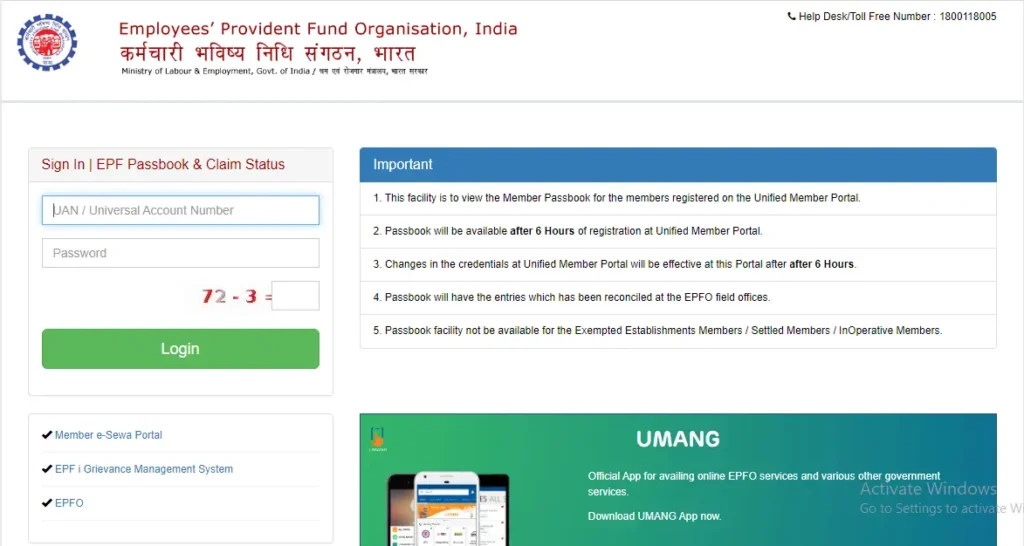
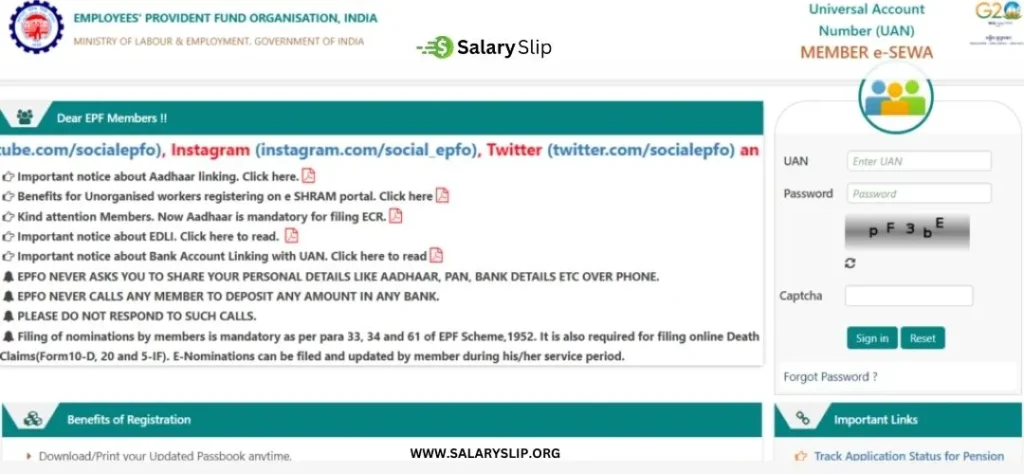
Once you’ve got your UAN, return to the homepage log in by using your UAN password, and fill in the captcha code. This step offers you access to your EPF account.

Login Process

4) Access the Passbook

After logging in, you may find a ‘Download’ section on the main menu. Click on ‘Download Passbook’ to proceed.

5) Select Member ID

Login Process

If you have multiple employers contributing to your EPF, you may need to choose your Member ID. Choose the applicable Member ID from the drop-down list.

7) Download the Passbook

Login Process

When you select your EPF ID, tap on the download button. Your EPF Passbook might be generated in PDF format, which you can save or print.

UAN Registration

Each EPF member has a 12-digit account number, the Universal Account Number, that is obtained by every member and the company upon registration. The UAN and EPF member IDs are linked. This acts as the account’s ID for transactions. Here is the guide to help you perform UAN registration and achieve UAN

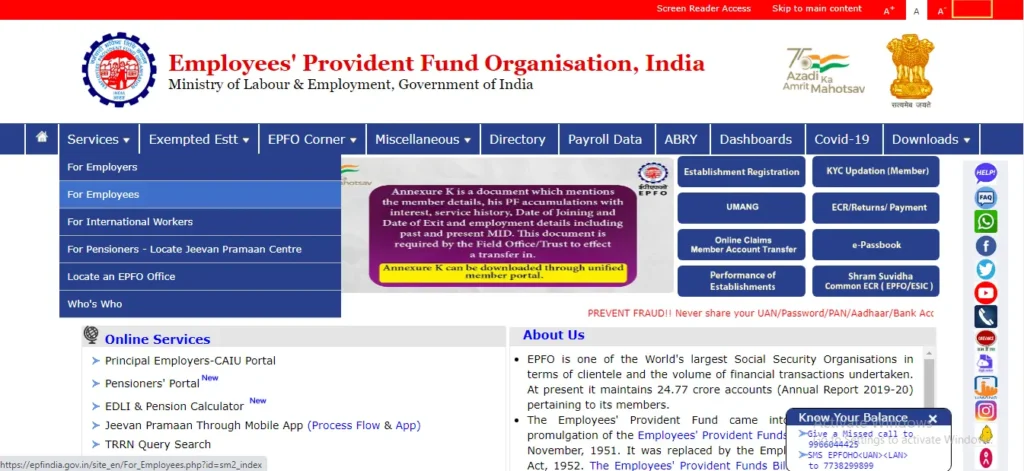
  • Go to EPFO Portal. Move to ‘Services’ at the top navigation panel; a drop-down menu will appear. Select ‘For Employees,’ from the menu, and you will be redirected to another page.
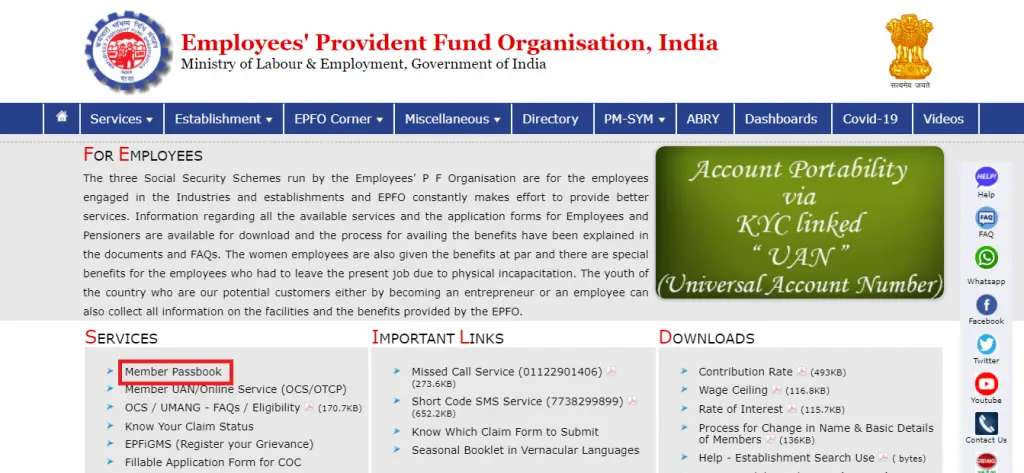
  • On the ‘For Employees’ page, click on ‘Member UAN/Online Service (OCS/OTCP),’ and you may be redirected to a new page.
  • On this web page, click on “get your UAN,’ from the “important links” section.
  • Enter your mobile number, fill in the captcha code, and request OTP.
  • You will receive an OTP on your registered number; enter that OTP to get your UAN number.
  • After validation, you will receive a message with the UAN number and its status on your phone.

Procedure to Activate UAN

Just obtaining the UAN amount is not enough to download your EPFO passbook. You also need to activate your UAN. The steps to activating UAN are given below.

  • Visit the EPFO Portal and choose the ‘Activate UAN’ alternative.
  • Register at the portal by using your personal information, like UAN/member ID, AADHAAR card number, date of birth, name, and phone number, and fill captcha code.
  • An authorization PIN might be sent to the registered number once you’ve entered the vital records and submitted it. To confirm your information, enter your PIN.
  • After PIN verification, your registration on the EPF/UAN portal is completed.

How to Download Your EPF Member Passbook Using the UMANG App

The UMANG (Unified Mobile Application for New-Age Governance) app gives easy access to your EPF Passbook on your mobile. Here’s how you can download it

1) Download the UMANG App

First, you must go to the Google Play Store or Apple App Store and set up the UMANG app. This app offered services associated with EPF (Employee Provident Fund)

2) Registration

After downloading the UMANG app, open it and complete the registration process. It consists of entering your phone number and receiving an OTP (One-Time Password) for verification.

3) Log In

Log in to the UMANG app by using your registered mobile range and OTP.

4) Access Your EPF Passbook

In the app, look for ‘EPFO’ and choose it. Then, choose ‘Employee Centric Services’ and opt for ‘View Passbook.’

5) Enter UAN

Enter your UAN (Universal Account Number) and the required details.

6) Download Your Passbook

Once logged in, you can view and download your EPF Passbook by using the app. It gives you access to maintain tabs in your EPF contributions anytime, anywhere.

Details Mentioned in an EPF Passbook

An EPF Passbook consists of the following details:

  • Establishment ID and Employer’s Name
  • Member ID and Employee’s Name
  • EPFO Name and kind
  • Detailed contributions to EPF (Employees’ Provident Fund)
  • Detailed monthly contributions in the direction of EPS (Employees’ Pension Scheme)
  • Interest in the amount with EPF
  • Monthly deposits and withdrawals by company and employees
  • Date and time of printing of the passbook

Keep in mind that if an employee has maintained one EPF account throughout their employment journey, they will be able to have an EPF passbook. On the other hand, if an employee has multiple EPF accounts, they will get more than one EPF passbook.

Alternative Ways to Check the EPF Account Balance

An e-passbook is the best way to get particular records about EPF transactions and account information. However, if you only want data about the account balance, you can use the given methods.

  • Checking Balance through SMS:- Simply send an SMS to 7738299899 from your registered phone number with the text ‘EPFOHO UAN ENG’ to get your EPF account balance. Please keep in mind that ENG stands for English.
  • Give a Missed Call: Members who’ve registered at the UAN Member Portal can get information about their latest PF contribution and PF balance by giving missed calls to 011-22901406 from their registered mobile numbers.

How is the EPF Passbook Updated

Regular updates are made in your EPF Passbook to reflect the latest transactions. This update generally happens every 6 hours, beginning with the contribution time. This implies that in this era, any contributions made through you or your company might be proven in the passbook. To make certain you are seeing the most recent transactions in your passbook, you have to look forward to this update.

Conclusion

Your EPF Passbook is not just a data-keeping passbook but also a gateway to economic empowerment and retirement readiness. Following the steps mentioned in this blog, you can download your EPF Passbook from the official EPFO website or the user-friendly UMANG app. This access to the passbook helps you to stay updated about your EPF contributions, plan your financial future, and get access to retirement funds. Making it a habit to often check and download your EPF Passbook, is an important key to ensuring that you are in the right direction towards your retirement goals.

FAQs:-

When does the EPF passbook get generated online?

The EPF passbook gets generated in up to six hours after a successful UAN registration at the EPFO internet site.

Who is eligible to download the EPF Passbook?

Only registered EPFO individuals can use the service to view and download their EPF passbook.

Do the EPF passbook entries get proven by EPFO?

All the mentioned entries are reconciled in EPFO discipline workplaces, after which they are updated on the EPF passbook.

How much time will it take for the online updates to reflect on the EPF passbook?

It will take around 6 hours for any changes or updates completed at the EPFO portal to reflect on the EPF passbook.

How to Login to EPFO Member Portal and How to Reset EPFO Login Password

0
EPFO LOGIN

EPFO stands for the Employees Provident Fund Organization, a statutory body established by the Indian government. This organization’s primary work is managing EPF under the Employee’s Provident Fund Miscellaneous Provision Act 1952. Since then, it has been providing its services to its customers. The organization works under the Ministry of Labour and Employment and is known to be a famous organization. This article will discuss the EPFO portal, how to log into it, the registration process, etc.

Process of EPFO Member Login

You can follow the easy steps to register for the EPFO portal. However, here are the quick and easy steps for the registration.

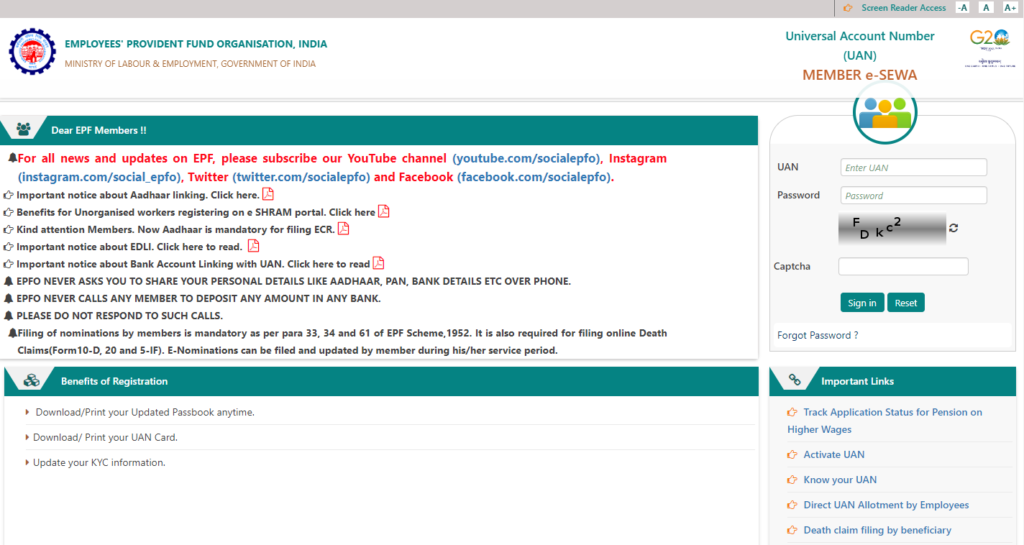
  • First, you have to visit the official website of the EPFO Unified portal, which is given below:

https://unifedportal-mem.epfindia.gov.in/memberinterface

Login Process
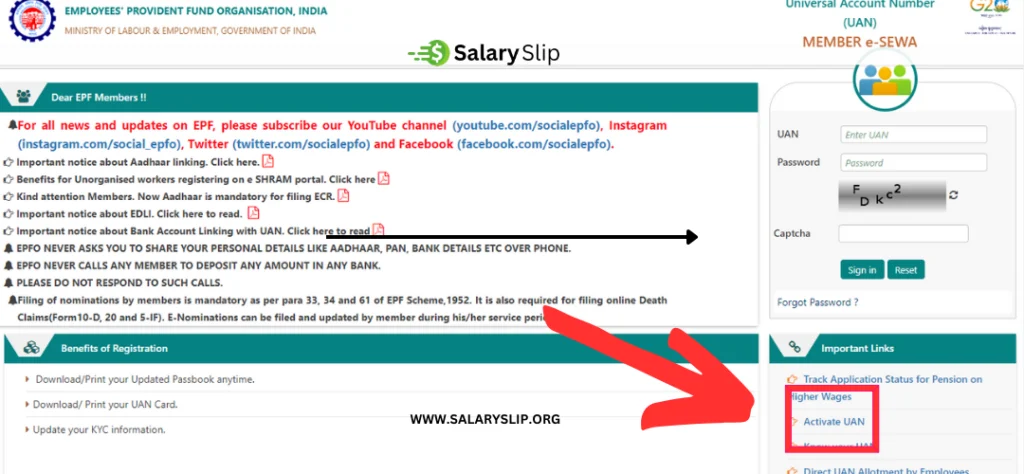
  • Now go to the home page and click on the button to activate UAN, 
Login Process
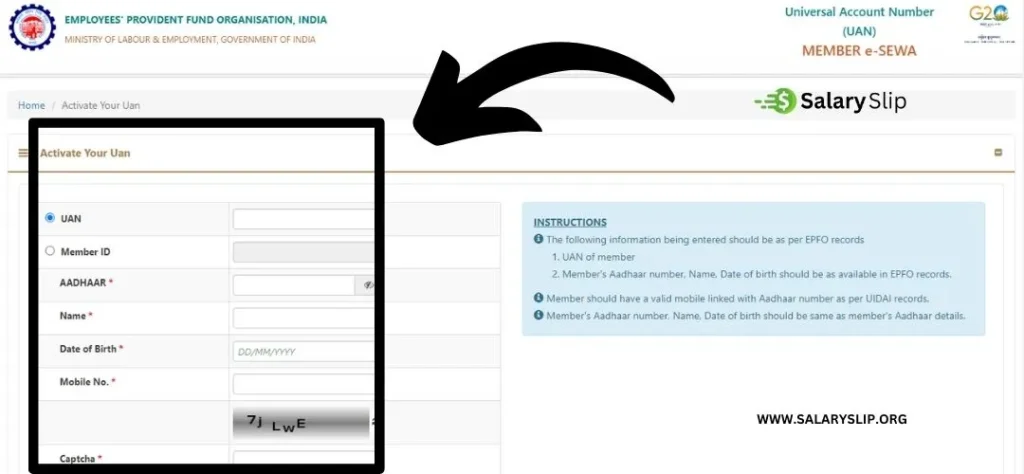
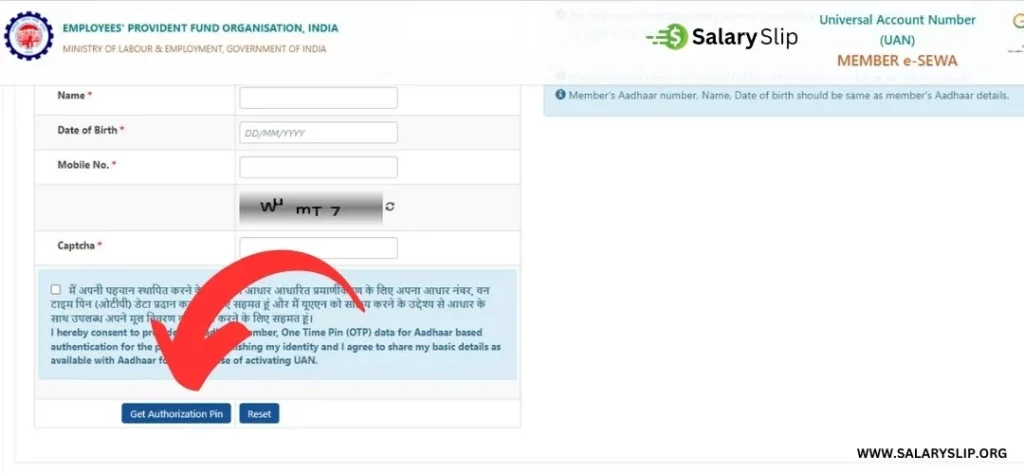
  • Please enter all the necessary details, such as the UAN number, mobile number, and member ID, which our EmployeeEmployee provides. Apart from this, fill in more information like name, date of birth, email ID, etc. 
Login Process
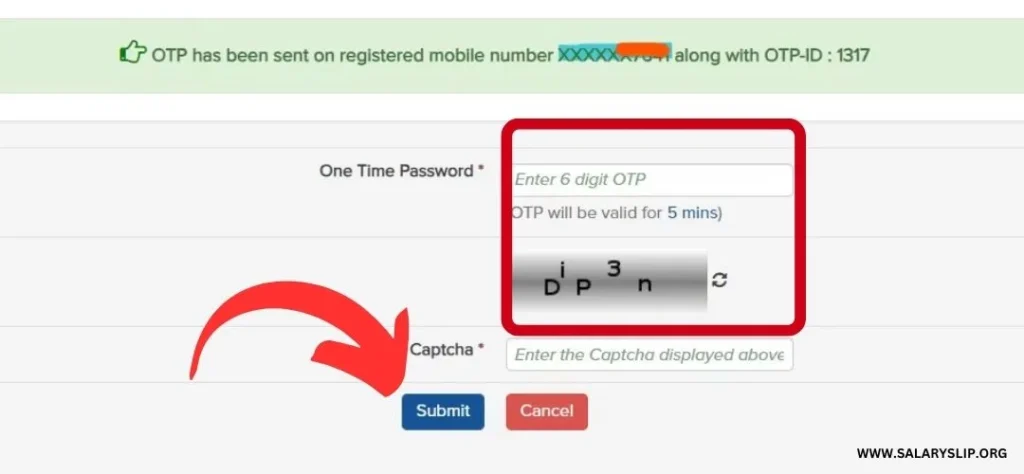
  • After filling in all the necessary details, click on the button ‘GET AUTHORIZATION PIN ’ button, which is given below. After clicking this button, the OTP was sent to your registered mobile number.
Login Process
  • Enter the OTP carefully and click on the submit button. 
Login Process
  • After verification, you need to set a password for your EPF account. 
Login Process
  • After setting a strong password, your account will be activated and you can log in with the help of UAN or password for checking the details. 

How to Change EPFO Password?

We often need help remembering our password, making it challenging to enter into the account. However, you can reset your password easily by following these steps.

  1. To reset your EPFO password, visit the EPFO/UAN member E-Sewa portal and click on forgetting password.
  2. Enter your UAN account and verify it by filling out the correct captcha. 
  3. Now, fill in all the necessary details, such as name, date of birth, and gender, which you registered with your EPFO account. Click on “verify” to confirm identity.
  4. Enter your Aadhar card details and captcha carefully and click ‘VERIFY.’
  5. After all this process, verify your mobile number by verifying the OTP sent to your registered number. 
  6. Click on confirm and reset your password. 

How to Check EPFO Balance Online?

  1. Firstly, you go to the official webpage of EPFO: https://unifedportal-mem.epfindia.gov.in/memberinterface/
  2. Secondly, visit the member passbook page. 
  3. Now, use your UAN password to log into your EPFO account. 
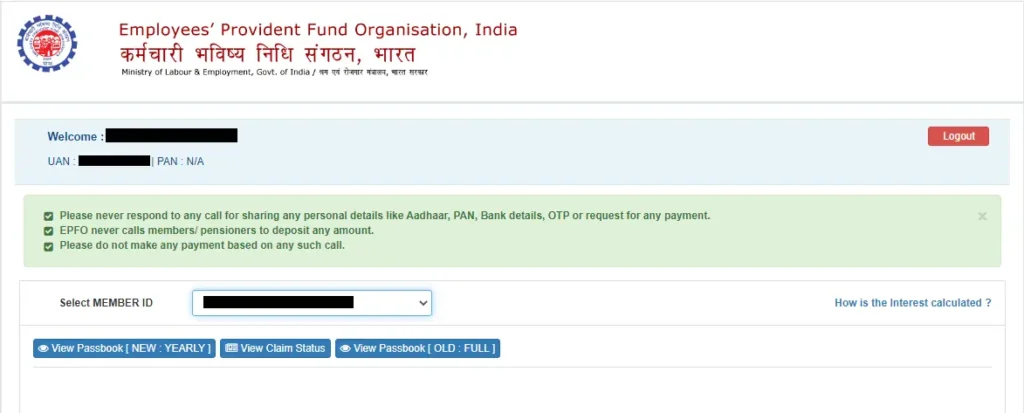
  4. After that, select the member ID that is linked to your EPFO account. 
  5. After you complete all the necessary details, your passbook will be displayed on your screen. 

Also Read:- PF Balance Check With And Without UAN Number | EPFO Benefits & Process

Steps for e-Kyc for EPFO

You can follow the below given steps for updating your e–KYC for EPFO:

  • STEP 1–  Firstly, you need to log into the E-Sewa portal using your UAN and password given by the EPFO.
  • Step 2– Once you log in to the account, go to the manage section, which is visible on the dashboard.
  • Step 3 – Now click “KYC” in the manage section. 
  • Step 4– Now you will be directed to a page where you must enter all your necessary details like Aadhar card, PAN card, driving license, passport, election card, ration card, bank account details, and national population registered details. 
  • Step 5– After adding all the important information, select the checkboxes given to the KYC documents and save the information by clicking the save button.
  • Step 6– After saving all the details, the data will be stored under the “pending KYC” within your account. 
  • Step 7– The EPFO will undertake the verification process for the given KYC details.
  • Step 8– After completing the verification process, your KYC status will be updated.
  • Step 9 – By completing the process, you will receive a notification regarding the updated status of your KYC. 

Steps to claim forms 

If you want to enjoy the facility of claiming forms, then you can follow the below-given steps:

  1. Before taking any steps, you must ensure that your Aadhar is linked with your UAN.
  2. Now visit the official website of EPFO: https://unifedportal-mem.epfindia.gov.in/memberinterface/
  3. It would help if you found a section dealing with claims or withdrawals on the portal’s dashboard. 
  4. Select the form based on your requirements: 
  • Form 31– This form deals with the withdrawal of EPF funds for purposes like housing, medical treatments, or education. 
  • Form 19– deals with the final settlements of EPF funds upon leaving employment. 
  • Form 10c– Deal with the withdrawal of EPS funds. 
  1. After choosing the form, fill in all the necessary details and attach all the essential documents such as bank account details, Aadhar card, or other documents.
  2. Now, submit the claim request through the portal. 
  3. Once the authorities approve your request. The fund will be generated in your bank account.   

Conclusion

The EPF scheme is one of the most beneficial because it encourages the country’s working class to save money. However, anyone can register and participate in this scheme through the EPFO portal. Both employer and employee can opt into this scheme. This article has provided all the details about the EPFO scheme.

FAQs:-

1) What is the complete form of EPFO?

The EPFO stands for the employee’s provident fund. It is an online platform that deals with various activities like pension and insurance schemes in India.

2) Describe key features of EPF.

The critical features of EPFO are employee services, real-time updates, accessibility, helpdesk support, etc.

3) What is the structure of EPFO?

The structure of EPFO consists of 3 schemes:-
1. The Employee Provident Fund Scheme, 1952(EPF)
2. Employees pension schemes 1992(EPS).
3. Employee’s Deposit Linked Insurance Scheme, 1976 (EDLI).

Recommended:-

1.Data Analyst Salary Per Month
2.Veterinary Doctor Salary Per Month
3.Salary Slip Format in Excel
4.Fashion Designer Salary per Month
5.India Post GDS Salary Per Month

PF Balance Check With And Without UAN Number

0
PF balance check

The Employees Provident Fund (EPF) is an important financial plan for millions of employees in India and boosts the stable savings and retirement plan. If you want to know how pf balance check then read our article. Monitoring your EPF balance is essential to ensure accurate contributions and keep your economic future safe. By using your Universal Account Number (UAN), you can easily check the PF balance in your salary slip. There are many ways to check PF balance with UAN Number. You can also check the Provident funds balance without a UAN Number. In this blog, we will tell you a way to check your EPF balance with and without the UAN.

What is EPFO (Employee Provident Fund Organisation)?

EPFO was established in 1951. It is an organization that encourages employees to keep savings for their retirement. This company works under the Ministry of Labour and Employment, Government of India.

Also Read:- What is PF in Salary | What is Medical Allowance in Salary | What is the Dearness Allowance

PF Balance Check

It is important to check your PF balance in various methods, with or without UAN. Here are the methods of checking Provident funds balance 

  • Giving neglected to 9966044425
  • Sending an SMS on 7738299899
  • Using EPFO online portal
  • Using UMANG mobile app

How to PF Balance Check With UAN Number?

To check your EPF balance with a UAN number, you may use the Member Passbook facility given by the Employees’ Provident Fund Organisation (EPFO). After registering at the Unified Member Portal, your passbook might be available after 6 hours.

How to check the PF balance through the EPFO portal?

To confirm your EPF balance, it is important to have your Universal Account Number (UAN) activated by the enterprise. UAN serves as a unique identification number for employment enrolled in EPF scheme, and ensures the seamless online operation of EPFO services, together with withdrawals, and loan programs. After activating your UAN, here are the steps you should follow 

  • Visit the official EPFO Portal.
  • Click on “Member Passbook” in the “Services” section.
  • Log in by using the activated UAN number and password.
  • Select Member ID and tap on the “View passbook option.”
  • Your PF details may appear on your screen.
  • To save the report, use the “Download Passbook” choice to print the passbook.

How to check PF balance by using the UMANG/EPFO app

The government released the Umang/EPFO app to make checking your PF balance convenient. To access the app, members need to complete a one-time registration by using a UAN-registered mobile number. Here’s a step-by-step process for using the UMANG app to check your PF balance

  • Download the UMANG app from either the Google Play Store or the App Store.
  • Find the “EPF” option in the ‘All Services’ tab.
  • Under ‘Employee Centric Service,’ click on ‘View Passbook.’

How can I check my PF balance without a UAN?

Here are a few methods to check your PF balance without a UAN:

  1. Check PF Balance by sending an SMS

You can check the Provident Fund (PF) balance by sending an SMS if you have registered your UAN with the Employee Provident Fund Organisation (EPFO). To complete the process, you can text on 7738299899. “EPFOHO UAN ENG” needs to be covered in the SMS message. The first 3 letters of your selected language, ENG, will be mentioned on your own UAN in this case. English, Bengali, Gujarati, Hindi, Kannada, Malayalam, Punjabi, Tamil, and Telugu are other languages that are supported.

  1. Checking the PF balance by Missed call

You can check your balance by making a missed call when you have finished KYC in your UAN, registered, and activated your mobile phone on the UAN portal. All you have to do is find the phone you registered with your UAN to make a missed call to 9966044425. After that, you’ll send a text message with data about your balance and the latest contribution made to your PF account.

EPF Balance Check through Website – Points to Remember

There are some points that contributors must keep in mind about the EPF balance check by visiting the official website. Some of these are mentioned below. 

  • The person who activated their UAN and registered on the UAN Member Portal can check their PF Balance by this method.
  • The facility of viewing the passbook may be available after 6 hours of registering on the UAN Member Portal.
  • If you have made some adjustments on the UAN Portal, the results will reflect on the website after 6 hours.
  • The passbook will show current entries that have been reconciled by EPFO Field Offices.
  • Exempted Establishments Members, Settled Members, and participants of inoperative money owed will now not be able to view their passbook on the EPFO website.

Is the e-nomination Process for PF accounts mandatory?

The Employees’ Provident Fund Organisation (EPFO) is not mandatory for nomination for PF balance. However, it is suggested to do an e-nomination for the PF account because it helps your nominees to use the EPF account after your death and stabilize your family.

How to Submit an e-Nomination in EPFO?

Here is the step-by-step guide to help you submit an e-nomination to EPFO online 

  • Visit the UAN Member e-Sewa portal.
  • Enter your UAN Number, and password, fill captcha code, and click on the sign-in option.
  • Now, pick the ‘E-nomination’ option under the ‘Manage’ tab.
  • Click on ‘Yes’ to replace the family statement.
  • Now upload the member of the family’s info in the e-nomination form by clicking on ‘Add Family Details’. More than one nominee can also be allowed.
  • Click on ‘Nomination Details’ to declare the total amount of percentage.
  • Next, click on ‘Save EPF Nomination’.
  • Lastly, click on ‘E-sign to generate OTP and submit the OTP acquired on the phone number linked with Aadhaar.

Check PF Balance without a registered mobile number.

Here are the various ways you should follow to check your PF balance without a mobile number 

  • Step 1: Sign in with your UAN and password to the official website
  • Step 2: Select the PF account for which you’d want to view your PF balance, and then click on view PF passbook 
  • Step 3: You may view the worker balance and company balance for your PF account, in addition to the pension amount, in the passbook’s closing column.
  • Step 4: To show every year’s PF contributions, choose the option to view the passbook 

Conclusion 

EPFO has provided various methods for employees to check their EPF balance easily. They can check it with or without a UAN Number. Whether through the UMANG/EPFO app, SMS, missed calls, or third-party apps like M-Sewa, employment can choose the technique that fits their accessibility and convenience, along with a PF balance check without a UAN Number.

However, it’s important to regularly check the PF balance. PF balance is important to a worker’s economic stability, and staying updated will help plan for a secure future. So, it is suggested that you use the above methods, including a PF balance check without a UAN number, and stay updated about your PF balance.  

FAQ’s:-

Is the PF account e-nomination method required?

Although e-nomination of Provident Fund (PF) debts isn’t required by the Employees’ Provident Fund Organisation (EPFO), it is beneficial to do so. By taking this action, you allow your nominees to use the EPF account if you pass away, protecting your family.

Can I use an Aadhar number to check my PF Balance?

To view the EPF balance, you should have your UAN number. It isn’t always possible to check your balance by using your Aadhar card number.

When is the EPF account balance updated?

The EPF balance is updated in your passbook 24 hours after the contribution is made.

Employees Provident Fund (EPF) – EPFO Benefits & Process

0
Employees Provident Fund

The Employees’ Provident Fund, or EPF, is a famous savings scheme that has been added by EPFO under the supervision of the Government of India. The employee and company contribute 12% of the employee’s basic salary and dearness allowance towards EPF. The current rate of interest on EPF deposits is 8.15% p.A. The interest on the EPF is tax-free and can be withdrawn without deciding to buy it. Employees avail of a lump-sum amount on their retirement, which is included with the interest rate.

Individuals can apply to avail of the diverse online services of EPF India through an online portal. The EPF online portal is a user-friendly platform that ensures the flow of services is transparent, efficient, and error-free

What is EPFO (Employee Provident Fund Organisation)?

The Ministry of Labour and Employment established EPFO in 1951. It offers insurance plans for local and foreign people. It is the area’s largest social protection organization for the number of economic transactions.

Also Read:- What is PF in Salary | What is Medical Allowance in Salary | What is a Salary Slip or Payslip

EPF Schemes

EPF contributions encompass numerous schemes, together with

  • Employees’ Provident Funds Scheme 1952 (EPF):- Mandatory for employees with incomes much less than Rs. 15,000 per month.
  • Employees’ Pension Scheme 1995 (EPS):- Provides pension benefits based on provider years and common wages.
  • Employees’ Deposit Linked Insurance Scheme 1976 (EDLI):- Offers lifestyle coverage to contributors with a minimum service duration.

Objectives of EPFO

Here are the main objectives of the EPFO:

  • To ensure every employee has an EPF account.
  • Compliance needs to be facilitated without difficulty.
  • Make companies comply with all of the regulations and rules set by EPFO regularly.
  • To ensure that online services are reliable and to make enhancements to their facilities.
  • For all member accounts to be accessed online without difficulty.
  • Claim settlements are to be reduced from 20 days to 3 days.
  • Promotion and encouragement of voluntary compliance.

UAN and EPFO Portal

All EPF subscribers have online access to their PF bills and may execute operations consisting of withdrawal and checking their EPF balance. EPFO assigns each member a 12-digit number called the UAN. Even if an employee makes adjustments, their UAN remains the same.

The Universal Account Number (UAN) simplifies access to the EPFO member portal. When a member’s role changes, their member ID changes, and the new ID is issued to the UAN.

What are the Services Offered by  EPF Scheme?

EPFO presents various services to businesses and their employees, helping them understand various aspects of the fund. Listed below are some of the services given by EPFO

Online Registration

Employees can easily complete their Online Registration in their Establishments (OLRE) online on the EPFO portal

Generation of UAN Details

Employees can generate their UAN details by using the EPFO online portal and then log in to the UMANG software for easy access to all OF-related data.

Online EPF Subscription

Organisations can easily make the PF bills/subscriptions online

Redressal of Grievances

EPF members can file a complaint in case of queries concerning the agreement of pension, PF withdrawal, transfer of PF, etc.

Online Claims Transfer Status and Passbook

EPF contributors can check the status of their PF claims and/or check/download their PF passbook by using their UAN

Missed Call and SMS Service

Users can get the details related to their PF account (stability, preceding contribution, and so on.) by sending an SMS (Format: EPFOHO UAN to 7738299899) or by giving a missed call at 011-22901406

EPF Member Passbook

EPF Members can easily download their passbook from the official portal. With this, they can check the detailed transaction history related to their contributions and withdrawals from EPF accounts.

Pensioner’s Portal

Employees can get the solutions to all their pension-associated queries together with Pension Payment Order (PPO), pension credit score, passbook details, and so on the portal.

One Employee, One EPF Account

The EPFO portal permits EPF account holders to merge their PF bills, operated/opened by various agencies, with their UAN.

TRRN Query

TRRN stands for Temporary return reference numbers used to check the status of the PF challan price of employees.

Helpdesk

The EPFO member portal offers a helpdesk for all PF-associated queries of the employees.

ECR Portal

ECR ( Electronic challan cum return portal) allows employees to log in to e- sewa portal and create their unique user ID and password. The ECR may be uploaded by employees with digital signatures.

EPF Contribution

The company and the employee make the same contributions to the EPF account, as mentioned below.

Contribution ThroughMonthly Percentage Contributed
Employer12%
Employee12% or 10%
Total24%

Key Points About Employees Provident Fund (EPF) Contribution

Employees Provident Fund EPF

Here are the various key highlights of EPF contribution made by both employees and the company

  • 12% Employer’s contribution consists of 3.67% EPF and 8.33% EPS
  • 10% EPF proportion is valid for the companies where there are 20 or much less than 20 employees /organizations with losses incurred more than or equal to the net worth (at the end of the economic year) /companies declared ill by the Board for Industrial and Financial Reconstruction
  • The total contribution made by the organization is distributed as 8.33% closer to the Employees’ Pension Scheme and 3.67% in terms of the Employees’ Provident Fund.
  • All contributions are updated in the EPF member passbook
  • The contribution made by an employee is going towards the provident fund of the employee.
  • Apart from the above contributions, an additional 0.5% towards EDLI has to be paid through the employees.
  • Certain administration prices towards EDLI and EPF made at the rate of 1.1% and 0.01%, respectively, additionally need to be incurred by the company. This method means that the business company has to make a contribution of a total of 13.61% of the funds toward this scheme.

EPF Eligibility

EPF’s full form is Employees Provident Fund (EPF), a category of Provident Fund Schemes. Here are eligibility criteria given below

  • All states in India can enjoy the provisions of the EPF scheme.
  • EPF account registration is important for salaried employees with a salary of as much as ₹ 15,000.
  • Employees with a salary of more than ₹ 15,000 may also create the EPF account concerned with approval from the Assistant PF Commissioner.
  • Organizations with more than 20 employees can apply for the EPF scheme.
  • Organizations with much less than 20 employees are eligible
  • Employees are eligible to get employee provident fund advantages, such as coverage advantages and pension benefits if they are considered active contributors to the EPF program.

What are the Benefits of the EPF Scheme?

Here is a list of EPFO benefits that an EPF employee member can get

1. Capital Appreciation

The PF online scheme gives an interest on the deposit held with EPF India. Additionally, rewards are given at maturity and ensure the growth of employees’ funds and boost capital appreciation.

2. Corpus for Retirement

Around 8.5% of an organization’s contribution is given to the Employee Pension Scheme. In the long run, the sum deposited toward the employee provident fund builds a healthy retirement corpus. Such a corpus would extend an experience of economic stability and financial independence after retirement.

3. Emergency Corpus

Uncertainties are a part of lifestyles. Therefore, every person needs to store some funds and stay financially stable. An EPF fund acts as an emergency corpus when an individual needs emergency funds.

4. Tax-saving

Under Section 80C of the Indian Income Tax Act, an employee contribution closer to their PF account is eligible for tax exemption. Moreover, funds generated through EPFO schemes are exempted from taxes. Such exemption may be availed as much as a limit of Rs. 1.5 Lakh.

5. Easy Premature Withdrawal

Members of EPF India can avail themselves of the benefits of partial withdrawal. Individuals can withdraw funds from their PF account to fulfill their unique requirements like pursuing better training, building a house, meeting wedding expenses, or availing medical treatment.

EPF Withdrawal Rules

There are three conditions upon which 100% of the EPF may be withdrawn

  1. Upon attaining the age of 58 years
  2. If you’re unemployed for 2 months or more
  3. Upon the demise of the member upon which the complete corpus is given to the nominee

If you want to withdraw from your EPF account earlier than retirement, then there are some terms and conditions that you want to take into account. These conditions are education, purchase of land, marriage, medical emergency, home loan reimbursement, etc.

How to apply for PF in India?

As an employee, your enrolment for EPF occurs at the discretion of your company, and the procedure is completed by your agency. If you’re a company proprietor, and your company wants to sign up under this scheme, you have to meet important eligibility criteria and gather a few documents to complete the process.

To be eligible for this scheme, your company should be a registered agency and need to be involved in the activity mentioned in Schedule 1 of the EPF Act. Apart from that, the minimum employee power of the company should be 20 humans. Once eligible, you can apply for an EPF account with the following documents.

  • A copy of the partnership deed in case of a partnership organization.
  • If your business company is a government or private limited company, you should have a copy of the Certificate of Corporation. You also want to publish a copy of the Memorandum and Articles of Association.
  • If you want to check into your society, you want to post a copy of the registration certificate of your society along with a copy of the guidelines and objectives of the society.
  • Apart from these particular documents, all agencies want to post salary tax documents, PAN details, partition deeds, first salary invoices, salary information of employees, and a copy of the balance sheet.

How to Check EPF Balance?

4 methods help you check your EPF stability

  • Using the EPFO portal – The process of checking your EPF balance through the EPFO member portal is simple. You need to log in to EPFO using your UAN and password. After logging in, you will be able to learn about your EPF stability under the member ID.
  • Using the UMANG app – You can download the UMANG app and carry out the process of checking your EPF balance on your phone. You can also raise and track claims through this app.
  • Using a missed name service – It is easy to check the EPF balance by giving a missed call to the number 011-22901406 from your registered mobile number.
  • Using an SMS service – If your UAN is activated, you could send an SMS to 7738299899 for an EPF status check.

Conclusion

Employees’ Provident Fund (EPF) is an investment scheme operated under the Employees’ Provident Funds and Miscellaneous Act, 1952. The EPF investment scheme is managed by the Central Board of Trustees (CBT) and regulated by the Employees’ Provident Fund Organization (EPFO). In this scheme, an employee needs to contribute 12% of their monthly salary to the fund.

FAQs:-

What are the reasons for an employee to partially withdraw EPF?

An employee can partially withdraw PF for medical purposes, education, marriage, home loan, purchase/ production of immovable goods, or house protection.

Does the calculation of 5 years of regular service consist of the internship time?

No, the 5-year calculation period includes the months when you have been on everlasting funds; however, it does not include the internship period.

Can an employee contribute to the Employee Provident Fund after leaving the company?

No, employees don’t need to contribute to the Employee Provident Fund when they leave their job and company. EPF mandates that a company contributes the same amount as the employee. However, considering a person has left the company, they cannot be considered an employee.

What is PF in Salary? Everything about PF You Should Known

1
what is pf in salary slip

A provident fund is an important retirement savings scheme that provides economic safety to employees. It is a type of investment that requires a worker to set their portion of income aside in a fund so they will use it later to meet their financial needs after retirement. There are different types of provident funds. 

Understanding the different types of provident funds and the way they work is important. In this article, we are going to tell you about provident funds, types of provident funds, its benefits, eligibility, important documents, how to claim PF, etc. So keep reading the article to get complete information.

What is PF in Salary?

PF in income refers to an important contribution made by both employers and employees toward a retirement savings scheme governed by the authorities of India. It is a retirement scheme that is maintained at some stage in the working years to ensure that there are enough funds during retirement.

Having PF in salary slip is beneficial in the future because it helps to create the retirement corpus in which making withdrawals for the total amount is possible after retirement. The amount in the provident fund commonly consists of the company’s contributions and interest rate free from profits tax.

Also Read:- What is Dearness Allowance in Salary Slip | What is HRA in Salary Slip | What is Travel Allowance in Salary Slip

Types of Provident Funds

You can be eligible for different types of provident funds depending on the nature of your employment. Here are the various types of provident funds available in India.

Types of PF

Statutory Provident Fund

Statutory Provident Funds is also known as General Provident Funds (GPF), are set up under Provident Funds Act 1925. It’s supposed to be for authority employees, authorized establishments and universities, railways, and other companies. Eligible employee’s contributions to the SPF or GPF account earn interest on the rate fixed by the government. 

Recognized Provident Fund

This type of provident fund is given to employees of private firms with more than 20 employees. Here, agencies and institutions can either install their own PF or they can choose the option to enroll in an approved scheme. If an enterprise chooses the previous course of action, the PF considers they need to be authorized by the Commissioner of Income Tax (CIT).

Unrecognized Provident Fund

In the above case, if the Commissioner of Income Tax (CIT) disapproves of the provident fund scheme, it was referred to as an unrecognized fund.

Public Provident Fund

This type of provident fund is to be handed to the public. You can invest in a PPF scheme, no matter what the nature of your employment. With this, you can spend money on PPF if you are salaried, self-hired, or maybe unemployed for a time. 

Benefits of Provident Fund

EPF is a retirement scheme that ensures that employees hold enough funds throughout their retirement time. Anyone running for a government or personal business can take advantage of the scheme. After knowing what PF is, you should know about its benefits. 

  • Loan Against the PF: A PF account holder is eligible for a loan against their PF stability under emergencies. However, the debtors have to repay the amount in 3 years of loan disbursal. 
  • Free Insurance: If the employee passes away during employment, they get free coverage of up to ₹ 7 Lakh under the EDLI (Employees Deposit Linked Insurance) scheme. Moreover, the PF account holder has to make a contribution to the insurance premium for the demise cover.  
  • Housing Loan: A PF account holder can withdraw as much as 90% of their overall PF stability for buying or building a new home. According to the EPF guidelines, an account holder also can take a Home Loan to buy land.
  • Partial Withdrawal for Financial Emergencies: Under medical emergencies or different unique situations, the PF account holder can withdraw their PF stability to handle the state of affairs.
  • A Provision for Pension: A PF account holder is eligible to get a pension after 58 years of age. To qualify for the pension, they have to make contributions to their PF account for a minimum of 15 years. The main advantage of the pension comes from the company’s contribution toward the EPF account. It is because 8.33% of their total PF contribution goes to the EPF account, benefitting the employee.

Eligibility Criteria for Employee’s Provident Fund

EPF full form is Employees Provident Fund (EPF), a category of Provident Fund Schemes. EPF scheme is issue to candidates who meet the following eligibility criteria 

  • All states in India can get provisions of the EPF scheme.
  • EPF account registration is mandatory for salaried employees with an income of as much as ₹ 15,000. 
  • Employees with an income of more than ₹ 15,000 can also apply for an EPF account to get approval from the Assistant PF Commissioner.
  • Organizations with more than 20 employees must sign up for the EPF scheme.
  • Organizations with less than 20 employees may join the EPF scheme.

Provident Fund contribution

PF contribution paid by employer and employee is 12% of (basic salary + allowance). Equal contribution is payable by worker and company. In case of institutions which employ much less than 20 employees or meet conditions, as according to the EPF rules, the contribution rate for both worker and the employer is set to 10%. For most employees working in a personal area, it’s the basic salary on which the contribution is calculated.

It is essential that employees’ withdrawal less than Rs 15,000 per month, to become eligible for EPF. As per suggestions in EPF, a worker, whose ‘basic pay’ is more than Rs. 15,000 per month, at the time of joining, isn’t required to make PF contributions. However, an employee who withdraws a pay of more than Rs 15,000 can still become a member and make PF contributions, through consent of the Employer and Assistant PF Commissioner.

How to Calculate PF on Salary?

The Indian government sets up policies to calculate the funds to be allotted to the EPF account. It is assigned to an account in which the employees and the employers deposit the PF amount. Each worker’s PF contains types of contributions: the employee’s and the company’s contributions.

  • The Employee’s EPF Contribution: The employees need to make a contribution 12% in their basic salary and Dearness Allowance every month to the PF account. For example, if an operating person’s basic monthly salary is ₹ 15,000, their monthly contribution towards the EPF account will be 12%, which is ₹ 1,800. 
  • The Employer’s EPF Contribution: Out of 12%, the employer contributes 8.33% to the Employees’ Pension Scheme and the remaining 3.67% to the EPF. Therefore, 3.67% of ₹ 15,000 might be ₹ 550. Therefore, the monthly EPF contribution for an employee income amount of ₹ 15,000 could be ₹ 2,350. 
Contribution ByContribution Per Month
Employee12%
Employer12%
Total Contribution24%

Also Read:- How To Calculate HRA in Salary

How to Calculate PF Amount at Retirement?

Those who want to know how to calculate PF need to follow these steps to determine the total amount they will get at retirement.

  • Enter the employee’s date of birth and retirement of 58 years in the given field.
  • Input the basic monthly salary and the growth in a year.
  • Provide the workers and the company’s contribution amounts.
  • Offer the federal authorities interest rates earned at the EPF balance.
  • Use the EPF calculation system to complete the calculation and get the final result based on this information.

Steps to Claim Provident Fund

To claim the PF online, you need to follow the steps mentioned below 

  • Obtain UAN (Universal Account Number): Log in to the EPFO portal and obtain your UAN if you have not.
  • Check Eligibility: Ensure you meet the eligibility criteria for claiming PF, which include unemployment for more than two months.
  • Fill out Form Online: Log in to the EPFO portal and fill out the PF withdrawal form.
  • Submit Required Documents: Upload necessary documents like an Aadhaar card, PAN card, bank details, and canceled cheque.
  • Track Claim Status: Monitor the status of your claim online on the EPFO portal.
  • Receive Funds: Once authorized, the PF amount may be deposited into your bank account.

Conclusion

Provident funds are a funding price range for long-time financial savings, mainly for retirement. In India, there are different types of provident funds that exist on the basis of employment categories, which include Statutory Provident Fund, Recognized Provident Fund, Unrecognised Provident Fund, and Public Provident Fund. Understanding these funds is vital for effective financial planning and a stable future.

FAQs:-

What is a Provident Fund and the way it works?

An Employee Provident Fund (EPF) is a retirement savings plan for salaried employees who work for a company with 20 or more employees. Overall, the Employee Provident Fund is a good method to save some money for retirement. It also works as an emergency fund if you need money for medical expenses, a wedding, or loan payments.

Is PF mandatory for income below Rs. 15,000?

If you are a salaried employee incomes at least Rs. 15,000 per month (basic salary + dearness allowance), your company is needed to sign up an EPF account for you.

When can I withdraw my PF?

Only once you retire can you withdraw your complete PF stability. Only once you reach the age of 55 will you retire. You will not be able to get your pension in case you retire earlier than reaching this age. However, 365 days earlier than you retire, you may get 90% of your EPF plan.

Tax Benefit To Employee On Medical Reimbursement

0
Medical Reimbursement

Allowances and reimbursements to employees provide many benefits in the corporate world. Among such assistance from the employers, employees also enjoy medical benefits, which include reimbursement of medical costs of the employees, partner, or their children. Such reimbursements are called Medical Reimbursements, under which employers reimburse the share of the health costs incurred by the employees. Exemption of no more than Rs 15,000 is authorized by the Income Tax Act on medical reimbursements generated by the company.

What is Medical Reimbursement?

A lot of health benefits are given to employees these days because they are facing many issues because of their long working hours, work stress & other factors, and medical costs incurred by them. One such benefit given by the company to employees is Medical Reimbursement. It is an arrangement under which employers reimburse part of their medical expenses incurred by the employees. According to the Income Tax Act, the tax exemption is set up to Rs 15,000 on medical reimbursement.

Also Read:- What is Travel Allowance | What is Housing Rent Allowance (HRA) | What is the Dearness Allowance

How does Reimbursement of Medical Costs Work?

The system starts off evolving with obtaining a prescription from a doctor along with a medical or health facility that offers healthcare services. The bill will consist of info such as the name of the service, date, amount charged, and different health-related facts. These bills and prescriptions are then submitted to the company for reimbursement.

Medical reimbursement is a simple and easy way. The employee has to pay for their medical expenses, prepare a bill from the hospital, and submit it to their company for reimbursement. The company will then reimburse the amount paid by employees.

Benefits of Medical Reimbursement

Benefits of Medical Reimbursement

Here are some benefits of medical reimbursement

  •  Covers medical charges: The benefit of medical reimbursement is to reimburse the medical costs that an individual incurs. This benefit offers economic assistance to individuals and allows them to cover the cost of their medical treatments.
  • Tax advantages: Medical reimbursement gives tax benefits. This way, the amount reimbursed will be tax-free under positive conditions.
  • Prevents unexpected economic fees: Medical reimbursement can help people cover unexpected medical costs if they occur
  • Access to quality healthcare: Medical reimbursement helps individuals to get access to quality healthcare facilities without stress about high medical costs. It helps you to get treatments on time without any financial stress.

How Much Amount Can Be Claimed?

The employees can take the tax benefit of the expenditure incurred by a limit of up to Rs 15,000. The exemption is to be effective at the reimbursement of costs that can be incurred on medical payments. An employer can reimburse the amount that is spent by the employee.

Tax Exemption Under Medical Reimbursement

Reimbursement of medical fees is taxable by the government under some conditions. An employee is eligible for tax exemption up to the amount of the medical reimbursement given by the agency. If the amount exceeds the required amount, the more fees are taxable.

What are the eligibility criteria for claiming Medical Reimbursement?

The Income Tax Act possesses some requirements that employees should meet to become eligible for medical reimbursement. Here are the eligibility criteria

  • Certain expenses must have been made for medical treatment through the employee.
  • The amount spent will be for his personal or his family (consists of spouse, kids, parents, and siblings )
  • Such an amount will be issued in the form of reimbursement by the business company.
  • The reimbursed amount by the company should not exceed Rs 15,000 (in the financial year).

How do you claim Medical Reimbursement benefits?

Here are the steps you should follow to claim medical reimbursement

  1. Obtain the desired documents: It consists of the prescription and payments.
  2. Submit the documents to the company or insurance organization: The employees need to post the applicable documents to their agency or insurance enterprise to complete the process of reimbursement.
  3. Verify the documents: The company will check the reimbursement claims and verify that the claims meet the standards for reimbursement.
  4. Approval: Once the documents are verified, the organization or insurance company will approve the reimbursement.
  5. Reimbursement: After approval, the employer or insurance enterprise will reimburse the claimed amount to the employee

Things to take into account about Medical Reimbursement

Here are some important things that employees should know regarding medical reimbursement

  • Timely submission: Submit the reimbursement claim on time to ensure timely reimbursements.
  • Keep records: Maintain records of payments, prescriptions, and other documentation associated with the reimbursement claim. This will assist in case of any discrepancies.
  • Cross-check the claim: Cross-check the reimbursement claims bill and tally them to avoid any discrepancies.

Conclusion

Employees get relief from taxes when it comes to their health. It is important to note that positive eligibility criteria and other necessities should be met to get this exemption under Medical Reimbursement. It is suggested to the employees to keep away from medical allowances with Medical Reimbursement because these are different terms, and other assumptions might carry you under the taxation, leaving you not using a choice but to pay tax, even in case you have an emergency for your health.

FAQs

Can I get medical reimbursement as a part of my salary?

Yes, some employers include medical reimbursement as a part of the salary package. In such cases, the amount of reimbursement is constant and given to the employee every month, quarterly, or annual basis.

Does medical reimbursement get brought in salary?

It depends on the organization’s medical insurance coverage. In some cases, medical reimbursement is given to employees with their salary, whereas in some cases, the employees should submit the medical bills to claim medical reimbursement. In other cases, you may get the reimbursement one after the other from the salary. However, the amount of reimbursement cannot exceed the real medical costs incurred by the employee.

Can I claim medical expenses in my ITR?

Yes, you may claim medical expenses as a tax deduction under Section 80D of the Income Tax Act in a situation with positive conditions.

What is Medical Allowance in Salary? Everything You Need to Know

2
What is Medical Allowance in Salary

Employers offer many health and related advantages to their employees to cover fees incurred on them, their parents, children, or brothers or sisters. These benefits include medical allowance and Reimbursement, etc.

Subsequently, individuals can also avail of medical allowance exemption under the Income Tax Act. With those health advantages, salaried individuals can easily control medical costs incurred in any financial year, especially with the growing role of FinTech software development in managing benefits. 

What is Medical Allowance in Salary?

Medical allowances are allowances that are paid to employees by the company, no matter whether they submit their medical bills or not. On the other hand, medical reimbursements entail reimbursements made to employees against unique medical bills they post.

To benefit from tax incentives, employees have to post monthly bills for medical Reimbursement equal to the incurred costs. Under the Income Tax Act, this allowance isn’t always considered an allowance that qualifies for exemption. As a result, medical allowance is completely taxable. However, employees can declare a tax advantage of as much as Rs. 15,000 below medical Reimbursement by offering valid bills or helping files.

Also Read:- What is Salary Slip? | What is Travel Allowance in Salary? | What is Housing Rent Allowance?

Types of Medical Allowances

Based on the company’s nature and coverage, there are three types of medical allowances, fixed medical allowances, Mediclaim policy, and medical reimbursement.

  • Fixed Medical Allowance: This refers to an amount paid by employers to employees as a part of their salary. Irrespective of whether or not this amount is spent on medical costs or not, it’s taxable. For example, if an employee’s salary consists of a medical allowance of Rs. 5,000, they’ll be taxed if their total salary falls under the taxable salary bracket for that financial year.
  • Mediclaim Policy: Employers regularly provide a Mediclaim policy only for the employee. Employers can declare this amount in their company return.
  • Medical Reimbursement: In this situation, employees are required to submit their medical bills, consisting of the medicine costs, to their company. Employers then reimburse the claims after verifying the medical bills.

How is Medical Allowance Taxed?

Fixed medical allowance stays taxable for any employee even though receiving treatment for ailments includes expenses. This set Reimbursement is taxable monthly under “Income from other assets.” Central government pensioners in India who live in the CGHS region are allowed to receive a set payment of 500 INR, which is also taxable.

Medical reimbursements are exempt from taxation up to Rs. 15,000, although the money was paid before the costs were incurred. If an employee gets a payment rather than Reimbursement for medical services acquired, it will be considered a part of the employee’s taxable salary. On the other hand, a set medical allowance isn’t included in the exemption policy, so it is taxed. Therefore, it is suggested that employees choose medical Reimbursement over filing a fixed medical allowance.

Medical Allowance and Medical Reimbursement

A medical allowance is a defined amount given by a company to the employee irrespective of whether or not the person receives medical treatment and submits bills to give proof of their expenses or not Now, medical Reimbursement occurs simplest while the organization reimburses the employee for the real costs spent. This Reimbursement is available as soon as the employee submits medical bills, which are then verified by the company to ensure that the payments are legal. Furthermore, a charge of medical costs via employers to salaried employees is exempt from taxation.

Eligibility to Claim Medical Expenditure

To claim medical allowance or reimbursements, here are the eligibilities that employees should meet

  • The medical allowance should be covered in the employee’s salary package.
  • You must submit the real medical bills and receipts to your company as proof of your expenses.
  • Medical allowance can only be claimed for yourself or for family members, along with spouse, children, parents and siblings.
  • The limit for medical allowance is set up to Rs. 15,000 per year.

How to Calculate Medical Allowance

The maximum tax benefit which can be claimed by an employee for medical expenditure is Rs. 15,000.

For example:-

  • Kannan, a 30-year-old engineer is eligible to get medical reimbursement of Rs 30,000.
  • Kannan has to provide medical bills worth Rs. 30,000 to claim reimbursements.
  • The tax benefits might be Rs. 15,000, even supposing he submits bills of Rs. 30,000.

How to Claim Your Medical Allowance?

Employees need to provide the following statistics to their employers to acquire medical benefits:

  • Medical costs: Employees need to save files of all medical fees paid for the year. The employees or a member of their family need to be mentioned on the invoices.
  •  Medical certification: Employees need to get a medical file from the medical expert or medical facility where the individuals will get treatment. The certificates need to encompass the patient’s name, the date of hospital treatment, the type of disease, and the cost of the hospital therapy.
  • Claim form: Typically, employers supply employees with a declaration form to complete and send alongside their medical costs and medical certification.

The company will take care of the request for reimbursements and switch the money following the company’s coverage as soon as the employees submit all the essential documentation.

Medical Allowance Exemption

While medical allowance is completely taxable, no tax on medical Reimbursement is possessed up to Rs. 15,000. The exemption by medical costs must be granted even though the fee preceded the incurrence of expenditure. If an employee is given an allowance in preference to Reimbursement for medical treatment overseas, it will be considered part of the taxable factor of the employee’s salary.

Conclusion

This allowance is that an employer will pay its employees, irrespective of whether they’ve submitted the medical bills to claim those costs or not. Employers offer those allowances every month. Employers provide this advantage to ensure the employees’ health and help them meet medical expenses during the economic year.

Frequently Asked Questions

1. Is Medical Allowance Part of the income?

Yes, it is part of the salary. Medical allowance is the amount that an employee gets every month with his pay and falls under the taxable amount.

2. What is the maximum limit of Medical Allowance?

The maximum sum that an employee can also request an allowance for is INR 15,000.

3. Who can claim medical allowance?

Employees who get a medical allowance from their organization as part of their salary package may also claim it in India. However, based on the organization’s policy, the requirements for receiving an allowance may also be imposed.

Police Constable Salary Per Month in India – State-Wise List 2025

0

Police constables are an important part of our state and police force departments. They work under senior officers to boost the safety of the country, save people from crimes, and look at cases. If you’re thinking of becoming a police constable, understanding the job role, skills, qualifications, salary, promotions, and career growth is important. In this blog, we tell you how much a constable earns, what allowances, perks, and benefits they will get, etc. So keep reading this complete article to get information. 

Overview Police Constable Salary

How much a constable makes depends on the job role and region of the posting. The pay scale for Constables recruited by the Staff Selection Commission GD (SSC-GD) is ₹21,700 to ₹69,100. State police departments can also provide slightly different pay scales to constables in their police force. Constables are generally part of pay level 3 and pay band 1. The basic salary for constables is around ₹39,692, in line with the month after accounting for allowances and deductions. The minimum constable pay scale and tiers go through periodic revisions according to the guidelines of the Pay Commission. The above-mentioned pay scale and salaries are according to the 7th Pay Commission.

Police Constable Salary State Wise

As we tell you, the salary of a police constable varies with the place in which you posted. Because of the region’s infrastructure, cost of living, and other factors, their salary varies. Here we talk about the police constable’s salary location-wise 

Delhi Police Constable Salary Structure and Pay Scale

The Delhi Police Constable’s Salary varies from Rs 21,700 to Rs 69,100 Per Month. The candidates can check details of the Delhi Police Constable Salary, and salary structure before joining this field. The salary includes Basic Pay, DA, HRA, TA, Ration Pay, and Grade Pay.

Pay LevelLevel 3
Pay Commission7th Pay Commission
SSC Delhi Police Constable grade payRs 2000
Basic PayRs. 21,700/month
House Rent AllowanceRs. 5208
Dearness AllowanceRs. 6076
Ration payRs. 3636
Traveling AllowanceRs. 4212
Delhi Police Constable Salary Per MonthRs. 40,842

UP Police Constable Salary Structure and Pay Scale

The basic Salary of UP Police Constable posts is Rs. 21,700/Month-. The gross repayment will lie between Rs. 30,000/- to Rs. 40,000/-per month. 

ParameterDetails
Initial Basic PayRs. 21,700/-
Pay ScaleRs. 21,700/- to Rs. 69,100/-
Grade PayRs. 2000
Pay BandRs. 5200 -20200
Gross Monthly SalaryRs. 30,000/- to Rs. 40,000/-
Annual SalaryRs. 4,20,000/- to Rs. 4,80,000/-

Maharashtra Police Constable Salary Structure and Pay Scale

Maharashtra Police Constable refers to a law enforcement officer post in the police department of the Indian state of Maharashtra, responsible for protecting people and imposing the regulations in place. The basic pay for Maharashtra Police constables ranges from Rs. 21,700/- to Rs. 63,100/Month. In Maharashtra, the grade pay for a police salary is Rs. 2,000. The pay stage for a salary is 03, and the pay scale band is PB-2 (Rs 5,200 – 20,200). Here are the complete salary details of the Maharashtra police constable 

CategoryAmount 
Pay Level03
Pay BandPB-1(5200-20200)
Grade Pay2000
Pay ScaleRs.21,700/- 69,100/-
Basic SalaryRs. 21,700/-
Maximum Salary Rs. 69,100/-
Dearness Allowance (DA)Rs 9104/- (42% Of Basic Pay)
House Rent Allowance (HRA)Rs 5859/- (27% Of Basic Pay)
Transport Allowance (TA)As Per Applicable
Other Work AllowanceAs Per Applicable
In Hand PaymentRs. 30979/- per month

Uttarakhand Police Constable Salary Structure and Pay Scale

Uttarakhand Police Constable is a Group C post below Level 3. Uttrakhand Police Constable’s salary lies between Rs. 21,700 to Rs. 69,100 per month. Along with this handsome pay, Constables also get the allowances and benefits. The salary structure of Uttarakhand  Police Constable is as follows.

Pay Level 3 
Basic PayRs. 21,700 per month
Grade Pay Rs. 1800
Dearness AllowanceRs. 3689
House Rent AllowanceRs. 5208
Traveling AllowanceRs. 4212
Ration payRs. 3636
Gross SalaryRs. 38,625

Punjab Police Constable Salary

Candidates who want to be posted at Punjab Police constable posts must undergo the 03 year training period, and the salary may be Rs. 19,900/- per month.

Basic PayINR 19,900
Dearness Allowance17 % of Basic Pay (INR 3,383)
House Rent Allowance24% (INR 5,400)
Conveyance AllowanceINR 1,579

Police Constable Perks and Allowances

According to the 7th Pay Commission Police Constable Salary Slip, applicants can even get perks and allowances together with their salary. Candidates will be subjected to those benefits after they complete their training period. The benefits are given below.

  • Dearness Allowances: This allowance is calculated as a percentage of basic salary and undergoes various revisions based on Changes in CPI.
  • Leave Encashment: Leave Encashment permits employees to transform unused paid leave days into cash. 
  • House Rent Allowance (HRA): House Rent Allowance (HRA) is given to employees to cover their apartment housing fees, specifically if they do not own a residence. The amount of HRA varies depending on factors including the worker’s city of house and is calculated as a percent of the basic salary.
  • Medical Allowance: Medical Allowance is a set amount provided to employees to cover their medical expenses, even though it is taxable.
  • Travel Allowance (TA): Travel Allowance (TA) reimburses employees for travel charges incurred at some stage in official responsibilities or business trips. It can be given as a hard and fast allowance or reimbursed primarily based on actual costs and the company’s guidelines.
  • Detachment Allowance: Detachment Allowance compensates employees for additional costs incurred when quickly working far from their ordinary place of business. It covers prices that include housing, food, and transportation, and it can be provided with a salary.
  • High Altitude Allowance: High Altitude Allowance is provided to employees working in high-altitude regions to possess health risks and soreness associated with such environments.
  • City Compensatory Allowance: City Compensatory Allowance is given to employees working  in towns with better living rates to assist them in maintaining their good lifestyle 

Skills Needed To Become A Police Constable

The following skills will let you become a constable and achieve your career.

  1. Physical health: Having good levels of health and physical stamina is vital for all constables. Besides working on subjects, constables can be required to deploy physical force to catch criminals and other suspects.
  2. Teamwork: Constables are the lowest-ranking police officers and are required to be adept at working in groups, taking action, and following suggestions from senior officers.
  3. Legal and defense information: Constables working in national police departments are required to follow the regulations properly to conduct investigations and gather proof in cases. CAPF constables can also take advantage of historical and navy information in their units.
  4. Ethics and integrity: The role of a constable carries plenty of importance in the country’s police and judicial structures. They need to fulfill the duty calls for high integrity and ethics to ensure equity and justice.

Police Constable Job Profile

The job role and duties of Police Constables encompass a wide range of responsibilities. These consist of:

  • Maintaining Law and Order: As a part of the defense force, Police Constables are geared up with guns to ensure peace and the safety of citizens.
  • Ensuring Passenger Safety: The constable needs to ensure the protection of passengers and take appropriate actions to eliminate any disturbances because of criminals.
  • Safeguarding State Security:  Police Constables play a critical role in keeping the country’s peace, security, and protection.
  • Registering FIR: Constables are responsible for filling up the FIR (First Information Report) in the right way and correctly keeping all important court case-related information.
  • Assisting in Investigations: Constables guide senior police officers in investigating cases, offering help in gathering proof and solving cases.
  • Acting as Security Guards: Constables are responsible for working as protection guards, monitoring assigned territories, and taking important actions to prevent any disruptions in the absence of senior officers.
  • Administrative Tasks: Constables are responsible for completing required office work at the police station, which includes filing reports and updates to their seniors.
  • Additional Duties: Other obligations of Police Constables may also contain police verification, visitor management (if required), VIP safety, and different assigned duties.

Police Constable Promotions

To work in a Police Department, constables must follow the department’s regulations. They normally get promotions to better positions like chief constable or assistant sub-inspector (ASI) after working for years. 

Department ExamsTo be considered for the placement of Sub Inspector, applicants for the Police Constable role may also take the SSC CPO test.
SSC CPO ExamCandidates with at least 30 years of service are eligible for promotion under this technique. Candidates can improve to the rank of Assistant Sub Inspector or Sub Inspector before retiring after 5 years.
Age-based promotion Candidates with at least 30 years of service are eligible for promotion under this technique. Candidates have the possibility to improve to the rank of Assistant Sub Inspector or Sub Inspector before retiring after 5 years.

Police Constable Career Growth

When someone starts work as a Police Constable, they have opportunities to be promoted and get higher task positions. If they work for several years and establish years of service record, they can go to higher positions. Here are the career growth of a police constable and police Constable Salary.

  • Constable: This is the average degree job in the police branch. Constables carry out various duties to maintain law and order.
  • Head Constable: After gaining experience and assembly standards, a constable can be promoted to the rank of Head Constable. They have more duties and may supervise constables.
  • Assistant Sub Inspector (ASI): ASIs have higher responsibilities than constables and head constables. They help senior officers with investigations and different responsibilities.
  • Sub-Inspector: Sub-Inspectors have more authority and oversee ASIs and constables. They are responsible for dealing with cases and maintaining order in their posted regions.
  • Inspector: Inspectors are senior officers who supervise sub-inspectors and control rooms or specialized systems in the police department.
  • ACP (Assistant Commissioner of Police): ACPs are responsible for overseeing more than one police station and ensuring the regulation and order in their areas.
  • DCP (Deputy Commissioner of Police): DCPs are responsible for larger areas in a city or place and are responsible for handling more than one police station.
  • Additional CP (Additional Commissioner of Police): Additional CPs assist the Commissioner of Police and oversee diverse divisions or departments in the police force.
  • Joint CP (Joint Commissioner of Police): Joint CPs help in the management and coordination of regulation enforcement activities across a city or area.
  • Special Commissioner: Special Commissioners keep specialized roles in the police force, along with overseeing essential departments or dealing with demanding situations.
  • Commissioner: The Commissioner of Police is the highest-ranking officer in a city police force. They are responsible for the general management and administration of the police branch.

Conclusion 

Being a Constable in the Police will offer you enough chances to grow in your career. Once you are permanent in the Police branch after the finishing training period of years, you’re eligible for all types of benefits, perks, and allowances. After serving a few years in the police branch, a Constable can get promotions and grow their career. But be sure to get enough information about the Police Constable salary before joining this job.  

FAQ’s:-

1) What is the UP Police Constable Salary?

The monthly basic salary of a UP Police Constable is 21,700/ with an annual salary of INR 260,400.

2) What is the Delhi Police Constable Salary?

The Delhi Police Constable’s Salary varies from Rs 21,700 to Rs 69,100 Per Month.

3) What is the Maharashtra Police Constable Salary?

The basic pay for Maharashtra Police constables ranges from Rs. 21,700/- to Rs. 63,100/Month-.

4) What is the Salary of a Uttarakhand Police Constable?

Uttrakhand Police Constable’s salary lies between Rs. 21,700 to Rs. 69,100 per month.