
Home Blog Page 12

GU iCloud: Complete Login, Registration, and Student Portal Guide for Galgotias University

0
GU iCloud: Complete Login, Registration, and Student Portal Guide for Galgotias University

The GU iCloud is a web-based cloud service for Galgotias University students and staff. It has cloud storage, and students can access academic documents and university materials. The GU iCloud login allows students to manage their assignments, save documents, and collaborate with professors and other students. The portal provides a secure space for the storage of study material, class notes, project reports, etc. It ensures access anytime, anywhere. You get smooth communication with students and faculty, which allows quick updates about classes, schedules, and academic notices. 

What is GU iCloud?

Galgotias University manages a specific cloud service platform known as GU iCloud. The portal’s main structure allows faculty and students to share access to resources and academic resources efficiently. iCloud Galgotias creates collaborative communication opportunities for faculty and students. 

Professors can share lecture material, important notices, and research resources with the students through a portal, and students can upload and manage their assignments. GU iCloud promotes teamwork by allowing students to work virtually together. Overall, the portal simplifies academic resource management, and learning becomes organised and interactive.

iCloud Storage Features from GU

GU Cloud provides users with secure cloud file storage for academic files, project reports, and multimedia content that is accessible from anywhere.

1) Simple Login

For faculty and students, iCloud login provides a straightforward process where university credentials unlock the system.

2) Collaboration Tools

Academic groups work together effectively as a team to improve their output with iCloud GU by working collaboratively while automatically sharing files and messages.

3) Academic Hub

Galgotias University has made accessible e-books, research, and lecture notes to students who log into GU using their University credentials on iCloud. 

4) Compatible on Multiple Devices

All users are able to connect at any time and from any place by using iCloud Login GUI on desktop computers, laptops, tablets, and mobile devices.

Also Read: What is CMA? || What is an EWay Bill? || How to Find Airtel Payments Bank IFSC Code

How can I log into GU iCloud? 

The following instructions can be followed to log into GU iCloud: 

1) Visit GU’s iCloud Portal. 

Users can visit the official GU Cloud site by visiting the browser. 

2) Put Your Details Here 

Once users have logged in with their Galgotias University email address and password, they can access GU iCloud. 

3) Verify Your Identity 

If required, complete the security verification as indicated during the login process. 

4) Go To Your Account

Users can access the cloud once they have logged in. 

After logging in, users can utilize the features of the GU iCloud dashboard, including cloud storage (for up to 160GB), academic resources, and collaboration tools.

Steps to resolve GU iCloud Login Issues

If you have any issues, you can solve them in the following way:

  • You must correctly use your GU iCloud info to properly authenticate your access.
  • It may be enough to clear the cache in your browser before logging in again.
  • If you are trying to recover your login information, you can use the “Forgot Password” link to get your password reset.
  • For additional assistance, contact the Galgotias iCloud support team.

Features of GU iCloud

The key features of GU iCloud are: 

  • Great Security: The university adopts strong authentication measures and advanced encryption protocols to secure the data. 
  • Reliable Cloud Services: iColoud GU offers consistent performance and smooth access to university resources without any hassle or hindrance. 
  • Accessibility & Convenience: The portal is available 24/7, and you can access it on any device, including desktops, laptops, tablets, and smartphones. 
  • Centralized Academic Resources: Students can easily save the lecture notes, assignments, research material, and project files.
  •  Collaboration Tools: The portal allows faculty and students to work in collaboration on various academic projects, share feedback, and exchange files. 

Steps to register for GU iCloud 

Here are the steps to register for GU iCloud:

  •  Once you are on the login page, locate the option to “Sign Up” or “New User”.
  •  Enter your enrollment number that was assigned to you at the time of admission.
  •  Enter mobile number and Email ID.
  •  Create a strong password by following the instructions provided on the portal.
  •  Click the “Submit” button. You will get a confirmation mail on your registered email ID regarding account activation.

Typical Problems & Solutions for iCloud GU

Below are the types of problem and their solutions related to iCloud GU:

 1)  Did you forget your password?

GU Users are able to restore their passwords on the iCloud login page by using the password recovery option. 

2) Not able to log in? 

 Ensure you have a stable internet connection, and ensure you have entered the correct login details. 

4) Is your account locked?  

If you need help as a student, contact Galgotias University IT Support.

Steps to Change Your Password

Follow the steps below to change your GU iCloud password:

  • On the login page, click the “Forgot Password” link.
  •  In the given space, type your mobile number or email ID.
  •  Follow the instructions mentioned in the email to reset your password.

 Getting in Touch with IT Support

For any persistent issues, please contact the IT helpdesk at your university. You will need to provide:

  • Your registration number.
  • A description of the issue.
  •  Any error messages are shown when attempting to log in.

How to protect your Accounts?

The best way to keep your GU iCloud account safe:

  •  Creating Strong Passwords
  •  Use both capital and lowercase letters, numbers, and symbols.
  •  Never use easily guessed information such as your name or birth date.
  •  Protecting Your Login Credentials
  •  Never share your password with anyone.
  •  Always log out of your account immediately when using shared devices.
  •  For better protection, change your password regularly.

Conclusion 

GU – iCloud (GU Cloud, iCloud Galgotias) is an effective method for academic users for a secure cloud service, positively impacting their learning landscape.

All of the information you need to use for the benefits of the academic cloud can be accessed through the official iCloud GU portal. GU iCloud, or GU Cloud, or iCloud GU, is an important app for all students attending Galgotias University. GU  iCloud login can shorten the time it takes to store a document and make it easier for users to collaborate on projects and retrieve academic material.

FAQS

What should I do if I forget my enrollment number?

 You can check your paperwork from the admissions department, or you can contact the university admissions office for assistance.

Can I access GU iCloud from my mobile phone?

 You can access the portal from any web browser. The portal is also responsive from a mobile phone.


How can I change my registered email address?

 You can change your email address by logging into the portal and accessing your personal information.

What if the portal is down at a critical deadline?

Contact IT support as soon as possible. Galgotias University will generally extend deadlines during technical issues.

What is the process to reset the password of my portal?

If you want to reset the password of your portal, you need to click “Forgot password” on the login page. Enter your email ID, and you will receive an Email regarding your password change process.

Recommended:-

1.LPA Full Form
2.PCS Full Form
3.Brock Purdy Salary
4.Full Stack Developer Salary
5.Salary Certificate Format

What is CMA? Full Form, Course Details & Career Scope

0
CMA Full Form
CMA Full Form

Amidst today’s highly competitive business environment, where every penny is being carefully accounted for, CMAs are highly sought after. Their knowledge extends far beyond mere numbers; they are the ones who help firms contain costs, improve productivity, and increase profitability while maintaining quality. It is a leadership role in financial decisions, not merely accounting. It promises a nurturing and well-paying career across the globe. Whether you’re a student exploring courses, a working professional wanting to switch jobs, or just an enthusiast in the financial market, CMA should have crossed your mind. In this blog, from CMA full form, “What is a CMA?” to “How do you become one?”, we’re going to walk through every single step: course details, eligibility criteria, salaries, and industries that can’t exist without CMAs.

Information About CMA Full Form

CMA full form: CMA stands for Certified Management Accountant.

On professional lines, the qualification enables one to handle accounting activities in the corporate sector, including the strategic planning of finance, cost control, performance evaluation, and budgeting. In short, a CMA is someone who analyzes, controls, and accounts for costs to help companies operate more efficiently.

It is not something that can be obtained with your normal accounting degree or ordinarily a CA (Chartered Accountant). CA, on the other hand, focuses mostly on audits, taxes, and statutory compliance, whereas CMA handles internal costing and helps management make decisions.

The new developments in BCom programs are also aligning more with professional courses like CMA as commerce education changes, contributing to the early development of strategic and useful financial skills in students.

What is CMA and Why Is It Important Today?

Though there is still uncertainty as to what exactly CMA is. The Institute of Cost Accountants of India (ICAI) offers this certification to anyone intending to specialize in becoming a Certified Management Accountant.

The demand for CMAs is higher today as companies become efficiency-focused and data-driven. Every company, whether it is a start-up or a multinational, needs to have expert knowledge in controlling costs and maximizing profit margins.

This is where the CMA certification comes in; it teaches you how to play a strategic role in business choices in addition to providing you with the technical expertise.

Also Read:- IPS Salary Per Month in India || GDS BPM Salary After 3 Years

Course Details of CMA in India: CMA Full Form, Eligibility Criteria, Fees, Exam Fees, and Pattern

As we know the full form of CMA is Certified Management Accountant. Let’s examine the specifics of CMA courses offered in India.

The CMA course is divided into three levels:

1) Foundation Course (for those who have finished 12th grade): 

Advice: After completing your 12th grade, you can enroll in an arts and science college to establish a solid foundation before starting the foundation course.

2) Intermediate Course: 

Students with a graduation degree or those who have finished the Foundation are eligible for this level.

Group I

  • Financial Accounting (FAC)
  • Laws and Ethics (LNE)
  • Direct Taxation (DTX)
  • Cost Accounting (CAC)

Group II

  • Operations Management and Strategic Management (OMSM)
  • Cost & Management Accounting and Financial Management (CMFM)
  • Indirect Taxation (ITX)
  • Company Accounts & Audit (CAA)

3) Final Course: 

Every level builds on the one before it, covering a broad range of topics from financial planning and cost management to economics and regulations.

Group I

  • Corporate Laws & Compliance (CLC)
  • Strategic Financial Management (SFM)
  • Strategic Cost Management – Decision Making (SCMD)
  • Direct Tax Laws and International Taxation (DTI)

Group II

  • Corporate Financial Reporting (CFR)
  • Indirect Tax Laws & Practice (ITP)
  • Cost & Management Audit (CMAD)
  • Strategic Performance Management and Business Valuation (SPBV)

What is the Eligibility for the CMA Course?

All three levels of the CMA test have different eligibility requirements. The eligibility requirements for all three levels of CMA courses are listed in the area below.

1) Eligibility Criteria: CMA Foundation

  • Completed Class 10 or its equivalent, then Class 12 or its equivalent
  • If they have passed the AICTE or another recognized board’s National Diploma in Commerce Examination.

2) Eligibility Criteria: CMA Intermediate 

  • Passed the Institute of Cost Accountants of India’s (ICAI) Foundation or entry-level Common Admission Test (CAT) or its equivalent, the SSC
  • Any stream of graduation (except fine arts)
  • The eligibility requirements for the CMA course would be met even by students who are awaiting results.

3) Eligibility Criteria: CMA Final

  • Students who have completed their intermediate level of study in any course (except fine arts) and passed in each of the eight course papers at the Intermediate level. 

Certified Management Accountant (CMA Full Form): CMA Course Fees and Duration

Twice a year, in June and December, the entrance exam, known as the CMA exam, is administered. Students can apply before January 31 of the same year if they want to take the June exam. For the December exam, the last date of application is July 31.

CMA Course Fees

CMA Fee TypeCMA Fee Amount
Cost of ProspectusINR 250
CMA course FeeFee for the CMA Foundation course: INR 6,000At the time of registration, the CMA Intermediate course price is INR 23,100 or INR 12,000; the remaining balance must be paid by January 31 and July 31 for the June and December term exams.When registering, the CMA final course price is INR 25,000 or INR 15,000; the remaining amount must be paid by January 31 and July 31 for the June and December term exams, respectively.

About the CMA Exam

To be qualified for the next part of the full course, candidates enrolled in any of the three CMA courses must take the institute’s exam. The CMA exam is conducted by ICMAI twice a year, in June and December. Depending on their qualifications, candidates have the right to appear for either of the two sittings. The CMA exam is conducted by ICMAIICMAI conducts the CMA exam, and it should be t should be completed by a given time for the upcoming session; candidates must submit their CMA exam forms with payment of the fee.

CMA Exam Fees

The CMA exam fees for the Foundation, Intermediate, and Final tests are listed in the table below.

CMA CourseCMA Exam Fee for Inland Centre Preference (in INR)CMA Exam Fee for Overseas Centre Preference (in USD)
Foundation120060
Intermediate1200 (for one group)2400 (for two groups)90
Final1400 (for one group)2800 (for two groups)100

CMA Exam Pattern

The table below mentions the CMA exam pattern for Foundation, Intermediate, and Final exams

CMA Exam Pattern FeaturesCMA Foundation Exam PatternCMA Inter Exam PatternCMA Final Exam Pattern
Mode of examOffline Centre-Based TestOffline Centre-Based TestOffline Centre-Based Test
Type of questionsObjectiveSubjectiveSubjective
Total marks100 (each paper)100 (each subject)100 (each subject)
CMA exam duration120 minutes180 minutes180 minutes
Number of groups–22
Number of subjects44 (in each group)4 (in each group)

CMA vs Other Courses (An Important Comparison) 

Let’s address a frequently asked question: what distinguishes CMA (Certified Management Accountant: CMA Full Form) from other well-known commerce certifications?

CourseFocusDurationJob Roles
CMACertified Management Accountant3–4 yearsCost accountant, financial analyst
CAAuditing & taxation4–5 yearsAuditor, tax consultant
CSCorporate law & compliance3–4 yearsCompany secretary, compliance officer
CPA (US)General accounting (US GAAP)1.5 yearsAuditor, financial controller

Although each course offers advantages of its own, CMA is the best choice for people who like efficiency, strategy, and management-level finance positions.

Is Becoming CMA a Better Career Choice?

For people who are interested in finance, being a Certified Management Accountant (CMA) can be a great career choice. The following are some noteworthy advantages of being a CMA:

  • Effective Way to Become Qualified: In comparison to other certifications like CA and CS, the CMA qualification is sometimes thought to be quicker and simpler.  The CMA course is a more accessible choice because it usually takes 3–4 years to finish and covers fewer chapters.
  • Increased Potential Salary: CMAs typically earn roughly 7 lakh per year, which is more than their CA colleagues’ 6 lakh. An attractive financial package is also a result of performance-based incentives.
  • Global Opportunities: Finding work overseas is made simpler by pursuing a CMA degree.  Relocating abroad is made easier by passing tests like the ACCA and CMA USA, which provide access to global professional opportunities.
  • Values and Ethics: By instilling fundamental ethical standards, the Certified Management Accountant program helps people focus on important business skills and earn more than non-certified professionals. Those who pursue CMA will also become more desirable to top employers for promotions and employment.

Future Career Scope of CMA

Because of their versatility and cross-industry applications, CMA skills find use in almost every industry. The CMA pathway is considered lucrative as well as an easy path with terms to career. With opportunities around the world, it also fosters development on a personal level-to their advantage, therefore enhancing one’s worth as an employee and as an organizational asset. A CMA student may choose to specialize in several sub-disciplines, including:

  • Chief Financial Officers: Being a CFO is seen as a high-level position where one can succeed in the company and support a CEO. Usually, CFOs are in charge of all financial reporting and forecasting tasks.
  • Management Accountant: In the field of certified management accounting, management accounting is an important subfield.  These experts help business managers make well-informed decisions by handling planning, budgeting, and strategizing.
  • Financial Advisor: To guarantee the feasibility of possible investments, financial managers are essential in evaluating their financial circumstances.  During financial study and analysis, these managers also counsel companies on issuing corporate bonds or dividing stock.
  • Chartered Accountant: One of the most prominent positions in the field of certified management accounting is generally considered to be a chartered accountant. Typical duties include completing business tax reports, auditing financial statements, and giving financial advice.
  • Accounting Manager: Accounting managers are in charge of creating and maintaining the accounting processes and systems that other professionals in the field use to gather and examine data. These experts frequently work for big businesses or organizations and supervise other accountants.

Is CMA the Right Option?

This is a basic checklist:

  • You enjoy working with statistics and figures.
  • You are into financial planning and business strategy and would rather analyze procedures than merely keep track of the transactions.
  • You can readily adapt to professional tests and be available for long study sessions.

CMA (Certified Management Accountant: CMA Full Form) might be the ideal choice for you if that describes you. Additionally, it enhances your academic understanding if you’re already working toward a degree in business.

FAQs 

Q1. What is the Full form of CMA?

Ans- Certified Management Accountant is what CMA stands for.

Q2. Who Conducts the CMA Course in India?

Ans- In India, the CMA course is offered by the Institute of Cost Accountants of India (ICAI).

Q3. How many Levels are there in the CMA Course?

Ans- There are three stages in the CMA course: Foundation, Intermediate, and Final.

Q4. What is the Average Salary of a CMA in India?

Ans-  In India, a CMA normally makes between Rs. ₹7 and ₹8 lakh annually.

Q5. Is CMA Recognized Internationally?

Ans- Indeed, CMAs have access to international employment prospects in management and finance.

Read More:

1.SDM Salary in India
2.BCA Salary in Inida
3.16 LPA in Hand Salary
4. Airtel Payments Bank IFSC Code 
5.How to Check PF Balance Online

Pacman 30th Anniversary: History, Google Doodle Game, and How to Play Online

0
Pacman 30th Anniversary

Google marked the 30th anniversary of Pac-Man in 2010. Pac-Man emerged as the world’s beloved arcade sensation and transformed its homepage into a completely playable game. This was the moment for celebration, not only for gaming history, but Pac-Man was also introduced to a new generation through Google Doodle. It is still remembered as one of the most successful and amazing web experiences.

Information About Pacman 30th Anniversary History

Pac-Man was developed on 22nd May 1980 by Toru Iwatani at Manco. The very first test was carried out in Shibuya, Tokyo. The introduction of Pac-Man redefined arcade gaming with its maze-chase mechanics, nonviolent gameplay, and easily recognizable characters.
Pac-Man gained popularity quickly and became a cultural juggernaut. It made up 1/3rd of all the arcade machines in North America by 1982, in just 2 years of launch. By 2009, Pac-Man had sold 300 million units across the world, and more than 1 billion people had played Pac-Man by 2010. All these achievements made Pac-Man the world’s most widely played video game
Pac-Man’s popularity was not just confined to arcades, but the Pawned machine, TV Shows, comics, and even cartoons used it. The innovative design and amazing experience of Pac-Man inspired generations of games and became popular in pop culture.

Pacman 30th Anniversary Celebration 

Google introduced its first-ever interactive doodle, “Pac-Man game” on 21st May 2010. It transformed the homepage logo into a classic maze. With Ms. Pac-Man for 2 players, used to start with clicking “insert coin” and clicking again (using WSAD for player 2). The playable doodle remained live for 49 hours and included the famous “kill screen” at level 256.

Google’s team, including Ryan Germick, recreated the login, sounds, graphics, and distinct personalities of the original game, along with original bugs such as corner-cutting behaviours, which made it a faithful recreation of the arcade classic.

Pac-Man Doodle became popular instantly and attracted more than 1 billion players within a few days of launch. The remarkable success of the doodle shows how nostalgia spreads through the world and reshapes the digital celebration for Pac-Man.

Also Read: Railway TTE Salary in India || Veterinary Doctor Salary in India

Pac-Man Doodle Impact on Gaming

The Pac-Man Doodle completely transformed the online gaming world with its amazing features:

  • Innovation and Interaction: It marked a new era for Doodles, introducing the moving, playable experience that was beyond static artwork.
  • Cultural resonance: It was not just about nostalgia; the Pac-Man Doodle served as the bridge to fill generational gaps and unite newcomers and original fans.
  • Technical Marvel: The Pac-Man Doodle was powered by open web standards such as HTML5 and JavaScript and delivered smooth, plugin-free gameplay.
  • Architectural achievements:Joining the original arcade gameplay, glitches and all, into a new web browser was an amazing technical advancement, which players enjoyed and praised a lot.

How to Play Pac-Man online?


You can easily play Pac-Man online without downloading anything. Here’s how to play it:

1) Use Google Search

  1. Open Google on your device
  2. Search “Play Pac-Man” or “Pac-Man Google doodle”.
  3. The very first result on the page will show you this amazing interactive game.
  4. Click on the “Play” or “Insert Coin” option to play the game.
  5. You can use your arrow keys if you are using a desktop, or the swipe option on mobile, to move Pac-Man through the maze.

2) Visit Google Doodle Archive

  1. Go to https://www.google.com/doodles
  2. Search Pac-Man 30th Anniversary (21st May 2010)
  3. Click on the game and play directly using your browser, without installation.

3) Mobile apps

  • Using your app store or Google Play Store, download the official Pac-Man app on your device.
  • Play the classic and updated versions using your phone.

Also Read:- What is an EWay Bill? || Loco Pilot Salary || SSC CHSL Salary

Gameplay Mechanics & Tips

Here are the important gameplay mechanics and tips for you:

  1. Objective & Rules: The player’s goal is to eat all pellets while avoiding ghosts (Blinky, Pinky, Inky, and Clyde). The 4 power pellets help you to flip the script and eat the ghost for bonus points. Clear all dots to move on next level.
  2. Level progression & Kill Screen: In every new level, difficulty increases, goats become faster, patterns are more challenging, and mazes become tighter. The famous level 256 kill screen crashes the game, and many doodle versions copied this bug.
  3. Insider’s tips: Google’s version has imitated the subtle corner-cutting quirks from the original version. You can maximise the ghost points 200, 400, 800, 1600 by timing pellet use when many ghosts are nearby. The experienced and advanced players crack the ghost AI behaviors like Blinky chasing vs Pinky ambushing, and avoid possible captures. You can attain 3,333,360 points by eating everything in all 255 levels.

Facts about Pac-Man

Here are the fun facts for the Pac-Man game for the gaming enthusiasts:
Pac-Man’s shape was inspired by a pizza with a missing slice.
The ghosts show unique AI behaviour.
The real name was “Puck-Man”, but it was renamed for Western audiences.
The creator of Pac-Man was Toru Iwatani, a designer at Namco.
Each ghost has unique behaviour, such as Blinky, the red ghost, who chases Pac-Man, Pinky, the pink ghost, who tries to ambush Pac-Man, Inky, the blue ghost, who acts according to Pac-Man and Blinky’s position, and Clyde, the orange ghost, who moves randomly.

Conclusion

Pac-Man’s 30th Anniversary is an example of how powerful nostalgia can drive engagement in the digital world. Google’s pliable doodle replenished a gaming classic in browsers, and bridges decades of players.
Whether you are reliving childhood memories or discovering a Pac-Man experience for the first time, you can immerse yourself in the amazing experience of the maze, chasing ghosts, and marvel at how 35 seconds of gameplay contain lots of history.

FAQs About Pacman 30th Anniversary

Is Pac-Man Google Doodle still available to play?

Yes, you can play Pac-Man Google Doodle on Google with simply the top result on search.

Does Pac-Man doodle charge any fees?

No, Pac-Man doodle doesn’t ask you for any amount. It’s completely free and no download is required.

How to control the Pac-Man in the Doodle version?

To control Pac-Man in the doodle version, use the arrow keys on a computer and swipes on mobile.

Can I add my friend to the play?

Yes. The “insert coin” option will allow 2 players into the gameplay. Player 2 has to use WASD keys to control Pac-Man.

What is the Pac-Man kill screen?

The Pac-Man kill screen is a programming bug that occurs at level 256, where the game crashes. The Doodle version also has the same glitch.

Recommended:-

1NSG Commando Salary 
2Google CEO Sundar Pichai Salary
3BSc Nursing Salary Country-Wise
4LPA Full Form
5Air Aisa CEO Salary Per Month

Freelance Jobs vs. Full-Time Work: How Commission-Free Platforms Affect Your Earnings

0

The decision between freelancing and traditional employment has never been more complex—or more important for your financial future. The earning potential gap between these career paths is widening in unexpected ways, largely due to technological advances and platform innovations that are transforming how freelance income works.

The Traditional Income Comparison

Historically, full-time employment offered predictable benefits: steady paychecks, health insurance, retirement contributions, and paid time off. These benefits created a significant value gap that freelancers had to overcome through higher hourly rates. A full-time developer earning $80,000 annually might need to charge $60-70 per hour as a freelancer to achieve equivalent total compensation.

This calculation has shifted dramatically. The value of traditional employment benefits has eroded while freelance earning potential has increased substantially. Let’s examine the real numbers.

The New Freelance Mathematics

Higher Effective Rates: Skilled freelancers now routinely earn 40-60% more per hour than their full-time counterparts. A senior developer who might earn $50/hour in traditional employment can often charge $75-90/hour for freelance jobs.

Reduced Platform Costs: Traditional freelance platforms charge 10-20% commissions, significantly reducing take-home pay. Freelancing without any commissions eliminates this overhead entirely, effectively increasing freelancer earnings by 10-20% immediately.

Geographic Arbitrage: Freelancers can live in lower-cost areas while earning rates from expensive markets. A developer living in Austin but serving Silicon Valley clients can achieve a lifestyle that would cost twice as much in California.

Tax Advantages: Freelancers can deduct home office expenses, equipment costs, professional development, and travel expenses. These deductions often reduce effective tax rates below what W-2 employees pay.

Real-World Income Scenarios

Let’s compare realistic scenarios for a software developer with 5 years of experience:

Full-Time Employee in Major City:

  • Salary: $120,000
  • Benefits value: ~$30,000
  • Total compensation: $150,000
  • After taxes and living expenses: ~$85,000 disposable income

Freelancer on Commission-Based Platform:

  • Rate: $75/hour
  • Billable hours: 1,800/year
  • Gross: $135,000
  • Platform fees (15%): -$20,250
  • Net: $114,750
  • After taxes and expenses: ~$75,000 disposable income

Freelancer on Commission-Free Platform:

  • Rate: $75/hour
  • Billable hours: 1,800/year
  • Gross: $135,000
  • Platform fees: $0
  • Net: $135,000
  • After taxes and business deductions: ~$95,000 disposable income

The commission-free model creates a $20,000 annual advantage over traditional platforms and $10,000 advantage over full-time employment—while offering significantly more flexibility and control.

The Hidden Costs of Full-Time Employment

Traditional employment includes costs that don’t appear on salary statements:

Commuting Expenses: The average American spends $5,000-8,000 annually on commuting costs, plus 250+ hours in transit.

Professional Wardrobe: Office-appropriate clothing costs $2,000-5,000 annually compared to casual freelance attire.

Meal Costs: Eating lunch out daily costs $2,500-4,000 annually versus cooking at home.

Opportunity Costs: Fixed schedules prevent freelancers from taking advantage of peak demand periods when they could earn premium rates.

Geographic Limitations: Job locations often force employees to live in expensive areas, increasing housing costs substantially.

The Freelance Income Ceiling

Perhaps the most significant difference between freelancing and employment is the income ceiling. Full-time salaries have built-in caps—even senior developers rarely exceed $200,000 in most markets. Freelance income has no such limitations.

Experienced freelancers often develop multiple income streams:

Direct Client Work: High-value project work at premium rates Consulting: Strategic advisory work that commands $150-300/hour Digital Products: Courses, templates, or tools that generate passive income Equity Participation: Some clients offer equity stakes for ongoing work

Top freelancers routinely earn $300,000-500,000 annually—levels that are virtually impossible in traditional employment outside of executive roles.

The Security Myth

Traditional employment is often perceived as more secure, but this perception is increasingly outdated. Mass layoffs in tech, finance, and other sectors have demonstrated that full-time employment offers limited security. Meanwhile, successful freelancers often enjoy greater stability through:

Diversified Client Base: Income from multiple sources reduces risk from any single client relationship ending.

Portable Skills: Skills and client relationships travel with the freelancer, unaffected by corporate restructuring.

Market Demand: High-demand skills create consistent opportunity regardless of economic conditions.

Financial Cushions: Higher effective earnings allow freelancers to build larger emergency funds faster.

Platform Economics and Your Bottom Line

The platform you choose dramatically affects your earning potential. Traditional platforms like Upwork and Fiverr charge substantial fees that compound over time:

Commission Fees: 10-20% of every project reduces your effective hourly rate significantly.

Payment Processing: Additional 3-5% fees on top of commission charges.

Subscription Costs: Many platforms charge monthly fees for premium features.

Withdrawal Fees: Charges for transferring earnings to your bank account.

A freelancer earning $100,000 annually on a traditional platform might pay $15,000-25,000 in various fees. Commission-free platforms like Jobbers.io eliminate these costs entirely, allowing you to negotiate payment terms directly with clients and keep 100% of your negotiated rates.

The Benefits Equation

The benefits gap between employment and freelancing continues to narrow:

Health Insurance: Freelancers can often find competitive health insurance through professional associations or marketplace plans.

Retirement Savings: SEP-IRAs and Solo 401(k)s often allow freelancers to save more for retirement than traditional 401(k)s.

Professional Development: Freelancers can deduct training costs and often learn faster through diverse project exposure.

Flexibility Benefits: The ability to control your schedule, location, and client relationships has significant quality-of-life value.

Making the Transition Strategically

For professionals considering freelancing, the financial transition can be managed strategically:

Start Part-Time: Begin freelancing while employed to build client relationships and test earning potential.

Build Emergency Fund: Save 6-12 months of expenses before making the full transition.

Develop Pricing Strategy: Research market rates and factor in all costs when setting prices.

Choose Platforms Wisely: Prioritize platforms that maximize your take-home earnings through low or no commission structures.

The Freelance Platform Advantage

Modern freelance platforms that don’t charge commissions create several advantages:

Higher Net Earnings: Keep 100% of negotiated rates instead of losing 10-20% to platform fees.

Direct Client Relationships: Build stronger relationships without platform interference, leading to better long-term opportunities.

Flexible Payment Terms: Negotiate payment schedules, methods, and terms that work best for both parties.

Reduced Administrative Overhead: Less complex fee structures mean simpler bookkeeping and tax preparation.

The Long-Term Financial Picture

Over a 10-year career span, the financial advantages of strategic freelancing compound significantly:

Higher Annual Earnings: 20-40% higher effective income compared to employment Faster Wealth Building: Higher earnings plus tax advantages accelerate investment growth Multiple Income Streams: Diversified revenue sources provide both stability and upside potential Geographic Flexibility: Ability to optimize living costs while maintaining earning power

The Bottom Line Decision

The choice between freelancing and full-time employment ultimately depends on your priorities, risk tolerance, and career goals. However, financial mathematics increasingly favors freelancing for skilled professionals, particularly when using commission-free platforms that maximize take-home earnings.

For those willing to embrace the entrepreneurial aspects of freelancing—client development, project management, and business operations—the financial rewards can be substantial. The key is approaching freelancing strategically, with a clear understanding of the true costs and benefits compared to traditional employment.

The freelance economy isn’t just about flexibility and autonomy—it’s increasingly about financial optimization and wealth building in ways that traditional employment simply cannot match.

16 LPA in Hand Salary: A Complete Guide

0
16 LPA in Hand Salary: A Complete Guide

For Indian professionals, getting a gross salary of 16 lakh per annum (LPA) is quite a groundbreaking affair; however, deductions, taxes, and contributions by the employer may largely change the actual in-hand salary. The understanding of such differences is fundamental in long-term financial planning, budgeting, and evaluating the real worth of a benefit package. 

We discuss the major factors like tax slabs, Professional Tax (PT), Provident Fund (PF), Employee State Insurance (ESI), and any other deductions that factor into converting the gross 16 LPA into an actual in-hand salary; we will also discuss other pay scales, ways of optimization, and comparisons with other income brackets of a similar range (for instance, 14 to 18 LPA). This guide will help you put numbers in perspective-whether you are evaluating job offers, planning your savings, or even lifestyle planning based on take-home pay. So, here we go.

16 LPA in Hand Salary: Breakdown

Salary ComponentDetails 
Gross Annual Salary16,00,000
Monthly Gross1,33,333
Approximate Monthly In-Hand1,10,000 – 1,15,000
Annual Tax Liability1,56,000 – 2,00,000
Effective Tax Rate9.75% – 12.5%
Recommended Emergency Fund3,30,000 – 3,45,000
Ideal Monthly Savings22,000 – 23,000

What is Salary Calculator?

A salary calculator is a tool used to determine an individual’s take-home pay. That is, among other things, it can be employed to get the take-home pay for the year, the monthly salary, total deductions for the year, and total deductions for the month. At the beginning of service, the employee gets a CTC form, onto which they can enter the amount for their bonuses, monthly professional tax, monthly worker provident fund (PF), and other monthly contributions to determine net income.

An automated tool called a take-home salary calculator is, in fact, an in-hand calculator that helps in determining your net pay after taxes, considering all incentives and deductions applicable to them. For precise computations, you should fill in all boxes of gross income and the total bonus box. Such amounts as basic salary, HRA and other allowances and deductions, professional tax, and PF, total deduction, net income, income tax, net salary after deduction of income tax are displayed along with CTC.

Your 2025 Dilemma: The New vs. Old Tax Regime

The question that never goes away keeps Indian taxpayers awake at night. With the 16 LPA package, various alternatives for the new tax regime on salaries, choosing the right one can be overwhelming and costly. 

Old Tax Regime Calculation

Your 16 LPA tax computation under the previous tax regime contains several deductions:

  • ₹50,000 is the standard deduction.
  •  Up to ₹1,50,000 (EPF, ELSS, etc.) under Section 80C
  •  Section 80D: Premiums for health insurance
  •  HRA:  If relevant

Expert Insight: “The bulk of middle-class taxpayers, around 16 LPA, still stand to increase their tax benefits under the old system, especially if paying rents and investing in tax-saving products,” says Rahul Sharma, CFP at WealthSecure Advisory.

New Tax Regime Benefits

According to the new tax regime, the 16 LPA in-hand salary provides:

  • Lower tax slabs
  • No need for tax-saving investments
  • Simplified calculation
  • Higher standard deduction of ₹75,000

You will benefit from the new tax code, allowing a tax-free pay of 16 LPA by 2025 without much tax-saving investments.

Use of a Salary Calculator: A Proper Guide 

These easy and quick methods can help you utilize a salary calculator to determine your take-home pay:

  • You may choose to fix the pay on a monthly or an annual basis. 
  • Cost-to-company (CTC) may be calculated by entering the gross salary and the total bonuses. 
  • Enter the proportion of the CTC that will correspond to the base pay. 
  • Although you can change this calculator to suit your needs, the default value might be 50% base pay to 50% CTC.

The calculator will promptly display the following data after you enter the necessary information.

  • Basic Salary
  • HRA
  • Other Allowances
  • Provident Fund
  • Professional Tax
  • Total Deductions
  • Net Salary
  • Income Tax
  • Net Salary Post Tax

How Do You Calculate the Monthly Salary of an Employee?

While minor tax planners profit from the new rule, those with large deductions benefit from the old one. After figuring out each aspect, you can estimate your take-home salary. These are some important salary calculation formulas to calculate salary:

  1. Net pay is what remains after granting dues of income tax, EPF, and professional tax, if any.
  2. Gross Salary = Base Salary + Allowances + Bonuses + Overtime (if applicable)
  3. Base Salary + Dearness Allowance*15*(Years of Service) / 26
  4. Gross Salary – Contribution towards EPF/PPF = Taxable Income
  5. Tax-exempt perquisites; health insurance premiums; investments eligible for tax deductions such as section 80C, 80D; and other eligible deductions such as standard deduction and interest on a home loan.

Elements of 16 LPA’s Gross Salary in Hand Salary

  1. Fixed Components 

Before deductions, these make up the majority of your monthly income:

  • The basic salary is normally between 35 and 50 percent of the CTC and is subject to complete taxation.
  • The House Rent Allowance may be exempt to a certain extent if a person pays rent and satisfies all criteria stipulated in Section 10(13A).
  • The Dearness Allowance is taxable for central government and public sector employees.
  • The special allowance is a taxable allowance given to cover a large variety of expenses.
  1. Allowances & Benefits
  • Conveyance/Transport Allowance: Generally, the allowance is covered by CTC and is only partially exempt under some circumstances.
  • For qualified travel, LTA is exempt from tax twice in four years.
  • Meal coupons and food allowance up to ₹50 per meal can be exempted, provided they are given as per the directives.
  1. Employer Contributions

Although not entirely available in-hand, these are a part of CTC:

  • EPF: 12% of base pay (deposited into bank/CPF account; not in-hand).
  • Gratuity of about 4.81% of base pay, paid at the end of employment; it is not included in monthly pay.
  • Health insurance premium for group health coverage.
  1. Performance Bonus and Variable Pay
  • Annual Bonus/Performance Incentives: Fully taxable, paid quarterly or annually.
  • Although it may not be included in your monthly take-home pay, this component raises CTC.
  1. Deductions (In-Hand Reduction)

To determine your in-hand salary, they are deducted from your total earnings:

  • Twelve percent of the base pay is the employee’s PF contribution.
  • Professional Tax: It varies from state to state and can go up to ₹2,500 annually.
  • Income Tax (TDS): Tax is deducted at the applicable slab rates after considering all deductions and exclusions.
  • Other deductions may include voluntary PF, NPS, loan EMIs (provided they are linked to the salary), etc.
  1. In-Hand Salary Calculation Overview
  • Monthly employer payments that are not received in cash
  • Deductions for employees (PF, Professional Tax, TDS)
  • Irregular payouts (bonuses, LTA claims)

Your monthly take-home pay typically ranges from 95,000 to 1,05,000 naira, depending on your tax situation, assets, and benefits.

Current and Frequently Looked-For LPA Pay in 2025

Annual Salary (LPA – Lakh per Annum)Monthly Salary Range (INR)Yearly Salary Range (INR)
1 LPA in Hand Salary₹7,600 – 8,300₹91,600 – 1,00,000
1.5 LPA in Hand Salary₹11,500 – 12,500₹1,38,600 – 1,50,000
2 LPA in Hand Salary₹15,500 – 16,600₹1,85,600 – 1,97,600
2.3 LPA in Hand Salary₹17,817 – 19,100₹2,13,000 – 2,27,600
3 LPA in Hand Salary₹23,300 – 25,000₹2,79,600 – 2,97,600
3.8 LPA in Hand Salary₹29,500 – 31,400₹3,54,800 – 3,77,600
3.9 LPA in Hand Salary₹30,350 – 32,300₹3,64,200 – 3,87,600
4 LPA in Hand Salary₹31,100 – 33,133₹3,73,600 – 3,97,600
4.5 LPA in Hand Salary₹30,000–₹32,000₹3,60,000- 3,80,000
5 LPA in Hand Salary₹38,900 – 41,400₹4,67,600 – 4,97,600
5.5 LPA in Hand Salary₹42,800 – 45,600₹5,14,600 – 5,47,600
6 LPA in Hand Salary₹45,500 – 49,800₹5,61,600 – 5,97,600
7 LPA in Hand Salary₹51,000 – 54,600₹6,12,000 – 6,55,200
8 LPA in Hand Salary₹57,200 – 62,400₹6,87,400 – 7,49,600
8.5 LPA in Hand Salary₹60,400 – 66,384₹7,24,800 – 7,96,600
9 LPA in Hand Salary₹63,600 – 70,300₹7,63,200 – 8,43,600
9.2 LPA in Hand Salary₹64,900 – 71,800₹7,74,800 – 8,62,400
9.5 LPA in Hand Salary₹66,800 – 73,700₹8,00,000 – 8,84,900
9.6 LPA in Hand Salary₹67,400 – 74,400₹8,08,000 – 8,93,000
9.8 LPA in Hand Salary₹68,700 – 75,700₹8,24,400 – 9,09,000
10 LPA in Hand Salary₹70,000 – 77,000₹8,40,000 – 9,25,000
11 LPA in Hand Salary₹76,300 – 76,300₹9,15,600 – 10,05,000
11.5 LPA in Hand Salary₹79,300 – 87,100₹9,51,600 – 10,45,300
12 LPA in Hand Salary₹82,000 – 90,400₹9,84,000 – 10,85,400
13 LPA in Hand Salary₹87,600 to 97,100₹10,51,200 to 11,65,800
13.5 LPA in Hand Salary₹90,300 to 1,00,400₹10,83,600 to 12,05,700
14 LPA in Hand Salary₹93,100 to 1,03,800₹11,17,200 to 12,45,800
15 LPA in Hand Salary₹98,600 to 1,10,500₹11,83,200 to 13,26,000
16 LPA in Hand Salary₹1,04,100 to 1,17,100₹12,49,200 to 14,06,200
16.5 LPA in Hand Salary₹1,06,900 to 1,20,500₹12,82,800 to 14,46,800
17 LPA in Hand Salary₹1,09,700 to 1,23,700₹13,16,400 to 14,84,400
17.5 LPA in Hand Salary₹1,12,400 to 1,26,700₹13,48,800 to 15,21,000
18 LPA in Hand Salary₹1,15,200 to 1,29,800₹13,82,400 to 15,57,700
19 LPA in Hand Salary₹1,20,700 to 1,35,900₹14,48,400 to 16,31,000
20 LPA in hand salary₹1,26,200 to 1,42,000₹15,14,400 to 17,04,300

FAQs

Q1. What is the in-hand salary for 16 LPA in India?

Ans-  Around ₹1,04,100 to ₹1,17,100 per month after deductions.

Q2. Which tax system is best for a salary of 16 LPA?

 Ans- While minor tax planners profit from the new rule, those with large deductions benefit from the old one.

Q3. How much tax is payable on 16 LPA?

Ans- Approximately ₹1.56 lakh to ₹2 lakh annually, depending on the regime.

Q4. Does PF contribution affect in-hand salary?

Ans- Indeed, a 12% PF withdrawal from base pay increases retirement savings while decreasing in-hand compensation.

Q5. How can I increase my take-home salary from 16 LPA?

Ans- Use smart salary structuring, tax exemptions, and optimal regime selection.

Also Read:-

IPS Salary Per MonthBSc Nursing Salary 
GDS BPM Salary After 3 YearsAir Aisa CEO Salary Per Month
PCS Full FormTallyman Axis Bank Login
SSC MTS Salary After 5 YearsRailway TTE Salary
8th Pay Commission Salary CalculationSDM Salary in India

What is an EWay Bill? A Complete Beginner’s Guide

0
What is an E-Way Bill

The E-Way Bill has emerged as an essential document for companies transferring goods within India in the fast-evolving GST scenario of today.  This electronic compliance tool, or “Electronic Way Bill,” was established by the Goods and Services Tax to ensure transparency, faster movement of physical goods, and check tax evasion.  Whether you are a manufacturer, trader, transporter, or a GST-registered person, it is essential to understand the E-Way Bill for the smooth and legitimate movement of consignments above a certain threshold.

This blog is meant to help figure out the E-Way Bill system, the way it comes into being, who needs it, how it actually operates, and why it holds such importance in the tax and logistics system of India.  Well, if you have ever been puzzled by the GST transportation rules, this detailed tutorial would explain the mechanism of the E-Way Bill for you step by step.

What is Eway Bill System?

Meaning to streamline the movement of goods and to ensure compliance with tax, the E-way bill system under the GST regime in India was introduced as an electronic document. An E-way bill as the short form for “Electronic way bill,” needs to be generated by the person in charge as per the set rules, before moving goods from one state to another or sales worth more than ₹50,000. It contains important details such as consignor and consignee, description of goods, value, and vehicle details. It tracks goods movement in real-time, checks tax evasion, and encourages transparency along the supply chain. It needs to be physically carried along by the transporter, and it can be generated online via the official site, SMS, API, or through mobile applications.

What are the Components of E-Way Bill?

To proceed with the e-way bill process, you first need to understand the components of it, which are bifurcated into 2 parts which Part A & B. What details a person should require are written below: 

1) Part-A 

  • Details of the GSTIN of the recipient
  • Place of delivery, i.e., PIN Code 
  • Invoice or challan number and date
  • Value of goods
  • HSN code
  • A transport document number, such as a bill of lading number, railway receipt number, goods receipt number, or airway bill number, is required.
  • Reasons for transportation 

2) Part B

  • In contrast, Part B includes the transporter’s information and transport details (e.g., vehicle number).

When should the E-Way Bill Process be Issued? 

When products worth more than Rs. 50,000 are moved in a vehicle or conveyance, then an E-Way bill is created.

E-Way Bills

When moving goods, you need to generate an E-Way Bill on the official portal, especially for certain goods, even if their value is under Rs. 50,000. 

E-Way bill is compulsory in major situations such as: 

  • Moving goods from a principal to a job-worker across state lines.
  • Transporting handicraft goods by dealers who aren’t registered for GST.

Also Read:- How to Become a CA || How to Check PF Balance Online

Who can Generate an E-Way Bill?

  1. Registered Person: When more than Rs 50,000 worth of goods are moved to or from a registered individual, an E-way bill needs to be created. A registered person or the carrier may choose to prepare and carry a bill even if the goods are valued less than Rs 50,000.
  2. Unregistered Person: Those who are not registered must additionally create an e-Way Bill. The recipient must, however, make sure all compliances are fulfilled as though they were the supplier in cases when an unregistered individual supplies a registered individual.
  3. Transporter: If the supplier has not created an e-Way Bill, transporters that transport products by air, train, road, etc., must likewise create one; however, they are not obliged to do so. 
  • The amount becomes less than or equal to the given amount when there is a single document (Individual). 
  • The amount could exceed in case all the documents are put together in an (aggregate) situation.

Through this table, you will get an idea of everything. Have a look: 

WhoWhen PartForm
Every Registered person under GSTBefore the movement of goods

Fill Part A
Form GST EWB-01
A registered person is a consignor or consignee, or is the recipient of goods (mode of transport may be owned or hired).Before the movement of goods
Fill Part B

Form GST EWB-01
The registered person is the consignor or consignee, and the goods are handed over to the transporter of goods.Before the movement of goods

Fill Part B
Information about the transporter must be provided by the registered person in Part B of FORM GST EWB-01.
Transporter of goodsBefore the movement of goodsNAGenerate e-way bill based on information shared by the registered person in Part A of FORM GST EWB-01
An unregistered person under GST and a recipient is registeredCompliance to be done by the Recipient as if he were the Supplier.NA1. The supplier or the transporter may not provide the conveyance details in Part B of FORM GST EWB-01 if the goods are being transported within the same State or Union territory for a distance of fifty kilometers or less from the consignor’s place of business to the transporter’s place of business for additional transportation.2. If supply is made by air, ship, or railway, then the information in Part A of FORM GST EWB-01 has to be filled in by the consignor or the recipient

List of Union Territories Covered by the Intrastate E-Way Bill

  • Andaman & Nicobar
  • Chandigarh
  • Dadar & Nagar Haveli
  • Daman & Diu
  • Lakshadweep

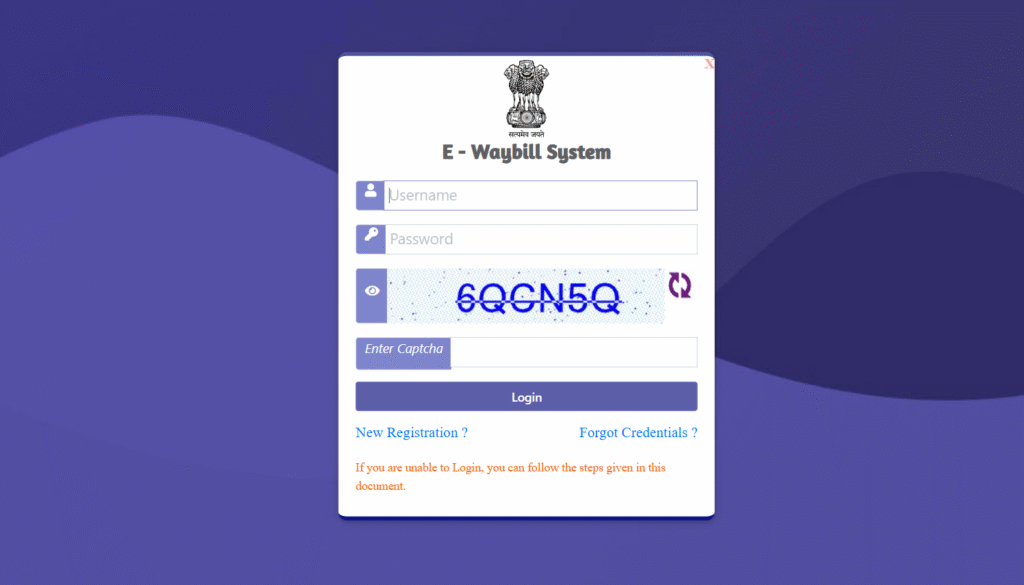
Steps/Process to Generate EWay Bill Log in

These steps will help you out in generating an E-Way bill log in. Follow the process:

  1. Step 1- EWay Bill Log in Portal, i.e., https://ewaybillgst.gov.in/, with your login credentials to access. 
  2. Step 2- When you select the “Generate new” option, a new generation form will show up on the main menu page.
  3. Step 3- Fill in the required details,
  • Select the translation type to “Outward” if you are a supplier
  • If you are the recipient, choose the “Inward” translation option and, if necessary, input the recipient’s and supplier’s information as well as the GSTIN.  Once a GSTIN number is entered, some of the forms will be automatically filled in.
  1. Step 4- Provide a goods description
  • Just as on your tax invoice, the product name and description must be filled out completely and accurately.
  • For the Product, enter the HSN Code. Click here to find the HSN code.
  • Enter the applicable rates for CGST and IGST.  For interstate transportation, IGST will be used, and for intrastate transportation, SGST/CGST.
  • Enter the approximate transportation distance, which will determine the validity of the E-way bill.
  1. Step 5- Then click on “Submit” to generate an E-Way bill. 

Note: To create an E-way Bill, a transporter’s registration and GST are required. Otherwise, you won’t be able to generate one.

Also Read: PCS Full Form || LPA Full Form || CTC Full Form || How to Become Marcos Commando

E-Way Bill Validity 

It is one of the important things to get to know about the validity of E-way bills, as they are based on the distance the items have traveled. An e-way charge is valid for the times indicated below. Validity is determined using the e-way bill’s creation date and time.

Type of conveyanceDistanceValidity of EWB
Other than over-dimensional cargoLess Than 200 Kms1 Day
For every additional 200 km or part thereofAdditional 1 Day
For over-dimensional cargoLess Than 20 Kms1 Day
For every additional 20 Kms or part thereofAdditional 1 Day

The Eway bill’s validity can also be extended by the person who generated it, either eight hours before or within eight hours of its expiration.

Beginning on 1 January 2025, e-Way bill validity extensions are limited to 360 days from the date of original generation.

Eway Bill Portal

The Government of India’s National Informatics Centre (NIC) created the official online platform known as the E-way Bill Portal to make it easier to create, manage, and track E-way invoices under the GST (Goods and Services Tax) system.  It functions as a consolidated system for all GST-registered users, carriers, and tax officials and is available at https://ewaybillgst.gov.in.

How this portal helps users: 

  • Create, reject, modify, and cancel E-way bills.
  • Utilize bill numbers or other criteria to keep track of E-way bills.
  • Manage user accounts and register transporters.
  • Get notifications, reports, and system updates.
  • For major users, such as logistics organizations, employ APIs to integrate systems.
  • Get the E-way Bill mobile app to access resources like FAQs and distance calculators.

EWay Documents and Required Details

  • Documents or information needed to create an eWay Bill invoice, bill of supply, or challan for the shipment of goods
  • Road transport- Vehicle number or transporter identification
  • When the exporting of goods is done by ship, rail, or air, the things we need are the document’s date, transporter ID, and transport document number

Note: The appropriate officer may block a vehicle while it is in motion to inspect the cargo or verify documentation, such as the E-way bill (Important Information to keep this in mind). 

Exemptions from E-Way Bill 

Certain products and transactions are exempt from the creation of an E-Way Bill since they don’t need one are written down below:

1) Exemption for Goods (E-Way Bill)

  • Natural/cultural stones or pearls/precious stones.
  • Kerosene Oil under PDS.
  • Liquid Petroleum Gas (LPG) is usually used for the supply of household purposes and non-domestic use.
  • Jewelry
  • Curd, Lassi, Any Milk product.
  • Fresh or Pasteurized milk
  • Fruits
  • Vegetables
  • Animals (Living), Plants, and Trees.
  • Animal flesh, meat
  • Salt
  • Some items which does not contain a particular brand, usually, such as rice or wheat flour.
  • Stationery products
  • Unprocessed tea leaves

2) Exemption for Transactions

It is not required to create an E-way bill when products valued at 50,000 rupees are transferred from one location to another.

  • If non-motorized vehicles are used to transport the items.
  • If the land customs station, airport, and air cargo complex, a Container Freight Station for clearance by customs, or an Inland Container Depot. 
  • Transportation of the goods within the area.
  • Transportation of goods to the Ministry of Defence

EWay Bills (Latest Developments) 

  • For returning non-filers, e-way bill production will be prohibited starting on August 15.
  • GST officers now have access to real-time data on the movement of commercial vehicles on highways due to the integration of the EWB E-Way bill system with RFID and FasTag.
  • This action will assist in monitoring these automobiles in real time and preventing GST avoidance.
  • In GST (Goods and Services Tax), you will be required to use a six-digit HSN code.
  • E-way bills can only be generated for intra-state goods transportation; they cannot be generated for interstate business-to-business transactions, and export invoices with the document type “TAX INVOICE” cannot be generated using the e-way bill portal.
  • Invoices such as imports and B2C bills that do not require an IRN are not necessary. Direct E-way bills can be produced for these invoices.
  • Using the seller’s and buyer’s postal identification numbers to calculate distance is one of the significant improvements made to the e-way bill. The determination of distance is based on the distance between two PINs.

FAQs 

Q1: When is an E-Way Bill Required?

Ans– An E-Way Bill is required when goods worth more than ₹50,000 are transported within or across states.

Q2: Who can Generate an E-Way Bill?

Ans- Registered persons, unregistered suppliers, and transporters can generate an E-Way Bill.

Q3: What is the Validity of an E-Way Bill?

Ans- Validity depends on distance, 1 day for every 200 km for regular cargo and 1 day per 20 km for over-dimensional cargo.

Q4: Can the E-Way Bill be Extended after Expiry?

Ans- Yes, it can be extended either 8 hours before or within 8 hours after expiry.

Q5: Are There any Exemptions to the E-Way Bill?

Ans- Yes, goods like fresh milk, fruits, jewelry, and transactions via non-motorized vehicles are exempt.

Recommended:

1.BSc Nursing Salary
2.Air Hostess Salary
3.Cyber Security Salary
4.Data Analyst Salary
5.Full Stack Developer Salary

How to Find Airtel Payments Bank IFSC Code Easily

0
Airtel Payments Bank IFSC Code

In today’s digital environment, where online payment transfers are quite common, being acquainted with the basics of banking identifiers is paramount. The Indian Financial System Code, or IFSC for short, is one such identifier. The code is important, as this ensures that the money goes to the correct bank branch when you are transferring money through RTGS, NEFT, or IMPS. In case you happen to be a customer of Airtel Payments Bank or if you are transferring funds to someone who holds an account at Airtel Payments Bank, the respective IFSC code will be needed. Airtel Payments Bank, however, is somewhat different from typical commercial banks, which have several branches and hence distinct IFSCs. How, then, is one to determine the correct IFSC code, quickly and accurately? This blog will discuss everything you should know about Airtel Payments Bank IFSC code. 

Airtel Payments Bank IFSC Code

Bank branches that take part in several online money transfer systems, including NEFT, RTGS, and IMPS, can be uniquely identified by their 11-digit alphanumeric Indian Financial System Code (IFSC). The Reserve Bank of India (RBI) assigns it.

  • The bank code is represented by the first four characters.
  • Zero is always the fifth character; it is saved for later use.
  • The particular branch is indicated by the final six characters.

Airtel Payments Bank has mainly an internet-based business model, and thus, has had a simplified view of the IFSC structure with few physical locations.

Airtel Payments Bank IFSC Code Format

The standard Airtel Payment Bank IFSC code is:

AIRP0000001

Breakdown:

  • AIRP – Airtel Payments Bank code
  • 0 – Reserved character
  • 000001 – Since it’s primarily a single-branch procedure, the branch code is unique.

Since Airtel Payments Bank is a centralized digital banking platform with a single primary branch structure, the majority of transactions involving the bank typically use this IFSC.

BankAIRTEL PAYMENTS BANK
IFSCAIRP0000001
MICR CodeNA-
Brand Code000001 (Last Six Characters of IFSC Code)
BranchAirtel Payments Branch
CityGurugram
DistrictGurugram
StateHaryana
AddressAirtel Center, Plot No-16, Udyog Vihar, Phase-4, Gurgoan
Phone No.+911244222222

How to Easily Locate the Airtel Payments Bank IFSC Code

Some quick and reliable ways to find the correct IFSC code for Airtel Payments Bank are written down below:

1) Airtel Payments Bank Official Website

The most authentic and up-to-date source is the official website:

  • Visit: www.airtel.in/bank
  • Proceed to the Help or Support area.
  • Search for Fund Transfer Information or Banking FAQs.
  • The IFSC code is typically displayed there as AIRP0000001.

2) Airtel Thanks App

If you use Airtel’s mobile services, the Airtel Thanks App is a convenient tool.

  • The Airtel Thanks App should open.
  •  Go to the section for Airtel Payments Bank.
  •  Tap on Banking Information or Account Details.
  •  This is where your bank information, account number, and IFSC code will appear.

3) RBI Official Website

The Reserve Bank of India (RBI) maintains an up-to-date list of IFSC codes for all banks:

  • Visit: https://www.rbi.org.in
  • Search for the IFSC code directory.
  • Select Airtel Payments Bank from the list of banks.
  • You will find the official IFSC: AIRP0000001.

4) Internet Banking Portals

Choosing themself for which destination bank and branch is feasible, the majority of bank account netbanking users can look into beneficiaries to SBI, HDFC, ICICI, or others.

  • Choose Airtel Payments Bank.
  • The system frequently automatically puts in the IFSC code AIRP0000001 when asked for the branch.
  • This ensures a verified and error-free IFSC code.

5) Third-party IFSC Code Finder Websites

There are a few reliable websites that let you look up IFSC codes by bank name:

Caution: To avoid inaccurate or out-of-date material, always verify third-party websites against official sources.

Airtel Payments Bank IFSC Code Search

The IFSC codes in India are very important as they narrow down the choice of a branch when making money transfers through various payment systems. Your bank’s IFSC code is written on the first page of your passbook or inside your checkbook. Any form of money transfer, including RTGS, NEFT, and IMPS, requires an IFSC code. No money transfer may be completed without an IFSC code. One must have the recipient’s information before starting a transfer, including the account holder’s name, the bank, the branch, and the IFSC code of that particular bank branch. The Details Needed to Transfer Money Using Any Payment Method.

  • Amount of remittance
  • Bank’s account number
  • Bank name of the receiver
  • Name of the receiver
  • Account number of the receiver
  • Receiver’s bank branch’s IFSC code

Steps to Open an Airtel Payments Bank Account

Generally, bank customers may choose from a variety of bank accounts, allowing them to conduct transactions, deposit their money, keep accounts interest on, or keep financial assets under safekeeping. To open an account with Airtel Payments Bank, the customer must satisfy the following requirements:

  • One has to be an Indian citizen.
  • Persons must be eighteen and older in order to be qualified.
  • A custodial or minor savings account can be opened, wherein the parents or guardians of the minor may open it on behalf of the minor.
  • The applicant must carry a valid form of identification or proof accepted and acknowledged by the government.
  • In consideration of the account type selected by the applicant and the deposit requirements for the minimum balance of a particular savings account, the applicant must also make an initial deposit, besides fulfilling the aforementioned criteria and obtaining bank approval.

Documents Required to Open an Airtel Payments Bank Account 

These are some documents that you will require to open a bank account in any of the branches:

Documents What You Need 
Proof of IdentityAadhaar Card, Passport, Driving license, Voter’s ID card
Proof of AddressAadhaar Card, Passport, Driving license, Voter’s ID Card
PAN CardOriginal/Photocopy of PAN Card
Form 16Only if the PAN card is not available
Passport Size PhotographsRecent photograph 

Uses of IFSC Code

NEETNational Electronic Fund Transfer enables you to electronically transfer funds from your bank account to any other bank account of the same bank or a different bank.
RTGSReal Time Gross Statement transfers a minimum limit of Rs 2 lakh.
IMPSImmediate Payment Service bank account holder can transfer funds 24*7 up to 365 days. 
Online Banking –

Format of IFSC Code

The bank’s name appears in the first four characters of the 11-character IFSC code, while the last six characters reflect the bank’s branch. Typically, the fifth character is 0 (zero), saved for later use. The IFSC format is as follows.

1234567891011
Bank Code0Branch Code

Since Airtel Payments Bank employs a single IFSC code, AIRP0000001, and runs a centralized online system, obtaining the IFSC code is simple. With the above-stated methods, especially through the official Airtel website or app, one can proceed to make fund transfers quite comfortably.

Always make sure of the IFSC Code before making any online transfer, especially whenever you are doing it for the first time or transferring money on someone else’s behalf. It’s good to know these fundamentals as digital banking takes a firm footing in our lives.

FAQs

Q1. What Is Airtel Payments Bank’s Ifsc Code?

Ans- The IFSC code of Airtel Payments Bank is AIRP0000001.

Q2. Where Can I Find My Airtel Payments Bank Ifsc Code?

Ans- It is available through the RBI IFSC directory, the official website, and the Airtel Thanks App.

Q3.Do All Users of Airtel Payments Bank Have the Same Ifsc Code?

Ans- Yes, the majority of transactions use AIRP0000001 because it is a digital system.

Q4. Can I use the Airtel Payments Bank IFSC code for NEFT and IMPS transfers?

Ans- Yes, the code is valid for **NEFT, RTGS, and IMPS** fund transfers.

Q5. What Details Are Needed to Transfer Money Using the Ifsc Code?

Ans- The required information includes the recipient’s name, account number, bank name, branch IFSC, and the amount to be sent.

Recommended:-

1.Indian Navy Marcos Commando Salary
2.Google CEO Sundar Pichai Salary
3.NSG Commando Salary
4.Salary Slip Format in Excel
5.Salary Certificate Format

How to Become a CA: A Complete Guide to Your Dream Career

0
How to Become a CA
How to Become a CA

If you have aspirations of one day becoming a Chartered Accountant (CA) in India, you are not alone. Every year, hundreds of thousands of students strive to make those two letters part of their life; that is, CA. The reasons may vary as to why someone pursues CA. Regular factors are respectability, tackling money matters with a degree, and referring to fantastic numbers, then solving numbers, not to mention the struggle you need to endure; it is a long and tough journey, but the outcome is worth the hard work. 

This guide will take you through essentials of becoming a CA in the steps you need to know, and what you will learn along the way as a CA, how to become CA after 12th, this will give you a look what skills you have to develop, salary and compensation (if paid on the 7th pay commission), and some other cool benefits being a Chartered Accountant.

What is a Chartered Accountant (CA)?

Chartered Accountants are professionals who are qualified to manage accounting, auditing, taxation, financial management and consultancy for individuals, businesses and governments. In India, a CA qualification is regulated by the Institute of Chartered Accountants of India (ICAI).

Imagine a CA as the person keeping it all together in the financial world. Whether that be filing taxes, auditing large corporations, or advising start-ups on how to manage their finances, all of the various roles a CA performs provide an essential service in every sector of the economy.

How to become CA after 12th – Step-by-Step Process

To become a CA in India takes diligence, a well-rounded education in commerce, and the ability to navigate several requisite stages. Here’s what that typically entails:

1. Register after completing Class 10: CA Foundation Route

You can start your CA journey early. After passing Class 10, you can register for the CA Foundation Course, but you can take the examination only after passing Class 12.

2. Pass the CA Foundation exam

This is the preliminary level examination, which consists of Accounting, Business Laws, Business Mathematics, and Economic concepts. This exam is scheduled twice a year, in May and November. If you have a good foundation of commerce concepts, this should be easily manageable.

3. Register for CA Intermediate

After successfully completing the CA Foundation examination, you will start the second level, which is CA Intermediate, consisting of two groups of four papers. The course should be completed within 18 months. Each group consists of papers such as Accounting, Corporate Laws, Taxation, Auditing and Assurance, and Financial Management.

4. Articleship (Practical Training)

After completing either one or both groups of CA Intermediate, you are now required to commence three years of articleship (practical training), a paid internship under the supervision of a practicing CA. This is where “you learned how to apply classroom knowledge in practice” and be properly prepared for life as a professional CA.

5. Clear CA Final

When you complete your articleship and clear both groups of the CA Intermediate examination, you are entitled to appear for the CA Final, the last and most challenging level of the course.

6. Apply for Membership

Once you have cleared CA Final, you are now eligible to become a member of ICAI, and now a Chartered Accountant.

Skills Required to Become a CA

Becoming a CA is not just about passing the exams. There are many skills, both hard and soft, required to be successful.

  • Analytical Thinking: If you want to be a successful CA, you will be solving complex financial questions almost daily, so analytical thinking is crucial.
  • Attention to Detail: In an auditing assignment or a tax return, one little mistake can cost the company a lot of money. So attention to detail is critical.
  • Good Communication: You must be able to clearly articulate some complex financial matters in ways that clients and others can easily understand.
  • Ethics and Integrity: As a CA, you will often deal with sensitive and confidential information that will require dealing with trust. Therefore, ethics and integrity are essential.
  • Time Management: CAs deal with multiple clients, audits, and deadlines during a busy timetable and must manage their time accordingly.

Salary of a CA in India (Including as per 7th Pay Commission)

1. Private Sector Salary

Beginning salaries for fresh CAs can range between ₹6 and ₹9 lakhs per annum based on company and location, with Big 4 firms Deloitte, PwC, EY, or KPMG offering packages north of ₹10 LPA to strong performers.

CAs with some experience quickly move up the salary ladder to salaries of ₹20–25 lakhs or more. Many will leapfrog further by starting their own firms or becoming partners of other CA firms; their earnings can be even higher.

2. Government Sector Salary (7th Pay Commission)

CAs working for the government (e.g., finance officers, PSUs, etc.) receive salaries based on the 7th Pay Commission. Therefore, the pay scale differs, but generally speaking, a CA will start at Level 10 or 11, with a salary between ₹56,100 to ₹78,800 (not including allowances like HRA, DA, transport).

There are good chances for the monthly in-hand salaries (with the allowances) to exceed ₹1 lakh in many cases.

Perks and Benefits of Becoming a CA

Now, onto the fun stuff – aside from the pay, CAs get nice perks that make it worthwhile to push through after the hard work.

  • Job Security: CAs are in high demand. Come rain or shine, accountants are required by companies.
  • Variety of Career Opportunities:- You can work in corporates, start your own practice, work in government, or be a professor. There are so many options!
  • A Respected Profession in Society: CA is one of the most respected professions in the country. It indicates hard work, intelligence, and integrity.
  • Global Recognition: Indian CAs are recognized in countries such as the UK, Canada, UAE, and Australia. With some extra certifications, you can work abroad too.
  • Work Life Balance (Eventually): Becoming a CA is very intense, but once you have established yourself, most CAs can choose their workload. (especially those in private practice!)

Challenges You Might Face (And How to Overcome Them)

It’s never easy to become a CA. The exams are notoriously difficult and the average pass percentage is quite low (for the last few CA exams, it’s around 10–15%). A majority of students will fail, and on average, students fail at least once, which isn’t that bad.

Here are some tips for staying strong throughout the process:

  • Be consistent with your studying—small repeated efforts over the span of the course will be much more beneficial than procrastinating your studying and cramming.
  • Find a coaching institute if self-learning isn’t adequate for you.
  • Talk to previous mentors and seniors about the expectations for studying and practicing at the different levels.
  • Failure isn’t frightening anymore—countless successful CAs took 2 or 3 attempts before succeeding, so just keep plugging away.

Can a Non-Commerce Student Become a CA?

Yes! People often question how to become CA after 12th science? Let us tell you that students from both a science and arts background can register for CA Foundation after 12th. There may be a little learning curve in the beginning, but with the right efforts and resources, it can definitely be done.

Tips to Succeed in Your CA Journey

  1. Start Early – The sooner you become a CA, the easier it is going to be.
  2. Use ICAI Resources – The ICAI offers materials, mock tests and sample papers. 
  3. Join Study Groups – Peer learning helps a lot, especially with difficult subjects. 
  4. Balancing Articleship with Study – Time management through your 3 years of training is everything. 
  5. Stay Focused – Keep reminding yourself of what made you start in the first place. The journey is long, but the destination makes it worthwhile.

Final Thoughts

Becoming a CA is a highly respected and financially rewarding career in India. Yes, it’s hard. Yes, it sacrifices. But let me tell you, when you see “CA” in front of your name, it is all worthwhile. 

If you are in school, or even in college, now is the perfect time to plan. Again, don’t forget, becoming a CA is a marathon, not a sprint, but you can definitely achieve it with hard work, patience, and just the right guidance.

Recommended:-

1.How to Become an Income Tax Officer
2.25 LPA in Hand Salary
3..How to Become Black Cat Commando in India?
4.GDS BPM Salary After 3 Years
5.How to Become IPS offiers

How to Check PF Balance Online: A Step-by-Step Guide

0
How to Check PF Balance Online: A Step-by-Step Guide 2025

Planning for the sake of the future for yourself and your family is essential. If you are a salaried employee at any company with more than 20 employees, you are eligible for the Provident Fund provided by the Employees’ Provident Fund Organisation (EPFO). The Provident Fund (PF) is a government-managed pension scheme that helps by saving a portion of the employee’s salary throughout their working tenure. You can check your Provident Fund account balance by using platforms like, EPFO portal, UMANG app, SMS, and missed call facilities. To know more about the topic of PF balance check online, take a look at the blog, which provides all the details. 

What is Provident Fund (PF)?

PF stands for the acronym for Provident Fund. PF refers to a type of pension provided by the Employees’ Provident Fund Organisation (EPFO), which operates under the Ministry of Labour and Employment. The benefits of the Provident Fund can be availed by all salaried employees working in organizations with 20 or more employees. With the PF account, you get a UAN (Universal Account Number), which is very important and stays the same even if you change your job. 

PF Balance Check: Ways to Check your Provident Fund Balance

PF account balance check can be carried out by two main methods- one with the help of the UAN and the other without the help of the UAN number. You can check your Provident Fund account balance with the help of the following methods:

  • Through the EPFO Portal
  • Through the UMANG App
  • Using SMS Facility
  • Using the Missed Call Facility
  • Through Employer
  • Through Offline methods

PF Balance Check – Provident Fund Account Balance Check With UAN Number

The methods to check the PF balance with the help of the UAN number include 2 ways:

  1. PF Balance Check Online through the EPFO Portal
  2. PF Balance check through the UMANG App

1) PF Balance Check Online through the EPFO Portal

In order to check your Provident Fund account balance, check online through the EPFO portal, follow the given steps:

  • Visit the EPFO portal: https://www.epfindia.gov.in/site_en/index.php.
  • Click on the option “For Employees” present in the tab under the section named “Services”, on the top right side of the page. 
  • Click on the option of “Member Passbook” present in the top under the “Services” section. 
  • After clicking on the tab, you will be redirected to a new page, which will require you to fill in your credentials like UAN number, password, and captcha code. 
  • After clicking on the “Sign in” option, a six-digit OTP will be sent to your Aadhar-registered mobile number. 
  • Enter the six-digit OTP, and click on the “Verify” option.
  • Your Provident Fund account balance will appear on the screen. 

Things to Keep in Mind before Checking PF Balance through the EPFO Portal

There are some requirements you need to ensure before you can check the PF balance through the EPFO portal. The list of requirements is given below:

  • You must make sure that your UAN number is activated and registered on the portal before performing a PF account balance check. 
  • Six hours post-registering on the EPFO portal, you will be able to view your passbook. 
  • The passbook will reflect the updated entries patched up by the EPFO Offices.

2) PF Balance Check through the UMANG App

You can also access your PF account balance check with the help of the UMANG (Unified Mobile Application for New-age Governance) app, which was launched by Prime Minister Narendra Modi, so that a single platform could be provided for all Indian Citizens to access pan-India e-Gov services ranging from Central to Local Government bodies and other citizen-centric services. To check your PF account balance through the UMANG App, follow the given steps:

  • Open the app and log in by providing the credentials, like your mobile number and MPIN.
  • Select the option of “Services” and click on the option of “Social Security”.
  • Now opt for the “EPFO” option from the list of services provided in the app. 
  • Select the option of “View Passbook” which is present under the “Employee Centric Service” tab.
  • Fill in your Unique Account Number and enter the OTP that will be sent to your registered mobile number, and click on the “Submit” option.
  • Download the Employee Provident Fund passbook provided and view your balance.  

PF Balance Check – Provident Fund Balance Check Without UAN Number

If your UAN number is not activated or registered yet, you can opt for the option of checking your Provident Fund account balance without the UAN number with the help of the following methods:

  1. PF Balance Check through SMS 
  2. PF Balance Check through Missed Call 

PF Balance Check through SMS

To check your Provident Fund account balance with the help of the SMS facility without the use of your UAN number, follow the given steps:

  • Send an SMS to the given mobile number: 7738299899. 
  • Type the message in the given format: ‘EPFOHO UAN ENG’. 

If you wish to change or set your preferred language, use the first three characters of the preferred language in the last three words of the message. 

LANGUAGE ABBREVIATION
English ENG
HindiHIN
PunjabiPUN
Gujarati GUJ
MarathiMAR
Kannada KAN
TeluguTEL
TamilTAM
MalayalamMAL
BengaliBEN

*You can check the balance through the SMS facility if your UAN is registered with your bank account, Aadhaar number, and PAN. 

*If the UAN number is not registered with your bank account, Aadhaar number, and PAN, you must complete the eKYC in order to avail the SMS facility. 

PF Balance Check through Missed Call

To check your Provident Fund account balance with the help of the missed call facility, follow the given steps:

  • Leave a missed call to the number 9966044425 from your registered mobile number.
  • After leaving the missed call, you will receive your Provident Fund account balance details with the help of the SMS app.

*The service for knowing your PF balance through mobile number is cost-free.

Things to Keep in Mind before Checking PF Balance through Missed Call

In order to avail the services to check your PF balance through the missed call facility, you need to ensure the following things:

  • Your Universal Account Number and your mobile number must be linked and activated with your PAN, Aadhaar, and a bank account to be able to access the missed call service. 

Steps to Check PF Balance for Exempted Establishments

If your company is an EPF-exempted establishment or a private PF trust, you cannot view your PF balance on the EPFO portal. You can follow the given steps:

  • The PF contribution is given to the trusts that are managed by the company instead of the EPFO portal.
  • So, the private PF trusts can provide the details regarding the Provident Fund account balance. 
  • Or, the employees can access the details regarding the Provident Fund account balance through their salary slip, the HR department, or the company’s portal. 

Contact Details

If you have any queries regarding the process, like eKYC, UAN number registration with account, or PF account balance check, you can contact the respective authorities at the given details:

EPFO Portal
Help Desk/Toll-Free Number14470
Directory (Head, Zonal Offices)https://www.epfindia.gov.in/site_en/Contact_us.php
UMANG APP
Contact Number 1800118005
Email Addresswebadmin-epfo@nic.in
Working HoursMonday to Friday (09:15 AM – 05:15 PM)
AddressEPFO HEAD OFFICE, Plate A, Ground Floor, Office Block-II, East Kidwai Nagar, New Delhi-110023

FAQs

1) What is the Provident Fund?

Provident Fund (PF) refers to the type of pension provided by the Employees’ Provident Fund Organisation.

2) What is the website for the EPFO portal?

The website for the EPFO portal is https://www.epfindia.gov.in/site_en/index.php.

3) What is a UAN number?

UAN is a 12-digit unique identification number given to every employee owning a PF account.

4) How much time does the PF balance take to get updated?

The Provident Fund account balance is updated within 24 hours of making the transactions.

Also Read:-

1.BSc Nursing Salary
2.Air Hostess Salary
3.IBPS Clerk Salary
4.IBPS PO Salary
5.Loco Pilot Salary

TCS Digital In-Hand Salary for Freshers: What to Expect in 2025?

0
TCS Digital in Hand Salary

One of India’s largest providers of IT services is Tata Consultancy Services (TCS). For the thousands of new jobs in the category, including Ninja, Digital, and Ignite, it hires new employees each year. It is a dream company for many graduates because of its exciting salary packages. But before applying for a job, understanding the TCS Digital In-Hand salary in 2025 is important for freshers. It sets the tone of the early professional journey and helps you manage your expenses. While the salary package looks more attractive on paper, what you get as your in-hand salary is what matters. Out of the above-mentioned three job roles in TCS Digital has the highest salary. With the help of this blog, we will tell you everything about the TCS Digital in-hand salary, various job profiles for freshers, its eligibility criteria, the recruitment process, and how to apply for the TCS Digital Role. 

TCS Job Profiles for Freshers

Organisation Name Tata Consultancy Services (TCS)
Post IT and Non-IT posts
Exam NameTCS National Qualifier Test 
Category-Wise Salary for FreshersFor Ninja- 3.36 LPAFor Digital- 7 LPAFor Ignite- 9-11 LPA
TCS Qualifying Exam Name  TCS National Qualifier Test
Bonuses and Perks Based on the entrance test 

TCS Digital In-Hand Salary For Freshers 2025

The TCS Digital CTC salary estimates range between Rs 3.36 LPA to 7.3 LPA for the fresher as per the 2025 update. However, TCS Digital In-hand salary after all the deductions like income tax, provident fund, and other company benefits is Rs 45,000 to 50,000 gross monthly.

These figures are just an estimated value of the TCS in-hand salary for freshers. While the exact salary package will depend on the job profile, the performance of the candidate, exam result, and the skills offered. Unlike the salary packages, TCS also offers bonuses, insurance, and internal certification as a perk for the eligible candidate.  

Categories of the TCS In-Hand Salary For Freshers

The TCS in-hand salary for the freshers is divided into 3 categories, that is, Ninja, Digital, and Ignite. The above-mentioned is detailed information about these three Categories: 

  1. TCS Ninja:CS Ninja is a great opportunity for freshers looking to kick-start their career in the IT industry. It provides positions in testing, maintenance, and software development, providing young people with a strong platform for advancement. The selection process usually includes an online test and interview rounds. Through TCS Ninja, the company not only hires young talent but also helps nurture and shape future tech experts. 
  2. TCS Digital: For recent graduates with a solid technical background and a drive for innovation, TCS Digital offers a premium opportunity. It looks for candidates with a solid understanding of areas like AI, machine learning, data analytics, and cloud computing. Compared to the regular hiring process, TCS Digital offers a more challenging selection process but also comes with better salary, faster career growth, and chances to work on exciting real-world projects.
  3. TCS Ignite: TCS Ignite, also called TCS B.Sc. Ignite & Smart Hiring is a special initiative by Tata Consultancy Services to open up exciting IT career opportunities for graduates from science and tech backgrounds. It’s designed for students who hold degrees like BCA, B.Sc. in fields such as Computer Science, IT, Mathematics, and even areas like Physics, Chemistry, and Cyber Security. The program not only hires fresh graduates but also offers training to help them smoothly transition into the IT industry. 

 Estimated Salary Packages of these 3 Categories of TCS: 

TCS Ninja Salary Rs 3,36,877 plus 60,000 incentives (for B.Tech Students)

Rs 3,53,578 plus 60,000 incentives (For M.Tech, M.Sc candidates)
TCS Digital SalaryRs 7,00,022 plus 60,000 incentives (For B.Tech Students)
Rs 7,30,034 plus 60,000 incentives (For M.Tech, M.Sc candidates)
TCS Ignite SalaryRs 9,00,000 plus 60,000 incentives (For B.Tech Students)

Rs 11,50,000 plus 60,000 incentives (For M.Tech, integrated, and M.Sc candidates)

TCS Job Profile For Freshers 2025

If you get shortlisted through the TCS NQT 2025, then you could be placed in either the IT or Non-IT sector, depending on your skills and how you performed in the selection process. The job role you get can vary, but here are some of the common TCS Job profiles for Freshers:

  • Software Developer: You’ll be writing, testing, and fixing code to build software based on what the client needs.
  • Systems Engineer: You’ll manage the company’s IT setup, like networks, servers, and systems, to keep everything running smoothly.
  • Data Analyst: This role involves working with data collecting, analyzing, and helping teams make smart decisions using those insights.
  • Business Analyst: You’ll act as the link between the client and the technical team, helping figure out what the business needs and turning that into clear plans.
  • IT Support: You’ll be the go-to person when something stops working, helping fix software or system issues and making sure everything stays up and running.

What is TCS NQT? 

TCS National Qualifier Test, also known as the TCS NQT, is the first big step in the TCS selection process. It’s a test that checks both your thinking ability and basic technical knowledge. How well you do in this test decides which role you’ll be considered for – either TCS Ninja or TCS Digital. So, it’s important to prepare well and give it your best shot. 

As we are talking about the TCS Digital in this blog, it includes the 3 main qualifier rounds for the TCS NQT that are: 

  • An Online Test that includes advanced aptitude and coding questions.
  • Technical interview 
  • And the third and last round is the HR Interview

After qualifying for these 3 rounds of the TCS NQT, you are eligible for the TCS Digital post.  

Eligibility Criteria for the TCS Recruitment

The above-mentioned is the Eligibility criteria for the TCS Recruitment: 

  1. Age Limit: You should be between 18 to 28 years old for off-campus hiring.
  2. Education: Only full-time degrees (like B.E/B.Tech, M.E/M.Tech, MCA, M.Sc) from a recognized university are accepted. Part-time or distance courses aren’t eligible.
  3. Marks Requirement: You must have at least 60% or a 6 CGPA in your 10th, 12th, Diploma (if any), UG, and PG.
  4. Backlogs: You must not have any active backlogs at the time of applying.
  5. Education Gap: A gap of up to 2 years (24 months) is permitted in your education, provided it is supported by valid documents.
  6. Experience: Freshers or those with up to 2 years of work experience are eligible to apply. 

Documents Required for TCS Recruitment 

There are a few documents required for the smooth functioning of the TCS Recruitment process and the interview process of the candidates that are: 

  1. Your Updated Resume/CV 
  2. Your Identity proof, such as the Aadhaar card or Pan Card. 
  3. Educational Qualification document, such as 10th, 12th marksheet, and semester-wise marksheet of college. 
  4. Passport Size Photography
  5. Hard Copy of TCS Application form 

Alos Read:- 25 LPA Salary | 11 LPA in Hand Salary in India || 8 LPA in Hand Salary 

What is the TCS Digital Recruitment Process?

The TCS Digital profile is basically made for candidates who are advanced in the next generation technology that is AI, Machine Learning, IOT, and big data. By clearing the TCS Digital Qualifier test, you can get easy recruitment in the TCS company. The test is more challenging and difficult to qualify for. The above-mentioned is a TCS Digital recruitment Process: 

  1. Exam Name- TCS Digital 
  2. Eligibility Criteria- B.Tech/M.Tech with 60%+ in 10th, 12th, and UG. No active backlogs
  3. Salary- Approx Rs 7 lakh per annum
  4. Process- The exam process of TCS Digital includes 3 stages that are 

1) An Online Exam that includes the Advanced Aptitude and Coding

It is the first round of TCS Digital NQT and is also known as the elimination round. In this round, there is a small online exam of 180 minutes for the candidates applied for the TCS Recruitment process. The online test is divided into 2 main sections, that is, the cognitive test and programming. 

SectionPartNo. of QuestionsDuration (Mins)Key Topics
Cognitive SkillsVerbal Ability2430Synonyms, Antonyms, Sentence Correction, Reading Comprehension
Reasoning Ability3050Decision Making, Number Series, Syllogism, Data Interpretation
Numerical Ability2640Percentages, Time & Work, Profit & Loss, Averages
ProgrammingProgramming Logic1015Data Structures, Algorithms, Basic Programming Concepts (C/C++/Java)
Coding & Email2 + 145Two coding problems and one email writing task.

2) Technical Interview

If you qualify for the first round of the exam, then you have to move on to the next round, which is the “Technical Interview.” In this round, the TCS higher authorities test your technical skills. So be prepared for the question-and-answer round on your core subjects, programming language, and the live coding test. 

3) HR Interview

The next and final round of the TCS Digital Recruitment process is the HR Interview. This round is made to test the communication skills, personality, and the cultural fit for the company. In this round, candidates have a chance to show their enthusiasm and the hard work for their dream company.  

How to Apply for the TCS Recruitment Process 2025?

Here are a few steps through which you can easily apply for the TCS Recruitment process 2025: 

  • Visit the TCS Careers Portal: Head over to the official TCS NextStep Portal, this is where all job applications are handled.
  • Sign Up: If you’re new, register by entering your email ID and some basic details to create your account.
  • Fill Out the Form: Add your personal, academic, and contact information carefully. Double-check to make sure everything’s accurate.
  • Upload Your Documents: Attach your updated resume, academic certificates, and a passport-sized photo in the required format.
  • Submit and Confirm: Once everything looks good, submit your application. You’ll get a confirmation email along with a unique reference number for future updates.

FAQS: 

1) What is the TCS Digital In-hand Salary for Freshers? 

As the new 2025 update, the TCS Digital in hand for freshers is approximately Rs 3.36 LPA to 7.3 LPA, so the candidates can get a Rs 45,000 to 50,000 in-hand salary per month as a fresher after all the deductions. 

2) Will TCS increase salaries in 2025? 

Yes, TCS has announced the salary hikes in 2025, which are totally based on the overall performance of the candidate. 

3) Will TCS give Work From Home to Freshers? 

No, the company authorities have decided to maintain the traditional work from office ethics; however, they can follow the hybrid mode for the freshers in 2025. 

4) What is the Recruitment Process for the TCS Digital? 

The students have to clear the 3 main stages of the exam, that is, the online exam, the  Technical interview, and the HR Interview for the recruitment in TCS Digital. 

Recommended:-

1.BSc Nursing Salary
2.Air Hostess Salary
3.CRPF Salary
4.Cyber Security Salary
5.Data Analyst Salary