


Relocating or refurbishing your office is a thrilling idea, until you realize that you need to somehow preserve years of invoices, employee contracts, personnel files, and compliance documents.
Business records are not just simple paperwork. They protect you during audits, assist with tax filing, establish ownership, verify warranties, record HR history, and ensure day-to-day operations. When changing addresses or undergoing renovations, these same records are much more susceptible to loss: boxes get lost, files are exposed to dust or water, and digital backups are forgotten, only to be found too late.
The good news is that the process of ensuring your business records are secure does not have to be complicated. The simplest solution is a bare-bones system: cut down on what you do not require, segregate what you need to protect, and keep everything safely locked up with unambiguous rules of access.
Sort, Keep, Shred, and Scan Your Documents
Assess what you actually have before you pack even one box. The amount of paper in most businesses is much more than necessary, and the relocation of unnecessary files raises both the risk and the cost.
Try a three-pile method:
- Retention: Records that are still required by law and are in active use but do not need to be reproduced.
- Scan: Paper that can be scanned and kept in a safe place.
- Shred: Duplicates, expired documents, and anything beyond retention requirements.
If you are not sure of retention periods, do not guess. Different rules apply in different jurisdictions and industries, and some records should be retained longer than you may think (particularly payroll, tax, and corporate governance records). When in doubt, verify requirements prior to shredding.
Identify Critical Files Needed for Daily Operations
Moving all records out with the intention of sorting them later is a common mistake. That “later” turns into someone desperately needing a vendor contract, client history, or compliance certificate while everything is locked in boxes.
Divide your papers into two categories:
- Operational necessities: Documentation your team may require every week (or even daily).
- Archival and compliance files: Files that are not frequently used but need to be secured.
The items necessary to run your business must move with you (or be available on-site in a safe, designated place). The archival files can be tightly stored provided they are not damaged or lost.
A simple guideline: if losing it for 48 hours would cause business inconvenience, put it in the access group.
Packing Tips: The Two-Layer Protection Method for Sensitive Files
The simplest risk reduction method when relocating is to assume that boxes will be stacked, bumped, temporarily left alone, or subjected to dust and moisture. All of that should be safeguarded by packing.
Use two layers:
- Interior: Documents placed in closed plastic sleeves or document tubs with lids.
- External surface: Strong boxes with clear and consistent labels.
Some minor packing upgrades are significant:
- Critical papers (not thin cardboard folders) should be put in waterproof document bins.
- It is important not to overload boxes so that lids fit properly and boxes do not burst.
- Include a sheet of printed inventory in each box (not only the one outside).
- Use tamper-evident tape to seal boxes with sensitive files.
Labeling matters too. Rather than labeling the outside “HR FILES,” label the box with a code such as “Box HR-03,” and make a separate master list. It is safer and easier to manage.
Digitizing Records: Scanning and 3-2-1 Backup Strategies
Scanning helps, provided that the digital files are arranged and secured. A random folder of PDFs on an individual’s computer is not a backup; it is a future headache.
When digitizing for a move or renovation, always keep it simple:
- Name files in a uniform manner (e.g., VendorNameContract2024-06-30.pdf).
- Share files in a common system using role-based access.
- Use version control for contracts and policies.
- Create a spreadsheet called a Record Index to make files searchable.
Above all, consider the 3-2-1 backup concept: three copies on two categories of storage and one offsite. Offsite may imply trusted cloud storage or a physical drive stored somewhere outside your premises.
Choosing Secure Offsite Storage for Important Documents
On-site storage is risky due to dust, water, demolition, or a series of contractors coming in and out of the building, no matter how tightly you close the room. In most instances, you should simply take sensitive records offsite for a temporary solution.
Options include:
- Chain-of-custody commercial document storage.
- Small amounts of important originals stored in secure lockers or bank-type storage.
- A locked records room in a secure secondary office building.
A safety deposit box Melbourne might be a temporary measure to store a small collection of high-value originals (such as deeds, company seals, or legal documents) when it is necessary to have them at that location temporarily or when you have permission to access them there. The point is to keep original documents in a place that is not affected by climate, is regulated, and is not part of the moving mess.
No matter which option you use, make sure you have checked the following basics:
- Access logs: Who is authorized to access the records?
- Climate: Ensure the location is climate-controlled (paper does not like humidity).
- Insurance: Verify coverage and documentation requirements for items.
- Accessibility: Check the speed of retrieval when required.
Chain of Custody: Ensuring Confidentiality During Transit
During a relocation, there are numerous hands on documents, including staff, movers, contractors, cleaners, and even building management. That is fine for desks and chairs, but not for sensitive records.
Establish a chain of custody policy prior to packing:
- Have one internal records owner who will oversee the process.
- Limit access to sensitive boxes to certain employees.
- Maintain an access log (a simple sign-out sheet is sufficient).
- Separate the transport of sensitive records from general office items.
When hiring movers, do not count on them to have confidentiality as their default. Enquire about background checks, processing, and the provision of secure transportation for business records.
Safeguarding Tax and Compliance Paperwork
Moves and renovations often coincide with business development—new offices, new personnel, and an increase in expenditure. It is at this point that tax and compliance paperwork will be even more critical.
When you are preparing, compile a special compliance bundle to keep at hand:
- Last year’s tax returns and records.
- Superannuation/benefits documentation and payroll records.
- Certificates and licenses of business registration.
- Large purchase invoices (especially for renovations and equipment).
In case you are not sure what to keep within immediate reach versus archives, it is a good idea to confirm with taxation accountants whether what you retain (or do not retain) conforms to audit and reporting requirements. Even a quick consultation will save you hassle down the line.
Post-Move Organization: The Re-Entry Plan
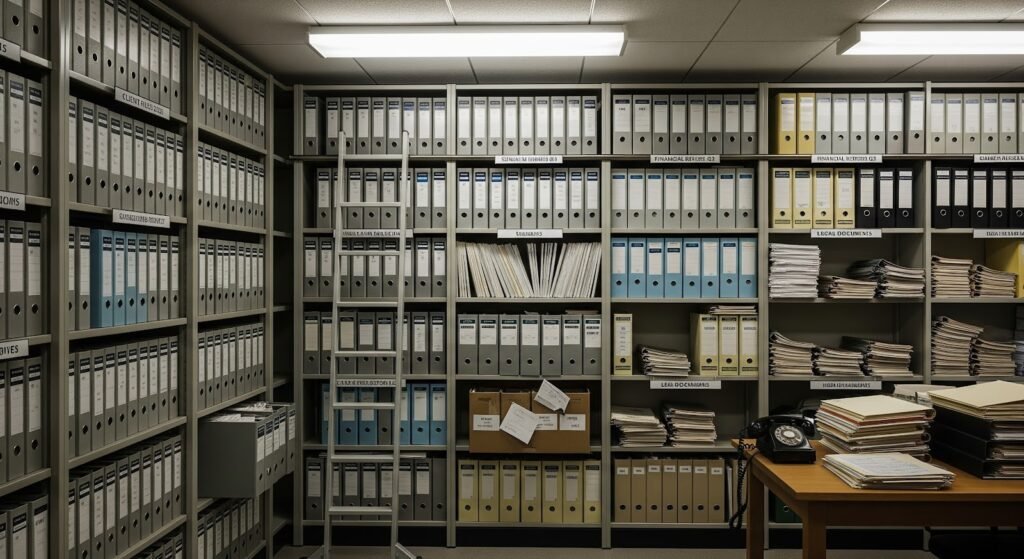
The number of businesses that manage to save their records in a move but fail to keep track of them later due to a failure to reconstruct a filing system is shocking.
Before moving day, determine what “done” looks like:
- Location of the new or renovated physical files.
- The way files will be sorted (year, department, client, etc.).
- Who restocks and verifies inventories.
- What becomes digitized after the move (stage two).
One trick is to set a “records reset day” during the first two weeks upon reopening. Schedule it on the calendar now, and make it an actual operational task—not just a cleanup.
Conclusion: Stress-Free Record Management
To make business records secure during a move or renovation, the simplest solution is to construct a portable system: reduce clutter, protect essential originals, keep necessities close by, and use offsite storage when the environment is unpredictable. By treating your records with clear ownership and straightforward rules, you prevent loss, decrease disruption, maintain confidentiality, and ensure your business continues to run well in the face of change.