


Never before has the world been marked by more natural calamities, health emergencies, and security issues than it is today, and with such a situation comes more need of competent professionals in crisis management. Such stressful, time-sensitive scenarios demand a highly technical and responsive combination of skills and speed in decision making. People ask what kind of technical jobs are crucial in these situations and what contribution they have in the situations that count the most. And regardless of your career change consideration or just wanting to know who is available to maintain communities safe in times of crisis, it would be a smart move to look at the most demanded technical jobs in crisis response.
Knowing Crisis Response and Its Technical Requirements.
Crisis response is a set of activities aimed at controlling the emergencies of various types such as hurricanes and wildfires in addition to pandemics and terrorist attacks. The technology is an essential part of the background, as it assists responders to obtain data, make sound decisions, communicate efficiently, and manage resources. The technical careers in this area are dynamic and intersect with the various subjects, such as engineering, information technology, communications as well as logistics.
Emergency Management Specialists: The Command Centers.
Emergency management specialists can be found at the center of the crisis response; they serve in an emergency management agency where they plan, organize and implement preparedness plans. Risk analysis, prediction of possible crises, and the ability to mobilize resources in a short time is often their job. Emergency managers who are technically talented use highly developed software programs to simulate and handle information about incidents in real time. They can be what saves them in times of disaster when their capacity to utilize the power of technology would be the only difference between chaos and order.
Instrumentation and Control Technicians: The Workhogs.
A technical position that does not necessarily feature in the headlines, yet plays a very important role in most crisis circumstances, is associated with instrumentation and control. The instrumentation and control systems are sophisticated and need professionals to install, maintain and troubleshoot. Professionals are certified (cert IV instrumentation and control) to handle the complex systems. As an example, during a chemical plant emergency or power grid failure, these technicians are in charge of the electronic systems that control all of the valves to alarm system stability and safety. The degree of their technical skills aids in preventing the possible secondary crises by upholding the system integrity in the case of the emergence.
Data Analysts/ Geospatial Technicians: Making sense of Chaos.
Disaster will overwhelm systems with large volumes of information, such as satellite imagery, weather service reports, social media updates, and sensor data. This information is interpreted by data analysts and geospatial technicians in order to give actionable information. The Geographic Information System (GIS) technology is used to map the affected regions, anticipate the patterns of movement (including wildfire spread or path of flood), and assist the responders in streamlining rescue and relief operations. Such experts provide decision-makers with comprehensive intelligence that helps to distribute resources effectively and save lives.
Communications Technicians: Maintaining Open Lines.
Crisis response can or can not be made effective through effective communication. The communications technicians are tasked to install and maintain emergency communication networks which are not always in favorable conditions. It could be the deployment of satellite phones, deployment of temporary wireless networks, or fixing the communication towers that were destroyed by storms; their technical know-how ensures that the coordination between agencies, responders and the public is never hampered. In the absence of these professionals, the responders may have problems in handling the key information delays in life or death situations.
Cybersecurity Experts: Critical Infrastructure Protection.
Cyber threats have become a reality in crisis situations in the modern globalized world. Cybersecurity specialists in crisis response undertake efforts to protect emergency management systems, power grids, transportation systems and medical infrastructure against cyber-attacks in case of an emergency. They do this in two ways: to prevent intrusion of crucial digital assets and maintain data integrity and its availability when needed most. The need to depend on digital systems also increases the demand of cybersecurity experts in this industry.
Logistics Engineers: The Supporting Agents of Response.
The success of any rescue or relief operation is supported by a complicated logistics structure. The role of logistics engineers is to use the technical skills to design and optimize the supply chains to bring food, medical supplies, and equipment to the affected regions. They assist in making sure that the resources are distributed in time and efficiently, by employing predictive analytics and real-time tracking technology. In many instances, their task is the incorporation of transportation technologies and warehouse management systems, which is why they are a driving force in the reduction of delays and waste in times of crisis.
HVAC and Environmental Control Technicians: Environmental Control.
The heating, ventilation, and air conditioning (HVAC) systems are essential to emergency shelters and field hospitals to ensure safe and healthy conditions. These systems must be operating smoothly, especially when the demand is surrounded by strains during disasters, and HVAC and environmental control technicians make sure that these systems operate well. Their competencies play a critical role in managing air quality, temperature and humidity indoors to curb a secondary health problem in the displaced populations or responders.
Career preparation for the Crisis Response Technical Jobs.
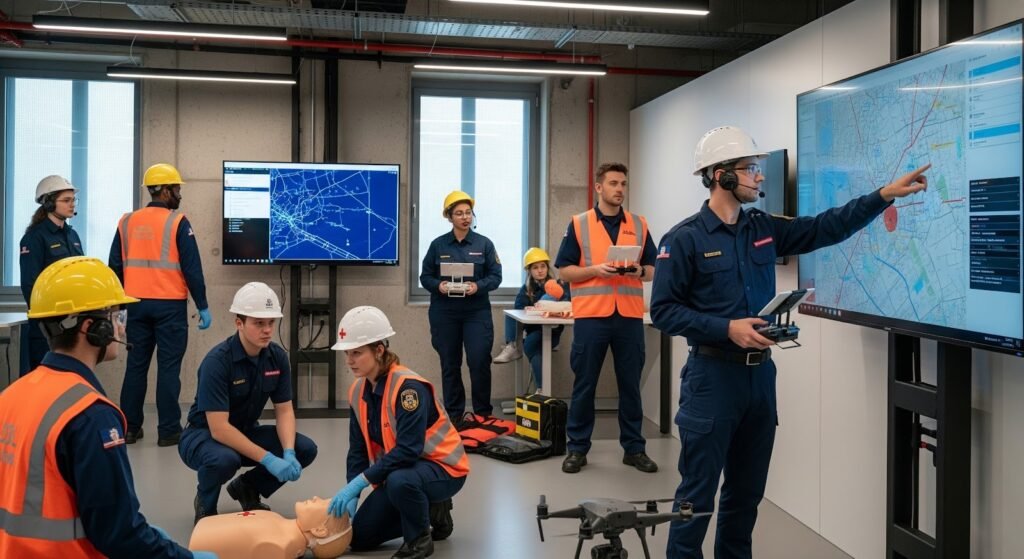
In case you think of entering such an effective sphere, it is important to take corresponding certifications and practice. To mention a few, when seeking employment in the technician job, a qualification like cert IV instrumentation and control can make you stand out among other applicants. Equally, emergency management, cybersecurity, GIS, or communications technology courses can be used to create a solid background.
The emergency management agencies may offer insight and networks through volunteering or interning. Remaining flexible and constantly updating skills in order to keep up with changing technology will also increase the chance of getting a job.
Conclusion: A Life Saving and Life Making Career.
Professional work in crisis recovery entails severe difficulties and genuine fulfillment. They need technologically competent professionals who are also strong willed and service oriented. Emergency management professionals organizing operations to instrumentation technologists and engineering control technologists who ensure safety-related systems are running are all vital in saving lives when it counts the most.